

What "approach" actually measures
In any heat exchanger selection there is one number that quietly decides the size, the price and the operating behaviour of the unit: the approach temperature. It is the smallest temperature difference between the two streams anywhere in the exchanger. In a counter-current plate heat exchanger that point sits at one end of the pack — usually where the hot stream leaves and the cold stream enters.
Suppose the hot side runs 90 °C in and 60 °C out, and the cold side runs 40 °C in and 70 °C out. At the cold inlet end the hot stream leaves at 60 °C while the cold stream arrives at 40 °C. The approach is 20 °C. Pull the cold outlet up to 58 °C and the hot outlet down to 59 °C and the approach collapses to 1 °C. Nothing about the plates changed, but the duty that was comfortable at 20 °C is now close to impossible at 1 °C.
The reason is that approach and surface area are connected through the log-mean temperature difference:
LMTD = (ΔT? ? ΔT?) / ln(ΔT? / ΔT?)
where ΔT? and ΔT? are the terminal differences at the two ends. As the approach shrinks, the LMTD shrinks with it, and because required area is inversely proportional to LMTD, the area required rises steeply. A duty that needs 40 m2 at a 10 °C approach does not need 80 m2 at 5 °C — it typically needs considerably more, because the LMTD does not fall linearly.
Why counter-current flow is the whole story
A plate heat exchanger is close to pure counter-current flow when the plates are arranged in a single pass: hot and cold streams enter at opposite ends of the pack and travel in opposite directions through alternate channels. This is what makes a plate unit able to work at approaches that would be uneconomic in a shell-and-tube exchanger.
In co-current (parallel) flow both streams enter at the same end. The temperature difference is large at the inlet and collapses toward the outlet, where the two streams are trying to reach the same temperature. The outlet approach becomes the limiting difference, and no amount of extra area can push the cold stream above the hot stream's outlet temperature. Counter-current flow has no such ceiling: the cold stream can leave hotter than the hot stream leaves.
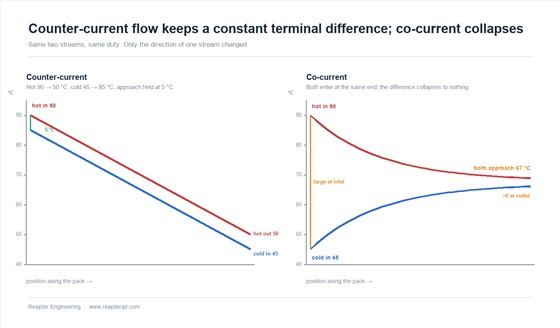
That single property is why close-approach duties — district heating return water, heat recovery from low-grade streams, condenser water in heat pump systems — so often end up on a plate unit rather than a tubular one. It is also why the arrangement of the plates matters as much as the plate pattern: a multi-pass or poorly ported pack is no longer counter-current, and the close approach you designed for disappears.
The cost curve: area against approach
Designers tend to think of approach as a performance target. It is more useful to think of it as a price signal. The relationship is not linear and it is not gentle.
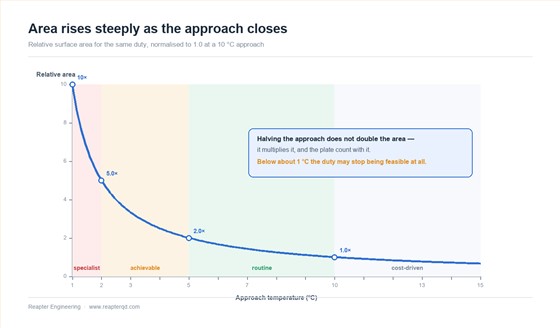
Between 10 °C and 5 °C approach the area penalty is noticeable but manageable. Between 5 °C and 2 °C it becomes a dominant cost driver — plate count climbs, frame length grows, and the unit may need to be split into two shells. Below about 1 °C the design stops being a matter of adding plates and becomes a matter of whether the duty is achievable at all given the fluids, the fouling tendency and the control accuracy available.
There is a second, less obvious penalty. Adding plates to gain area, at constant flow, lowers the velocity in each channel. Lower velocity reduces pressure drop — which sounds welcome — but it also reduces the wall shear that keeps a surface clean. A generously oversized close-approach unit can foul faster than a tighter one, and as it fouls the approach that was already thin disappears first. The unit that was designed for 2 °C performs at 4 °C after a season and no longer meets the duty.
How close is practical
The honest answer is that it depends on what is on the other side of the number. As a working guide for gasketed plate units in clean service:
- 10 °C and above — routine. Selection is driven by pressure drop and cost, not by approach.
- 5 °C — the common practical target for HVAC, district heating and general process duty. Well within normal design practice.
- 2–3 °C — achievable and regularly done, but the design must be checked for flow distribution, fouling sensitivity and control stability rather than just sized for area.
- 1 °C and below — a specialist duty. Expect multiple units in series, generous margins on the control side, and a frank conversation about whether a welded or plate-and-shell construction is more appropriate.
Fouling moves all of these thresholds. The same 2 °C approach that is comfortable on clean water is not realistic on a stream with a meaningful fouling tendency, because the fouling resistance is added directly to the thermal resistance chain and eats a large fraction of a small driving force. On dirty duty, a wide-gap channel with a more modest approach is usually a better answer than a tight pack that blinds over.
What breaks when you push below 2 °C
Three things stop working before the thermodynamics does.
Flow distribution. A plate pack is a manifold. With many channels in parallel, small manufacturing tolerances and port pressure variations produce uneven flow between channels. At a large approach the imbalance is hidden; at a 1 °C approach the channels carrying less flow have almost no driving force and effectively stop contributing area.
Control. A close-approach unit has a steep gain: a small change in flow produces a large change in outlet temperature. That is fine with a good control valve and a fast sensor, and troublesome with a slow loop or a control valve sized for a much larger unit.
Fouling tolerance. The margin between "meets duty" and "does not meet duty" is measured in a fraction of a millimetre of deposit. Any duty specified below 2 °C should come with a cleaning regime that is actually followed, not assumed.
How to specify a close-approach duty
- State the approach explicitly, with the terminal temperatures at both ends, not just the inlet and outlet of each side. Most selection errors start with an incomplete temperature specification.
- Say whether the approach is a clean or fouled condition. A 2 °C approach guaranteed only when clean is a different promise from one guaranteed at end of season.
- Give the fouling resistance you expect, or the fluid analysis needed to estimate it. Do not leave it to the supplier to assume.
- State the available pressure drop on both sides. A close approach is often achievable only by trading pressure drop, and that trade has to be authorised by someone who owns the pumping cost.
- Confirm the flow arrangement you can accept — single pass where possible, and if not, understand what multi-pass does to the effective LMTD.
- Ask what happens at 50 % load. Close-approach units are usually specified at design point and operated well below it.
Common questions
Can a plate heat exchanger achieve a 1 °C approach? Mechanically yes, and it is done on duties such as heat pump condensers and low-grade heat recovery. Practically it requires a large area, careful flow distribution, clean fluids and tight control. It is a design problem rather than a catalogue selection.
Why can a plate unit reach closer approaches than a shell-and-tube? Because a single-pass plate pack is genuinely counter-current, while a shell-and-tube with baffles is partly cross-flow and its effective mean temperature difference is lower for the same terminal temperatures. The correction factor applied to LMTD for a shell-and-tube is a direct penalty on close-approach duty.
Does a closer approach always save energy? Not by itself. It allows a lower hot-side supply temperature or a higher cold-side delivery temperature, which can save energy upstream. But the extra area costs money and the lower channel velocity can increase fouling. The saving has to be evaluated over the life of the unit, not at the selection sheet.
What approach should I ask for on district heating return water? Something in the 3–5 °C range is typical for the secondary side of a substation, with the exact figure set by the network's return temperature target. Below that, check that the primary-side control valve and the load profile can actually hold the condition.
Where this leaves the selection
Approach is the parameter that ties together thermodynamics, geometry and operating cost, and it is the one most often left vague in an enquiry. Specifying it precisely — with the terminal temperatures, the fouling condition and the pressure drop budget — does more for the outcome than any other single line on the datasheet.
Reapter manufactures gasketed plate heat exchangers and plate-and-shell units, and supplies replacement plates and gaskets for installed units. If you are working through a close-approach duty, send us the terminal temperatures, the fluid data and the pressure drop available, and we will come back with the arrangement and surface area the duty actually needs — including an honest view of where the practical limit sits.
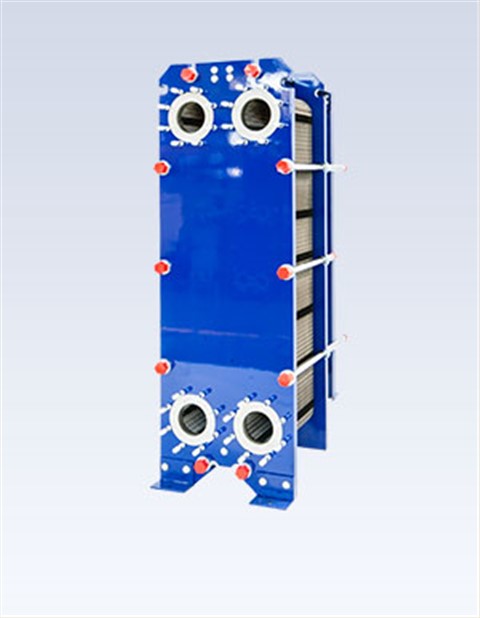 Food grade plate heat exchanger
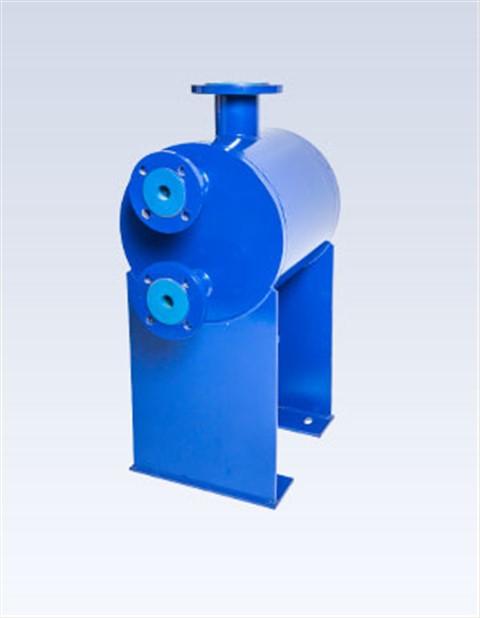 Plate And Shell Heat Exchanger