

A substation has two design points, not one
District heating substations are usually specified at a single point: the coldest day, with space heating at full load and domestic hot water at peak draw-off. That point sets the surface area, the connection sizes and the pressure drop allowance. The unit then spends most of the year far below it — in summer, on domestic hot water alone, often at 10 to 25 percent of the winter peak.
Many substations are hydraulically correct in January and awkward in July. The cause is rarely the plate pattern or the material. It is that the exchanger was sized for a duty it performs for a few weeks, and nobody checked what happens to the hydraulics at the other end of the year.
Sizing for both points is not complicated, but it has to be done deliberately: the cold day sets the area, the annual profile sets the arrangement.
Why the summer duty is the harder one
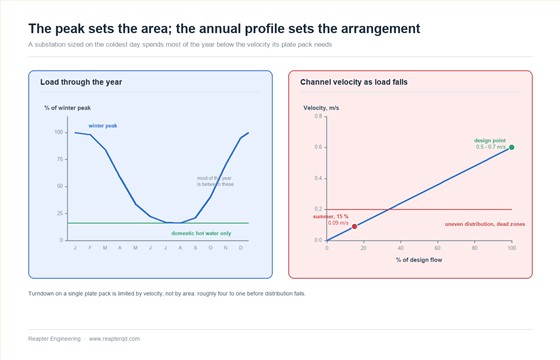
At low load the unit is not short of area — it is short of velocity. A plate pack sized for a winter peak of, say, 2 MW and then asked to deliver 250 kW of domestic hot water runs at roughly one eighth of design flow. Channel velocity falls with flow, and below a certain point the flow stops distributing evenly across the plate width.
Maldistribution is quiet and cumulative. The active part of the plate carries a higher velocity and does more of the heat transfer; the rest carries almost nothing and becomes a dead zone where suspended solids settle and scale grows undisturbed. The unit still meets its setpoint, so nothing looks wrong — until the following winter, when the same unit no longer reaches design duty and the pressure drop has climbed.
Low flow creates two more problems on the secondary side. The control valve sits close to closed for most of the summer, where its authority is poor and the loop tends to hunt; and the draw-off pattern of domestic hot water is intermittent and sharp-edged, so the unit is asked to follow step changes with a control valve that is already at the bottom of its range. A substation that cycles hot and cold in summer is usually not badly controlled. It is badly proportioned.
The winter point: what actually sets the surface area
Four inputs decide the area, and only one of them is the load. The first is the temperature programme: network supply and return, and the secondary design temperatures — commonly 90 to 120 °C supply and 50 to 60 °C return on third-generation networks, with secondary circuits at around 70/50 °C for radiators or 45/35 °C for underfloor heating. Low-temperature fourth-generation networks run nearer 50 to 60 °C supply, and there the approach temperature becomes the dominant term in the whole design.
The second input is the approach temperature — the difference between the hot-side outlet and the cold-side inlet at one end of the unit. For domestic hot water, 1 to 2 K is a normal target; for space heating, 2 to 5 K. Reducing the approach from 2 K to 1 K is not a small refinement: it increases the required area sharply, and it is worth doing only where the network return temperature has value.
The third is the fouling allowance. Ten to twenty percent of additional area is the usual guard against the fouling that will accumulate between cleaning intervals. The fourth is the pressure drop budget — commonly 20 to 50 kPa per side in a substation, set by the available differential pressure at the substation rather than by the exchanger.
Note what is not on that list: the summer load. It has no influence on the area, which is exactly why it gets ignored, and exactly why it causes trouble later.
Turndown is a hydraulic limit, not a marketing figure
Turndown is often quoted as a ratio, which hides the mechanism. What matters is the velocity in the channel. Design velocities in gasketed plate heat exchangers typically sit between 0.3 and 0.8 m/s; below roughly 0.2 m/s, distribution across the plate width becomes unreliable, and the fouling mechanism described above starts. Above roughly 1.0 m/s, pressure drop and erosion risk rise quickly and the extra heat transfer is expensive to buy.
That gives a practical turndown of about four to one on a single pack — not the ten or twenty to one that a summer duty of 10 percent would require. The table below shows why a unit sized only on the peak looks acceptable on paper and behaves badly in service.
| At the two ends of the year | Winter peak | Summer, DHW only |
|---|---|---|
| Primary flow | 100 % | 10 – 25 % |
| Channel velocity | 0.4 – 0.8 m/s | 0.05 – 0.15 m/s |
| Flow distribution | Even across the plate | Partial, dead zones form |
| Control valve | Well inside its range | Near closed, poor authority |
| Fouling tendency | Moderate | High, at low wall shear |
| Thermal performance | As designed | Better than designed |
One line in that table deserves emphasis. Thermally, an oversized unit at part load performs better, not worse: more area per kilowatt means a closer approach and a lower return temperature. The penalty of oversizing is entirely hydraulic and operational. That is why the fix is a different arrangement, not a smaller unit.
Four arrangements that cover the annual profile
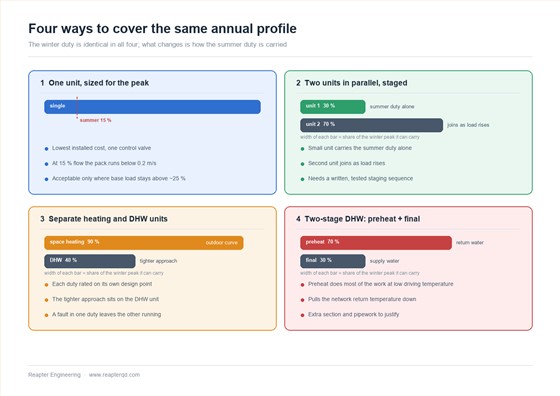
There is no single correct answer, but there are four arrangements in common use, and each one solves the turndown problem in a different way.
- One unit, sized for the peak. The simplest and cheapest to install. Acceptable where the summer load stays above about a quarter of the peak — for example a substation serving a hospital, a hotel or an industrial process with a year-round base load. It needs an explicit check of summer velocity and valve authority, not an assumption.
- Two units in parallel, staged. Two smaller packs of unequal size, brought in sequence as load rises. The small unit covers the summer alone at a sensible velocity, and both run at the winter peak. More valves, more footprint, and a control sequence that has to be written and tested — but the turndown becomes effectively unlimited.
- Separate heating and domestic hot water units. Common in substations where the two circuits have different temperature programmes and different control requirements. The DHW unit is sized on its own peak and its own approach, which is usually the tighter of the two; the heating unit follows the outdoor temperature curve. This also isolates the two duties, so a fault in one does not take out the other.
- Two-stage domestic hot water. A preheat section using network return water, followed by a final section on supply water. The preheat does most of the work at a low driving temperature and pulls the network return down, which is the single most valuable thing a substation can do for a district heating network. It costs an extra section and more pipework, and it rewards networks that price return temperature.
Return temperature is the system-level result
In a district heating network the substation is not only a customer; it sets what the return main carries. A low return temperature increases the network's capacity without new pipe, reduces distribution losses and improves the yield of heat sources — which is why fourth-generation networks are designed around 50 °C supply and 25 to 35 °C return.
Two things in the substation decide whether that is achieved: the approach temperature of the domestic hot water unit, and whether the control actually runs the primary valve to the position that just meets the setpoint rather than a comfortable margin above it. A unit with excess area and a badly tuned loop can still return water 15 K hotter than necessary. Sizing and control belong in the same conversation.
A sizing sequence for a substation unit
- Establish the temperature programme for both circuits — network supply and return, secondary design flow and return, and the domestic hot water setpoint with its cold water temperature.
- Calculate the winter peak duty from the building load, with a separate figure for the domestic hot water peak. Do not merge them into one number; they behave differently.
- Fix the approach temperature targets — tighter for domestic hot water, looser for space heating — and record them, because they will be quoted back at you at commissioning.
- Set the allowable pressure drop per side from the available differential pressure at the substation, not from a default figure.
- Size the area on the peak, then check the velocity and pressure drop at the summer duty. If the summer velocity falls below about 0.2 m/s, change the arrangement rather than the plate pattern.
- Check valve authority at minimum load. If the control valve is below roughly 20 percent open for most of the year, the arrangement is wrong for the profile.
- Record the resulting data points — both design conditions, flow, pressure drop and approach — and pass them to commissioning as the reference set.
Common questions
Can one plate heat exchanger serve both space heating and domestic hot water?
Yes, and combination units with two independent packs in a common frame are widely used. The constraint is that the two duties have different temperature programmes and different control requirements, so each pack must be rated on its own design point. A unit rated on the combined peak and then expected to deliver domestic hot water alone in summer will have the turndown problem described above.
Why does our substation oscillate in summer when the load is low?
The usual cause is a control valve operating near its closed position, where authority is poor and a small change in draw-off produces a large change in position. Check the valve's authority at minimum load before changing anything in the control loop — the loop is often doing its best with a badly proportioned valve.
What approach temperature should be specified for domestic hot water?
One to two kelvin is the normal range on the primary side. Going below 1 K increases the required area steeply and makes the fouling allowance more critical, so it is a decision with a cost. Whatever value is chosen, specify it together with the fouling allowance; an approach quoted without one is not a specification.
Is it better to oversize a single unit than to install two?
Oversizing does not damage thermal performance — it improves the approach at part load. It damages hydraulics: velocity falls, distribution becomes uneven, and fouling accelerates in the dead zones. Where the annual profile has a genuine turndown of more than about four to one, two units or two packs are the more robust answer.
What information is needed to rate a substation exchanger?
Flow rate on both circuits, all four temperatures, allowable pressure drop per side, fouling factor or allowance, medium and its chloride content, design pressure and temperature, connection sizes and the available footprint. With those, a rating can be produced and compared like for like against other offers.
How Reapter supports district heating projects
Reapter rates each substation duty on its own design point rather than quoting from a catalogue, and issues the general arrangement drawing, plate arrangement chart, pressure drop curves and material certificates with the unit — the documents a commissioning engineer actually works from. Where a network mixes equipment from several suppliers, replacement plates and gaskets are produced to the installed plate pattern, so a mixed fleet can be supported from one source and one delivery schedule.
For projects outside China, units are packed for sea freight, documentation is issued in the project language where required, and operating data from site — flows, four temperatures and both pressure drops — is reviewed by our engineering team with a written response, so that a question at commissioning does not wait for a flight.
Send us the two design points and the connection data, and we will return a rating with the summer case checked as well as the peak. Contact us to request a quotation.
Reapter Engineering Team · Qingdao Ruipute Heat Exchange Equipment Manufacturing Co., Ltd.
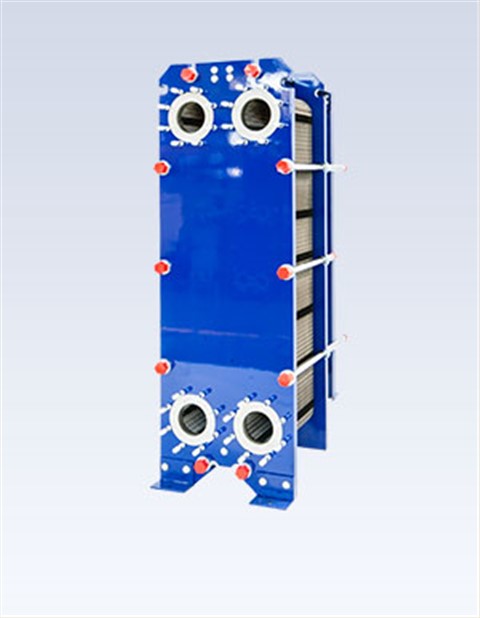 Food grade plate heat exchanger
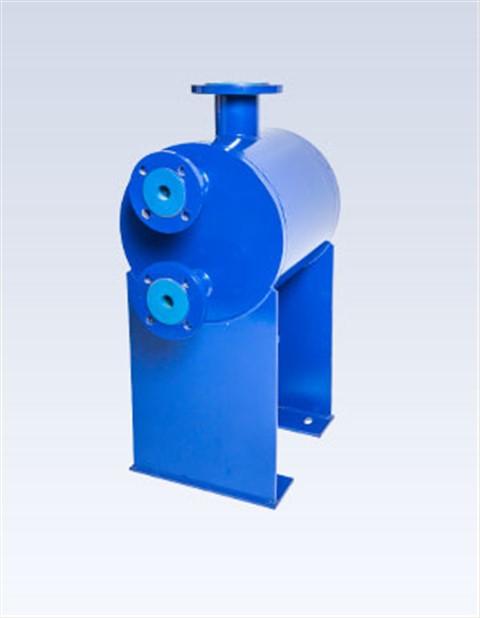 Plate And Shell Heat Exchanger