

What "hygienic" changes in a plate exchanger
The thermal duty of a food-grade plate heat exchanger is usually unremarkable: pasteurise, cool, heat-treat, recover heat. What makes the unit different is that every surface the product touches has to be cleanable, and every place the product can sit without being cleaned becomes a place where bacteria grow between shifts.
That single requirement changes the geometry. A standard industrial plate unit is designed to be tight and efficient. A hygienic unit is designed to be tight, efficient and free of crevices, dead ends and surfaces that cleaning fluid cannot reach at a velocity that removes soil. The two sets of requirements pull against each other, and the compromises are what the hygiene standards exist to constrain.
The standards landscape
There is no single global "food grade" mark. A project usually references two or three of the following, and it is worth being precise about which one the customer actually means, because they cover different things.
| Standard / regulation | Region | What it covers |
|---|---|---|
| EHEDG guidelines and component certification | Europe (widely referenced worldwide) | Hygienic design principles and cleanability of components; certification is by test of the component design |
| 3-A Sanitary Standards | United States | Design and fabrication requirements for dairy, food and beverage equipment; the 3-A symbol is administered by 3-A SSI |
| FDA 21 CFR Part 177 | United States | Indirect food additives — the elastomers and polymers permitted in food-contact gaskets |
| EC 1935/2004 | European Union | Framework regulation for all food-contact materials; inertness and declaration of compliance |
| EU 10/2011 | European Union | Specific rules for plastic food-contact materials, including migration limits |
| Local dairy and beverage codes | National | Additional requirements, often prescriptive about cleanability and inspection access |
Two practical points. First, compliance is a property of the assembly as installed, not of a catalogue page: a certified component installed with an unhygienic pipe connection is still a hygienic risk. Second, a declaration of compliance for materials is not the same as a certificate for hygienic design — a gasket can be made of compliant elastomer and still sit in a groove that cannot be cleaned. Both documents are usually needed, and they answer different questions.
Where bacteria actually hide in a plate pack
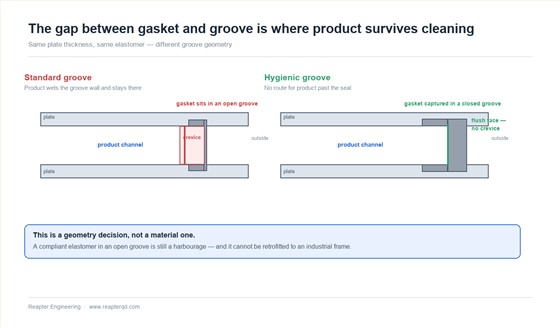
Product flows in the channel between two plates. The gasket seals that channel from its neighbours and from the outside. Between the gasket and the edge of the plate there is a narrow band of metal that the product can reach but that cleaning flow does not always flush. That band, and the groove the gasket sits in, are where the problems are.
In a standard design the gasket sits in an open groove and the plate edge is exposed. Product enters the gap between the gasket and the groove wall by capillary action and by pressure pulsation, stays there through the cleaning cycle, and provides a sheltered site at a temperature the product likes. Over a production run this is enough to build a biofilm that reseeds the process stream at every start-up.
The hygienic alternative is a closed groove: the gasket is captured so that it has no exposed crevice on the product side, and the plate edge outside the seal is arranged so that anything that does leak is visible on the outside rather than trapped inside. This is a geometry change, not a material change, and it is the single most consequential difference between a food-grade plate and an industrial one.
The port area is the second site. Where the product enters and leaves the pack, the flow has to turn through a port hole and distribute across the channel. If that transition contains a recess, a blind pocket or a sharp step, cleaning fluid bypasses it and product remains. Good hygienic design keeps the port free of dead space and makes the inlet and outlet self-draining.
Design features that matter
- Closed gasket groove with the gasket flush to the product side and no exposed crevice.
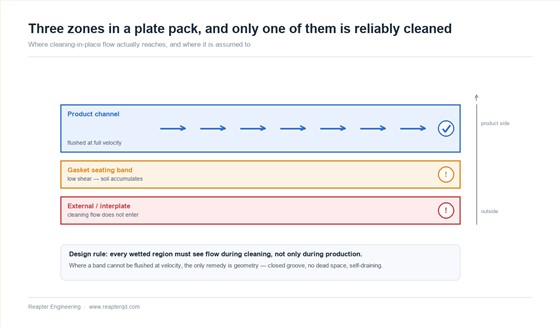
- No dead ends in the product path — every wetted region should see flow during cleaning, not just during production.
- Self-draining geometry when the unit is opened or when the line is emptied, so no product pools in the pack.
- Contact points kept out of the product path — the points where plates touch each other create narrow gaps that are hard to flush.
- Surface finish appropriate to the product, typically specified in the 0.4–0.8 μm Ra range for product contact surfaces; rougher surfaces hold soil, and unnecessarily polished ones add cost without adding cleanability.
- Inspection access — a unit that cannot be opened and visually inspected in a reasonable time will not be inspected.
- No threaded product connections; hygienic couplings and a design that can be drained and cleaned in place.
Materials and food contact
Plates are almost always stainless steel, commonly 316L, with the grade selected for the product's chloride content and the cleaning chemicals rather than for the duty temperature alone. Chloride stress corrosion cracking is the failure mode to design against: a chloride-rich product combined with a hot surface and a stressed plate will crack, and cleaning with hypochlorite makes it worse.
Gaskets are where the food-contact compliance question really sits. Nitrile (NBR) is the workhorse for fatty and general products; EPDM is preferred for hot water, steam and many aqueous duties and for resistance to the caustic and acid cleaning cycle; fluoroelastomer grades are used where temperature or chemical resistance demands them. Whatever the elastomer, it should carry a declaration against FDA 21 CFR 177 or EC 1935/2004 and EU 10/2011 as applicable, and the declaration should be traceable to the actual batch, not just to a material family.
A frequent mistake is to select the gasket for the product and forget the cleaning regime. A gasket that resists the product perfectly but swells in 2 % caustic at 80 °C will fail within months, and the failure will look like a product problem.
Cleanability: CIP integration and verification
Most hygienic plate units are cleaned in place rather than opened. That makes the cleaning circuit part of the exchanger design, not an afterthought.
Cleaning-in-place relies on three variables working together: velocity, temperature and chemistry, applied for long enough. The critical one for a plate pack is velocity, because the corrugation creates sheltered regions where the local shear is lower than the bulk value. The flow rate used for production is usually not the flow rate needed for cleaning — cleaning often requires a higher velocity through the same channels, which means a dedicated cleaning flow rate, sometimes through a bypass arrangement.
Verification is the part that gets skipped. A cleaning regime that is not verified is a belief. The recognised methods are a visual inspection after opening, an adenosine triphosphate swab, a protein residue test, or a tracer test using a detectable substance applied to the surface before cleaning — the riboflavin test used in hygienic design validation is the best-known example. Whichever method is used, the result should be recorded against the cleaning procedure and the procedure revised when the product changes.
Documentation and traceability
For a food or beverage plant the paperwork is part of the product. Expect to supply, and to be asked for:
- Material certificates for the plate and gasket batches.
- Declarations of compliance for food-contact materials.
- Surface finish specification and the inspection record.
- Gasket elastomer identification, so a replacement can be matched rather than guessed.
- A cleaning procedure with the verified parameters, not just a recommended range.
Traceability matters most at the point of replacement. A gasket fitted during a maintenance shutdown that is not the specified elastomer will fail sooner, and without batch traceability the cause is hard to establish after the fact.
Common questions
Is a "food grade" plate heat exchanger just a standard one with different gaskets? No. The gasket elastomer is one element. The groove geometry, the port design, the absence of dead space and the surface finish are equally part of it, and they cannot be retrofitted to an industrial frame.
Can a standard plate unit be used for food service? It is done, particularly for utilities such as cooling water that never contact the product. For direct product contact, the cleanability argument usually wins once the cost of a contamination event is considered.
How often should a hygienic unit be opened for inspection? That is set by the plant's food safety plan rather than by the exchanger. A common pattern is periodic inspection with cleaning-in-place in between, with the interval shortened whenever the product or the cleaning chemistry changes.
Does a smoother plate surface always clean better? Up to a point. Below roughly 0.4 μm Ra the additional benefit is small, and the risk is that an over-polished surface loses the micro-texture that helps cleaning fluid wet the surface. The dominant variables are geometry and velocity.
What causes a hygienic unit to fail an audit? Most often an unhygienic connection — a threaded fitting, a dead leg in the pipework, or a gasket replaced with a non-compliant part. The exchanger itself is rarely the finding.
Hygiene is a geometry decision
Hygienic design is not a coating or a certificate applied at the end. It is a set of geometric decisions — closed groove, no dead space, self-draining, cleanable at a verifiable velocity — made at the point where the plate pattern and the gasket are chosen. Getting those right, and documenting them, is what allows a plate heat exchanger to sit inside a food safety system rather than beside it.
Reapter supplies gasketed plate heat exchangers for food and beverage duty, including units for dairy, brewing and juice processing, together with replacement plates and gaskets. If you are specifying a hygienic unit, tell us the product, the cleaning regime and the standard your project references — we will propose a configuration that meets the cleanability requirement and set out what documentation we can supply to support your own validation.
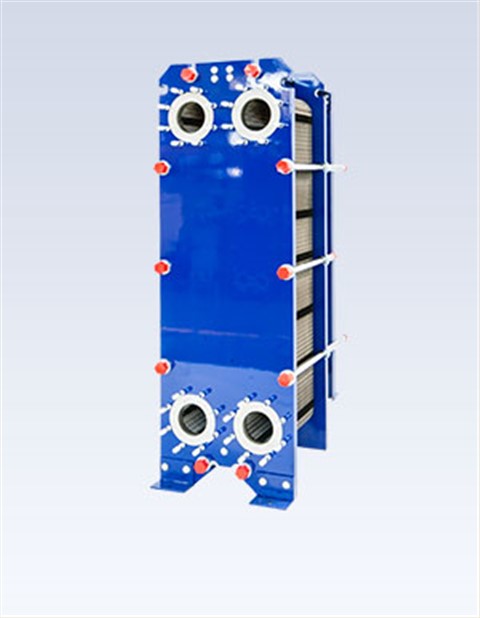 Food grade plate heat exchanger
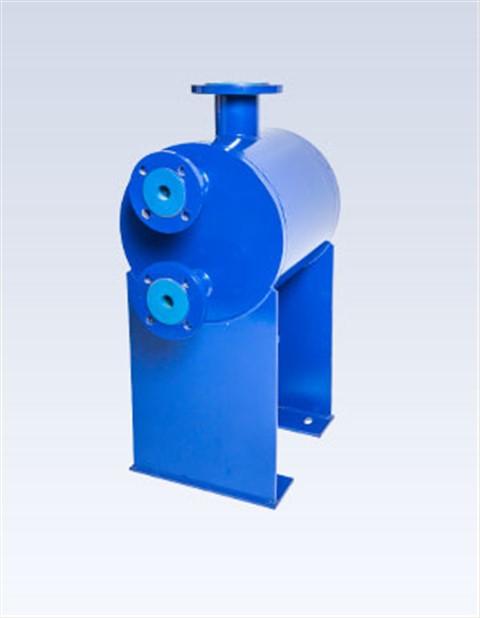 Plate And Shell Heat Exchanger