

The construction type decides where the gaskets sit — and that decides everything else
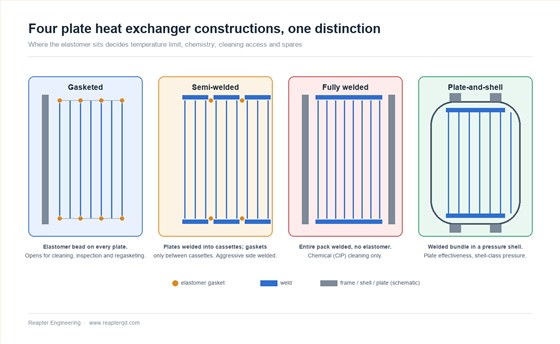
Plate heat exchangers share one core idea: corrugated plates stacked into a large heat transfer area inside a small frame. They are not, however, one product. The defining difference between the construction types is a single question — where is elastomer allowed to touch the media? In a gasketed unit, every plate edge is sealed by a molded rubber bead. In a semi-welded unit, plates are welded into cassettes and only part of the media path sees a gasket. In fully welded and plate-and-shell designs, elastomer disappears from the media path entirely. That one question drives the temperature limit, the chemical compatibility, the leak behaviour, the cleaning method and the spare parts strategy of the unit for its whole life, so the choice deserves to be made deliberately rather than by default.
Four constructions, one distinction
Gasketed. The classic plate heat exchanger. Each plate carries a molded elastomer gasket, the pack is compressed by a frame, and the whole unit can be opened for mechanical cleaning, plate inspection and regasketing. It remains the default choice for water-to-water duties in HVAC, district energy and most industrial processes, because nothing else matches its combination of cost, thermal effectiveness and serviceability.
Semi-welded. Plates are laser-welded together in pairs or groups — the cassettes — and the cassettes are sealed against each other by gaskets. One circuit flows inside the welded cassettes and never touches elastomer; the other flows through the gasketed channels. The aggressive or volatile medium goes on the welded side, the benign medium on the serviceable side.
Fully welded (frame-mounted). The entire plate pack is welded — no gaskets anywhere in the media path — while the pack still sits in a frame that carries the nozzles. Temperature and chemical limits move up to those of the plate material and the welds themselves, at the cost of never being able to open the pack.
Plate-and-shell. A welded plate bundle mounted inside a cylindrical pressure shell. It pairs plate-side heat transfer effectiveness with shell-and-tube style nozzles and pressure capability, which suits high-pressure and phase-change duties where a rectangular frame would be at its limit.
What the elastomer actually limits
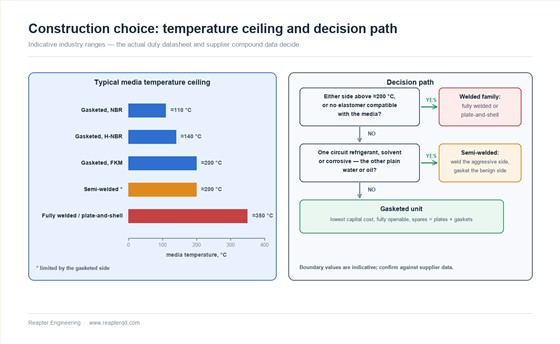
The gasket is the most temperature- and chemistry-sensitive component in the media path, and it sets the operating ceiling long before the stainless plate does. Nitrile (NBR) compounds are comfortable to roughly 110 °C, hydrogenated nitrile (H-NBR) to about 140 °C and fluorocarbon (FKM) to around 200 °C, with short excursions beyond that possible depending on the supplier's compound data. Above those levels — thermal oil circuits, steam at high pressure, molten-salt-adjacent processes — no gasketed design survives, which is precisely where the welded family takes over. Chemistry works the same way: oils, solvents, refrigerants and oxidising chemicals attack or swell specific elastomers, and a compound that is perfect for hard water can be wrong for a single process additive.
The third limit is subtler: in a gasketed unit the two circuits meet around every plate through gasket beads, so a damaged bead creates a controlled external leak but also represents the main cross-contamination path. Welded construction removes that path — and with it, the ability to open the pack. Every construction choice is therefore a trade between the seal you accept and the access you give up.
The trade-off in numbers
| Construction | Elastomer in media path | Typical media temperature ceiling | Open for mechanical cleaning | Typical duties |
|---|---|---|---|---|
| Gasketed | Yes — every plate | ≈110–200 °C by compound | Yes — full plate and gasket access | Water/water HVAC, district energy, general industry |
| Semi-welded | One circuit only | ≈200 °C, set by gasketed side | Partial — gasketed side opens | Refrigerant evaporators and condensers, aggressive–benign pairs |
| Fully welded, frame-mounted | No | ≈350 °C class, plate-material-limited | No — chemical (CIP) cleaning only | Thermal oil, aggressive chemicals, high temperature |
| Plate-and-shell | No | ≈350 °C class, pressure set by shell | No — chemical cleaning only | High-pressure and phase-change duties, compact sites |
The figures in the table are indicative industry ranges, not ratings for any specific unit: real limits depend on the plate material, the gasket compound, the plate pattern and the frame design, and they must be confirmed against the manufacturer's data for the actual duty.
Semi-welded: weld the side that needs it, gasket the side that does not
Semi-welded construction earns its keep wherever one circuit is hostile and the other is ordinary. In an ammonia refrigeration plant, the refrigerant side is welded while the brine or water side stays gasketed and serviceable. The same logic applies to solvent condensation, to aggressive process chemicals paired with cooling water, and anywhere a leak of the primary medium to atmosphere would be unacceptable. The design keeps the welded side completely gasket-free while preserving the right to open, inspect and regasket the benign side — a middle path that costs more than a gasketed unit but far less than welding both circuits and losing all mechanical access.
Going gasket-free changes the maintenance model, not just the temperature limit
A fully welded or plate-and-shell unit never needs gaskets — but it also never opens. Fouling must be managed with chemical cleaning circuits (CIP), backflushing and disciplined water treatment, because there is no mechanical fallback. That shifts weight onto decisions made before purchase: honest fouling margins, accessibility of cleaning nozzles, and a realistic view of what the media will deposit over years. The spare parts strategy changes too. A gasketed unit stocks plates and gasket sets; a welded unit stocks spare cassettes, gaskets only for the semi-welded side, or in the worst case a spare core, so lead times deserve more attention at the ordering stage. Welds also respond differently to thermal cycling than elastomers: they do not creep or take a compression set, but repeated large temperature swings work the weld zones, which is one more reason thermal oil and rapid-cycling duties need a purpose-designed welded pack rather than an adapted gasketed one.
A practical decision sequence
- Write down both circuits at their worst case — maximum temperature, maximum pressure and full media chemistry — not at design averages.
- Check elastomer compatibility for both circuits against supplier compound data. If no compound survives, or the media temperature sits above the FKM class, the answer is the welded family.
- If exactly one circuit is hostile — refrigerant, solvent, corrosive chemical — and the other is plain water or oil, specify semi-welded with the aggressive side welded.
- If both circuits are water-like and comfortably inside gasket limits, specify gasketed and count how often the unit will be opened; frequent cleaning favours keeping it that way.
- Within the welded family, choose frame-mounted or plate-and-shell on pressure, nozzle orientation and footprint: shell construction pays off at high pressure and with phase change.
- Price the life cycle, not the purchase order: regasketing intervals versus CIP downtime versus spare core lead times tell you which construction is genuinely cheaper for your plant.
Common questions
Can a gasketed plate heat exchanger be converted to welded construction later? No. The plate packs are built differently — gasketed plates carry gasket grooves and hanging features that welded packs do not, and the frames and nozzle arrangements differ. The construction type is chosen at specification stage, which is why the worst-case duty review matters before ordering.
Is a fully welded unit the same as a brazed plate heat exchanger? No. Brazed units are small, copper- or nickel-brazed plates with no frame at all, aimed at compact refrigeration and hydronic duties. Fully welded industrial units keep a frame or a shell, handle far larger capacities and higher pressures, and follow a different design and service logic.
How do you clean a heat exchanger that cannot be opened? Through chemical cleaning circuits: isolated cleaning pumps circulate inhibited acid or alkaline solutions through both sides, followed by neutralising and rinsing, sometimes combined with backflushing. Cleaning nozzles and drainability should be checked at the specification stage, because retrofitting access to a welded unit is not realistic.
Which construction should a steam heater use? Moderate steam pressures sit comfortably inside gasketed capability with the right compound, and keep the unit serviceable. High-temperature or high-pressure steam pushes toward fully welded or plate-and-shell construction, where the gasket no longer defines the limit.
Conclusion
Gasketed, semi-welded and fully welded plate heat exchangers are not good-better-best versions of one product; they are three answers to one question — where the seal goes. Read the worst-case duty, check the elastomer before the plate, and let the media decide the construction. Reapter engineers and supplies all construction families for projects worldwide, supports duties from HVAC water circuits to thermal oil and refrigeration, and helps buyers match construction, materials and spare parts strategy to the actual plant conditions. If you are weighing one construction against another for a specific duty, contact us for an engineering review and quotation.
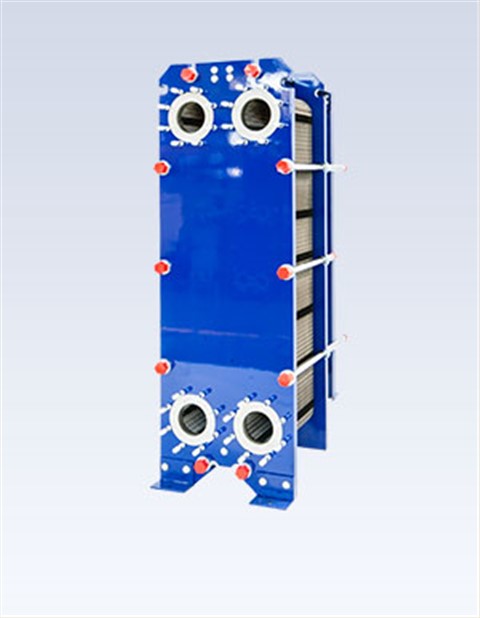 Food grade plate heat exchanger
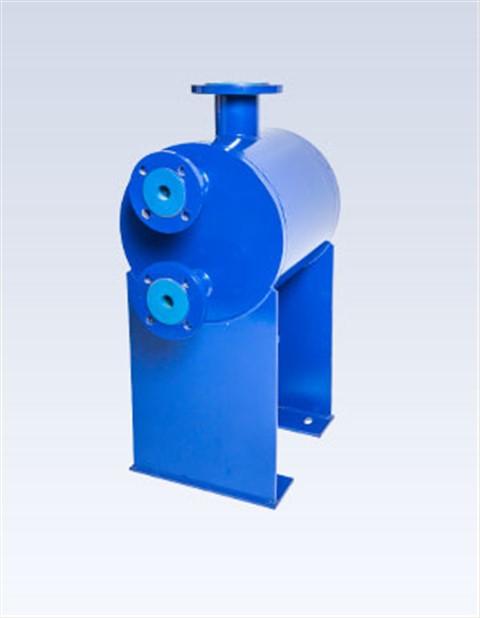 Plate And Shell Heat Exchanger