

Freeze damage is preventable — but only before the first cold night
Of all the ways a plate heat exchanger can fail, freezing is among the least forgiving and the most preventable. A plate pack is a stack of thin channels, typically 2–5 mm wide, with a very high surface-area-to-volume ratio. That geometry is what makes the technology so efficient in service — and so efficient at losing heat when circulation stops. One cold night with standing water inside the pack can bulge plates and open internal leaks that only appear when the unit is restarted. Protection comes down to three defences, applied in time: drain the unit properly, fill it with the right glycol concentration, or keep the water warm and moving. Which defence fits which unit depends on whether it is seasonal, standby or continuously running — and on how cold the site actually gets.
What freezing actually does to a plate pack
Ice rarely forms uniformly across a plate pack, and that is precisely the problem. When circulation stops, the channels nearest the outer casing and the inlet header cool fastest, while channels carrying warmer residual flow cool more slowly. The first ice crystal nucleates in a stagnant channel and bridges its narrow width. That plug raises the hydraulic resistance of one path, so any residual flow redirects into neighbouring channels — which then cool and freeze in turn. The failure cascades through the pack rather than spreading evenly.
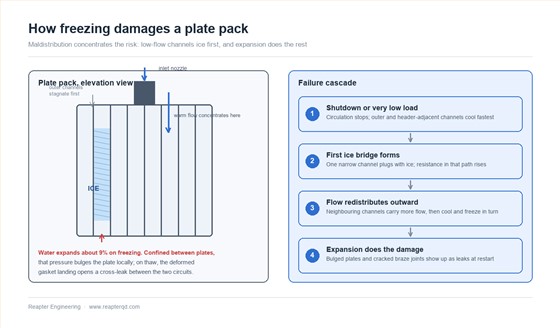
The mechanical damage follows from basic physics: water expands roughly 9% as it freezes. Confined between two plates, that expansion produces local pressures far above the design rating of the unit. The plate bulges locally, and in gasketed units the deformed sealing land no longer compresses the gasket evenly — after thaw, the two circuits cross-leak internally. In brazed units there is no gasket to absorb the deformation: the whole pack is rigid, and the braze joints between plates can crack instead. A frozen heat exchanger is therefore not automatically saved by thawing it; the leak often shows up days later at restart, when nobody connects it to the cold snap two weeks earlier.
Three lines of defence
First: drain it — properly. For any unit taken out of service through winter, complete drainage is the cheapest and most reliable defence. Both circuits must be emptied at true low points, not just at the nearest valve. Piping sags, dead legs and instrument tappings hold water that a single drain valve never reaches, so the circuit should be blown through with compressed air until only mist leaves the vents. Leave drain valves open and tagged. Remember that the connecting pipework freezes too — a perfectly drained exchanger piped into a water-filled loop is not protected.
Second: fill it with glycol. Units that stay in service, or standby units that must start instantly, cannot rely on draining. An inhibited glycol solution sized to the site's design minimum temperature is the standard answer. The key discipline is concentration: mixed too weak, it protects nothing; mixed too strong, it wastes heat transfer performance all year to guard against a cold snap that never comes. The concentration should be verified with a refractometer at fill and each autumn — colour tells you nothing, and topping up with plain water silently dilutes the protection.
Third: keep it warm and moving. Flowing water carries latent heat and is very hard to freeze; it is standing water that does the damage. Minimum circulation on a winterstat, heat tracing on casings and exposed nozzles, and insulation on dead-leg spools all keep the borderline channels above freezing. For packaged units shipped or stored outdoors, the same logic applies before winter even starts: units should leave the factory drained and blown down, and gaskets should not be stored below the elastomer's minimum temperature limit.
Glycol concentration: the numbers that matter
Two facts govern glycol selection. First, freeze protection and burst protection are different targets: freeze protection keeps the solution fully liquid, while burst protection merely allows it to slush without splitting pipework. A slushy solution still circulates poorly and transfers heat badly, so a standby unit that must start on demand should be protected to the true freeze point. Second, propylene glycol and ethylene glycol behave differently: propylene is preferred where incidental contact with potable water or food-adjacent processes is possible, while ethylene gives slightly better freeze protection per unit of concentration and somewhat better heat transfer. Typical published values for inhibited solutions are:
| Inhibited glycol | 20% by volume | 30% | 40% | 50% |
|---|---|---|---|---|
| Propylene glycol | ?7 °C | ?13 °C | ?21 °C | ?33 °C |
| Ethylene glycol | ?9 °C | ?15 °C | ?24 °C | ?36 °C |
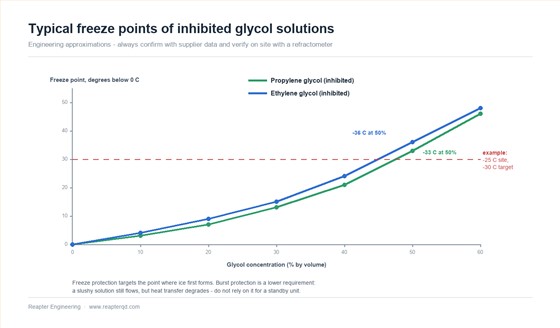
The working rule is to set the solution's freeze point at least 5 °C below the site's design minimum — for a ?25 °C site, a ?30 °C solution, which means roughly 40–45% ethylene glycol or about 48–50% propylene by volume. Use inhibited, industrial-grade glycol with a corrosion inhibitor package matched to the system metals; automotive antifreeze is not a substitute. Check gasket compatibility at the selected concentration, and accept the duty penalty: glycol solutions carry less heat per litre than water and are more viscous, so a glycol-filled exchanger needs capacity margin that must be designed in, not discovered in January. Above roughly 60% concentration the freeze point starts rising again, so more is not always better.
A practical winterization sequence
- Establish the design minimum for the site — the lowest temperature the system can realistically see, not the seasonal average. Coastal and inland sites on the same project can differ by 10 °C or more.
- Classify each unit as seasonal (drain), standby (glycol or keep-warm) or continuous (glycol where exposure exists). One rule for the whole plant usually over- or under-protects something.
- If draining: empty both circuits at low points, blow down with compressed air, verify at the highest vents, and leave valves open and tagged.
- If filling with glycol: calculate system volume, pre-mix to the target concentration with demineralised water, fill, circulate and confirm with a refractometer at several points. Label the circuit with its concentration and date.
- Protect the periphery: trace and insulate exposed nozzles, vent and drain lines, and any instrument stubs that hold water.
- Document and inspect: record readings, then at spring restart check for bulged plates, weeping gaskets or unexplained cross-contamination — the signature of a freeze event that happened despite the plan.
Common questions
Can I just drain the unit and leave the valves shut? No. Residual water trapped in channels and dead legs is exactly what causes bulged plates. Drain, blow down, verify, and leave the drains open until refill.
How much glycol is enough? Enough to put the freeze point at least 5 °C below the site design minimum. For most cold-climate installations that lands between 30% and 50% by volume; beyond about 60% protection reverses and heat transfer keeps getting worse.
Do brazed units need the same treatment? Yes, and they are less forgiving: there is no gasket to show distress first, and a cracked braze joint usually means the unit is uneconomic to repair. Drain or glycol-protect them like any other.
Does glycol hurt performance? Somewhat. Compared with water, glycol solutions have lower specific heat and higher viscosity, so the same duty needs more flow or more surface. Suppliers publish correction data; size for it at design stage rather than accepting a colder-than-promised output in winter.
The unit froze last winter and seems fine — should we worry? Yes. Internal cross-leakage from a bulged plate often appears only under thermal cycling, weeks after the thaw. A plate pack inspection or a pressure-hold test on both circuits is cheap compared with unplanned downtime in the next heating season.
Conclusion
Freeze protection is not a product feature — it is a discipline of draining, correct glycol concentration and circulation, applied before the weather turns. Reapter supplies gasketed and semi-welded plate heat exchangers to projects across cold-climate markets, and we size winterization recommendations — materials, gaskets, glycol duty margins and spare parts — around each site's real design minimum. If you are preparing units for a winter shutdown or troubleshooting a suspected freeze event, contact our engineering team with your site conditions and duty, and we will help you specify the protection the unit actually needs.
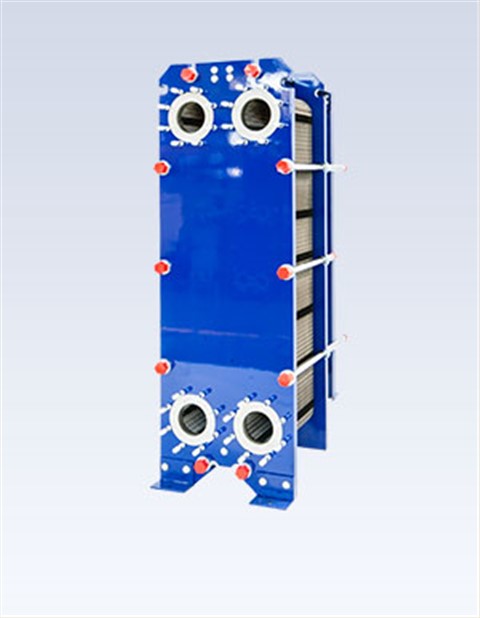 Food grade plate heat exchanger
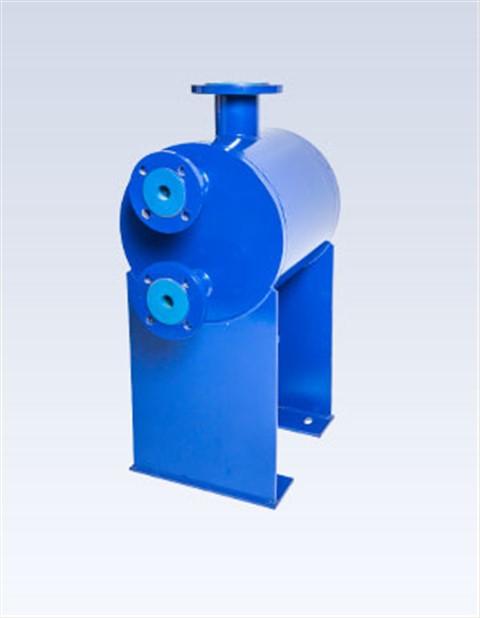 Plate And Shell Heat Exchanger