

Material choice is a service-life decision, not a cost decision
In plate heat exchanger specification, material selection is often treated as the last item on the checklist — after duty, surface area, and plate pattern have been settled. In practice it is the decision that most directly determines whether the unit is still in service in ten years or has been replaced twice.
The reason is straightforward. A plate heat exchanger has two material systems working at once: the plates, which must resist corrosion from the process medium, and the gaskets, which must resist both the medium and the temperature. Corrosion that perforates a 0.5 mm plate is not a gradual degradation — it is a failure. And because plates are the largest repeat-cost item in the unit, getting the material right the first time is the single most effective way to control lifetime cost.
The four materials that cover most industrial duties
Roughly nine out of ten industrial plate heat exchangers are built from one of four plate materials. Each occupies a distinct position on the corrosion-versus-cost spectrum:
Stainless steel 316L — the general-purpose default
316L is the baseline. It handles clean water, steam, most food products, and a wide range of mildly aggressive chemicals at moderate temperatures. It is weldable, formable, readily available, and by a wide margin the least expensive of the four.
Its limitation is chloride. 316L is vulnerable to chloride pitting and stress corrosion cracking, and that vulnerability increases sharply with temperature. Above roughly 60 °C, even modest chloride concentrations can attack it. This is why 316L is the wrong choice for seawater, brine circuits, or any duty where chloride content is unknown or variable — a category that includes far more processes than most specifications assume.
Titanium — the answer to chlorides, with one caveat
Titanium resists chloride attack exceptionally well and is the standard choice for seawater, brackish water, brine, and chloride-bearing process streams. Its protective oxide film reforms instantly when damaged, which gives it excellent performance in flowing chloride environments.
The caveat is that titanium's corrosion resistance depends on that oxide film remaining intact and on the environment staying oxidising. It performs poorly in dry chlorine gas, in some strongly reducing acids, in anhydrous conditions, and in high-temperature alkaline service. Titanium also has a practical temperature ceiling in chloride service — crevice corrosion risk rises above roughly 70 °C in some chloride environments — which means "titanium" is not a blanket answer to every chloride problem.
254 SMO — high-chloride duty where titanium does not fit
254 SMO is a super-austenitic stainless steel with roughly 6% molybdenum and added nitrogen, giving it a pitting resistance equivalent number (PREN) in the low 40s — dramatically higher than 316L's mid-20s. It tolerates chloride concentrations and temperatures that would destroy 316L, and it retains useful strength at higher temperatures than titanium.
In practice 254 SMO occupies the gap between 316L and titanium: duties where chloride content is too high for stainless steel but where titanium's temperature or chemical restrictions rule it out. It is significantly more expensive than 316L and harder to form, which is reflected in plate cost.
Hastelloy C-276 — the last resort that keeps working
Hastelloy C-276 is a nickel-based alloy with chromium and molybdenum that resists an unusually broad range of aggressive media: strong oxidising and reducing acids, mixed acids, halogen-containing compounds, and chloride-bearing solutions at high temperature. Where 316L and titanium both fail, C-276 is often the material that survives.
The trade-off is cost — frequently several times the price of 316L for the same plate — and availability. It is specified only where no cheaper material will hold, and it is almost always the outcome of a corrosion study rather than a catalogue comparison.
Comparing the four
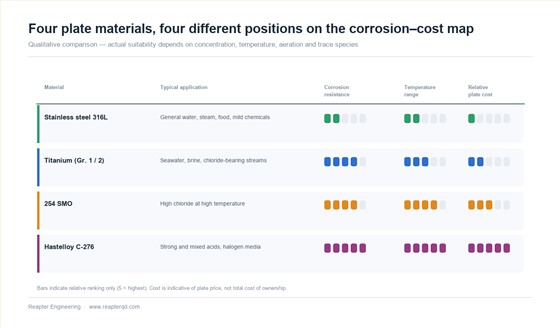
| Material | Strength | Typical limit | Relative plate cost |
|---|---|---|---|
| Stainless steel 316L | General corrosion, food, water, steam | Low chloride; temperature-sensitive | Baseline |
| Titanium (Gr. 1 / Gr. 2) | Seawater, brine, chlorides | Reducing acids, dry chlorine, high-temperature chloride crevice risk | Moderate |
| 254 SMO | High chloride at high temperature | Strong reducing acids | High |
| Hastelloy C-276 | Strong acids, mixed and halogen media | Cost; availability | Highest |
The table is deliberately qualitative. Absolute corrosion rates depend on concentration, temperature, aeration, flow velocity, and the presence of trace species, and no summary can substitute for a corrosion assessment on the actual process stream. What the table does provide is the sequence in which materials should be considered: start at the top, and move down only when the duty rules the simpler option out.
Do not forget the gaskets
A heat exchanger built from Hastelloy plates and fitted with nitrile gaskets is not a corrosion-resistant unit. The gasket is frequently the limiting component, and its temperature rating is often lower than the plate's:
- Nitrile (NBR) — good general-purpose choice for water, oils, and many food products at moderate temperature.
- EPDM — excellent for hot water, steam, and many chemical duties; the standard choice for higher-temperature water-based service.
- HNBR — used where higher temperature is combined with oil or hydrocarbon contact.
- Fluorocarbon (FKM / Viton) — the highest-temperature elastomer in common use, and the choice for aggressive chemical and hydrocarbon duties.
Gasket temperature limits are typically the binding constraint on a gasketed unit's operating envelope. When specifying materials, the plate and the gasket must be selected as a pair against the same duty conditions — including any short-term temperature excursions, which are a common cause of premature gasket failure.
A practical decision sequence
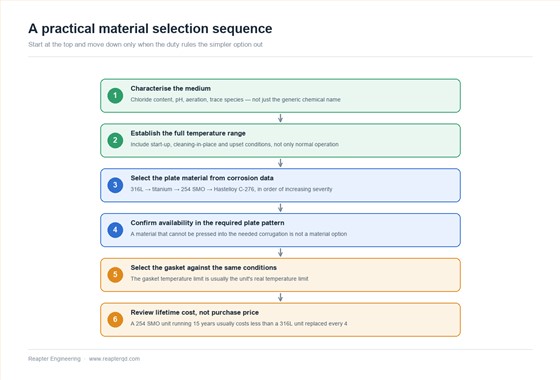
- Characterise the medium properly. Concentration, chloride content, pH, aeration, and trace species matter more than the generic chemical name. "Cooling water" can mean anything from clean condensate to aggressive brackish water.
- Establish the real temperature range, including start-up, cleaning-in-place, and upset conditions — not only normal operation.
- Select the plate material from corrosion data, then confirm that the chosen material is also available and formable in the required plate pattern.
- Select the gasket against the same conditions, treating its temperature limit as the unit's temperature limit.
- Review the total lifetime cost, not the purchase price. A unit built in 254 SMO that runs for fifteen years typically costs less than one built in 316L replaced every four.
Common questions
Is titanium always better than stainless steel?
No. Titanium outperforms 316L in chloride-bearing service, but it is the wrong material in reducing acids, dry chlorine, and some high-temperature chloride duties. It is also more expensive. The correct question is which material suits this medium at this temperature.
Can I mix materials in one unit?
In some cases, yes — and it is occasionally the correct engineering answer where one side of the exchanger sees a far more aggressive medium than the other. It requires careful review of galvanic effects and is a decision for the manufacturer, not a catalogue substitution.
How do I know if my existing plates are under-attacked by corrosion?
Inspect for pitting, edge cracking, and gasket groove deformation at each opening. Corrosion that has started rarely reverses, and a plate pack showing early pitting on a chloride duty will typically fail within a few service cycles.
How Reapter handles material selection
Reapter manufactures plates and gaskets in stainless steel, titanium, titanium-palladium, 254 SMO, and nickel-based alloys, with special materials sourced against verified mill certification. Because plate and gasket are selected together against the same duty, we ask for the full process conditions — not just a plate model number — before quoting, and we will say so when a requested material is the wrong choice for the application.
Send us the medium, the concentration, and the operating temperature range, and our engineering team will return a material recommendation with the reasoning behind it.
Reapter Engineering Team · Qingdao Ruipute Heat Exchange Equipment Manufacturing Co., Ltd.
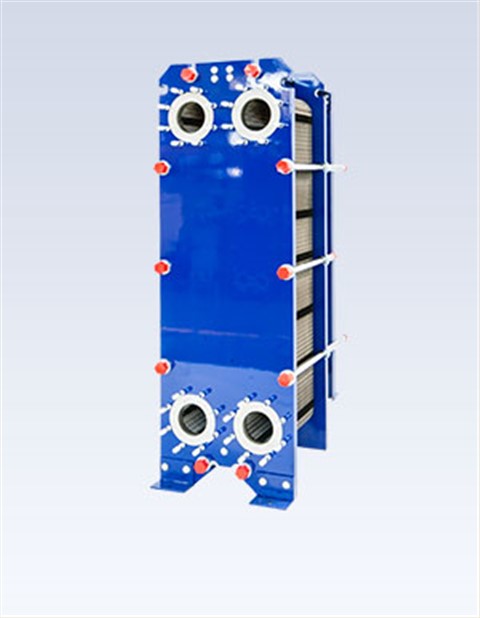 Food grade plate heat exchanger
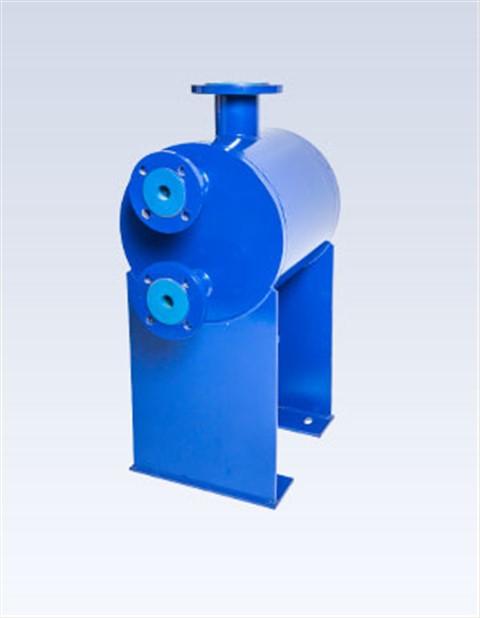 Plate And Shell Heat Exchanger