

A paper mill is a heat-recovery business
Ask a papermaker where the money goes and the answer is usually fibre, then energy. A mill buys heat for drying, steam for the bleaching plant and hot water for showers and washing — and then pays again to cool the warm water it discharges. Closing that loop is where plate heat exchangers have quietly become standard equipment: they recover heat from warm white water, condensate and secondary heat loops, they fit in tight mill corners, and they open for cleaning on a schedule a production manager can actually keep. This article maps the duties where gasketed and wide-gap plate heat exchangers earn their place in a pulp and paper mill, explains how fibre consistency and water chemistry set the plate style and the alloy, and describes the fouling and cleaning discipline that keeps the heat-recovery figures the mill was promised. Whether you are specifying a new machine, retrofitting heat recovery into an old one, or replacing plates in a frame that has run for years, the same two numbers — fibre and chlorides — decide most of the outcome.
Where plate heat exchangers earn their place
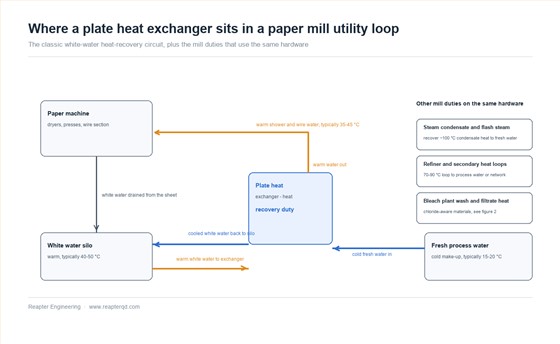
The classic circuit is white-water heat recovery. Water drained from the wire section leaves the machine warm — typically in the 40–50°C range — and collects in the white-water silo. A plate heat exchanger takes that warm water on one side and cold fresh make-up water on the other, returning cooled white water to the silo and delivering warm shower and wire water back to the machine. Every kilowatt recovered here is a kilowatt the steam system does not have to produce, and the temperature spread across the exchanger is exactly the kind of close-approach duty plate technology does well.
| Duty | Hot side | What it heats | Watch-outs |
|---|---|---|---|
| White-water heat recovery | White water, ~40-50 °C, fibre-bearing | Fresh process water to 30-40 °C | Consistency and scale set plate type |
| Shower and wire water | Recovered warm water | Machine showers, felt washing | Nozzle plugging if solids carry over |
| Condensate and flash steam | Condensate, ~90-100 °C | Fresh water, boiler make-up preheat | Trap condition; keep condensate clean |
| Refiner and secondary heat | Secondary loop, ~70-90 °C | Process water or district-heating network | Closed loop: verify water treatment |
| Bleach plant washing | Filtrate or warm water | Rinse water for washers | Chloride-bearing: material selection |
| Miscellaneous cooling | Lubrication oil, hydraulic circuits | Cooling water | Check oil-side pressure rating |
None of these duties is exotic. That is the point: one hardware family — frames, plates and gaskets — serves the whole mill, which simplifies spares, training and cleaning chemistry.
Fibre sets the plate: consistency is the first specification
The first question for any stock-side duty is not thermal — it is mechanical. Fibre-bearing water is classified by consistency, the percentage of dry solids in the stream, and consistency decides whether a conventional chevron plate pack will run, mat and blind, or block outright.
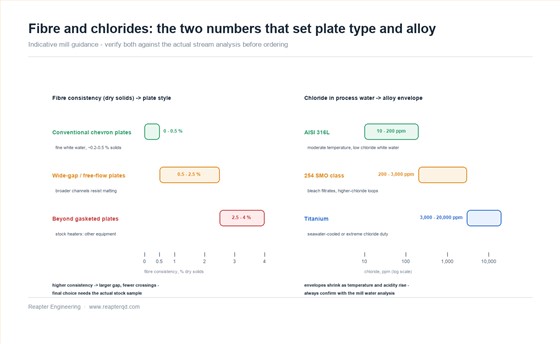
- Fine white water, roughly 0.1–0.5% consistency. Machine white water after the silo, wire pit water and most filtrates sit here. Conventional chevron plates handle these streams well, and the corrugation turbulence keeps fibres moving to the channel exits.
- Above roughly 0.5%, think wide-gap. Free-flow or wide-gap plates drop some of the corrugation crossing points and widen the channels, trading a little thermal performance for a large gain in clogging resistance. Broke systems, pulp dilution water and some screening filtrates belong here.
- Stock above a few percent consistency is not plate territory. Stock heaters and dilution duties at higher consistencies need equipment designed for the purpose. Choosing a gasketed plate exchanger for such a stream is a purchase order that becomes a maintenance problem.
Consistency is not a constant, either. broke handling, repulper surges and upsets upstream of the silo can send a slug of thick stock toward an exchanger sized for fine white water. Upstream screening, a duty-side bypass and an alarm on differential pressure are cheap insurance; a blinded pack on a running machine is not.
White water chemistry: scale and chlorides
The second and third numbers that matter live in the water itself. White water is rarely just water: it carries dissolved calcium carbonate from fillers and make-up water hardness, and in bleached grades it can carry chlorides from the bleaching chemicals. Each leaves a different signature on the pack.
Scale is the temperature-driven problem. Calcium carbonate solubility falls as temperature rises, so the warm side of the exchanger — exactly where the recovered heat is — is where the deposit forms. Scale is a hard, adherent layer that robs approach temperature gradually, and it does not respond well to gentle chemistry. The countermeasures are velocity and cleaning: design the warm side to stay in its velocity band, and clean on a schedule set by approach-temperature drift rather than by calendar habit.
Chlorides are the material problem. Chloride concentration and temperature together decide whether 316L stainless survives, whether a higher-alloy austenitic grade is needed, or whether the duty has crossed into titanium territory. A closed white-water loop that recycles repeatedly can concentrate chlorides well above the make-up water value — measure the loop, not just the intake.
Materials: matching the alloy to the stream
The guidance below is indicative — real selections need the actual water analysis, the operating temperature and the pH — but it shows how the choice moves as conditions tighten. At moderate temperatures and low chloride levels, 316L is the workhorse for white water and condensate duties. Bleach plant filtrates and higher-chloride loops move the selection toward the super-austenitic 254SMO class of alloys. Seawater-cooled sites and extreme chloride duties call for titanium plates. The envelope shrinks as temperature rises: an alloy comfortable at 30°C can pit at 60°C in the same water.
Two practical notes complete the picture. First, gaskets follow the chemistry too: the standard NBR grades handle white water and condensate duties well, while oxidizing chemical streams need an elastomer matched to them. Second, cleaning chemistry must be compatible with the weakest metal in the pack — a caustic CIP that suits 316L is also the routine cleaner of choice for scale control, but dosing and temperature still belong in a written procedure, not in the operator's judgement on the day.
Fouling and cleaning discipline
Fouling in a mill exchanger has a predictable shape. Performance does not collapse; it slides. The approach temperature creeps up week by week as scale and fibre matting build, and the temptation is to raise flows or live with it until the seasonal shutdown. The better discipline is to treat approach temperature as a trend line: record it, watch its slope, and schedule a clean when the slope steepens rather than when the duty is lost.
Cleaning itself is straightforward on a gasketed frame — open the pack, wash the plates, inspect the gaskets — and that openability is precisely why plate technology dominates mill heat recovery. For in-place cleaning between opens, a caustic-based circulation at the chemical supplier's recommended strength and temperature handles fibre and filler deposits; scale needs an acid stage, inhibitor included, selected for the plate alloy. Two rules prevent most cleaning damage: never mechanically scrape the gasket side of the plate, and never let a chemical circulate past its approved temperature. After every open, re-tighten to the manufacturer's free-length target and re-check after the first thermal cycle — the same discipline described in our article on gasket compression set.
What to send the supplier
A mill exchanger quotation is only as good as the data behind it. The short list that separates a workable selection from a warranty argument:
- The duty: flows, temperatures in and out on both sides, and the allowable pressure loss.
- The stream: expected consistency and fibre type on stock-side duties; a full water analysis — hardness, chlorides, pH, conductivity — on water-side duties.
- The history: for retrofits, the old exchanger's performance trend and what actually fouled it.
- The constraints: cleaning chemistry in use at the mill, shut-down windows, and the space the frame may occupy — plate packs fit where shells do not.
- The upstream safeguards: strainers, screening and bypass arrangements already in place.
Support across the mill's life
Mills run exchangers for decades, and the support that matters arrives long after the purchase order. Replacement plate packs in the original corrugation, wide-gap alternatives for duties that turned out fibrous than expected, gasket sets matched to the frame's age, and re-rating when the machine speed changes — these are the interventions that keep a heat-recovery train performing for twenty years. Reapter supplies gasketed, wide-gap, semi-welded and fully welded plate heat exchangers and supports paper mills worldwide with thermal re-ratings, replacement plates and gaskets for all major frames, and diagnostic reviews of heat-recovery performance. Send us the duty data and a water analysis; our engineers will come back with a selection, a material recommendation and a cleaning plan sized to your shutdown calendar. Contact us to review your mill's heat-recovery duties.
Common questions
Can a plate heat exchanger handle white water with fibres in it? Yes, within consistency limits. Fine white water up to roughly half a percent dry solids runs well on conventional plates; higher consistencies should move to wide-gap plates; stock beyond a few percent belongs in other equipment. Screen upstream and alarm on differential pressure to survive surges.
Why is our recovered-heat performance falling when the exchanger is only a few years old? Almost always scale or fibre matting on the warm side, not a thermal failure. Track the approach temperature trend, then open and clean on the slope, not after the duty is lost. Verify the cleaning chemistry against the plate alloy.
Which alloy do we need for bleach plant filtrates? Chloride concentration and temperature decide it. Low-chloride, moderate-temperature duties run 316L; many filtrates need the 254 SMO class; extreme duties need titanium. Measure the actual loop water — recycling concentrates chlorides above the make-up water value.
Can we retrofit heat recovery into an old machine room? Usually yes, and the plate format is chosen for it: the frame footprint is small, connections can often be adapted to existing pipework, and the duty can be phased in one exchanger at a time. Start with the white-water silo circuit, where payback is typically fastest.
Conclusion
In a pulp and paper mill, a plate heat exchanger is not one machine but a role filled across the site: white-water heat recovery, shower water, condensate, secondary heat and filtrate duties all run on the same hardware family. The two numbers that decide success are mechanical and chemical — fibre consistency sets the plate style, chlorides and temperature set the alloy — and the discipline that preserves the payback is a fouling trend line plus a cleaning procedure the alloy can tolerate. Specify with the real data, operate inside the velocity band, clean on evidence, and the heat-recovery figures the project promised will still be there in year ten.
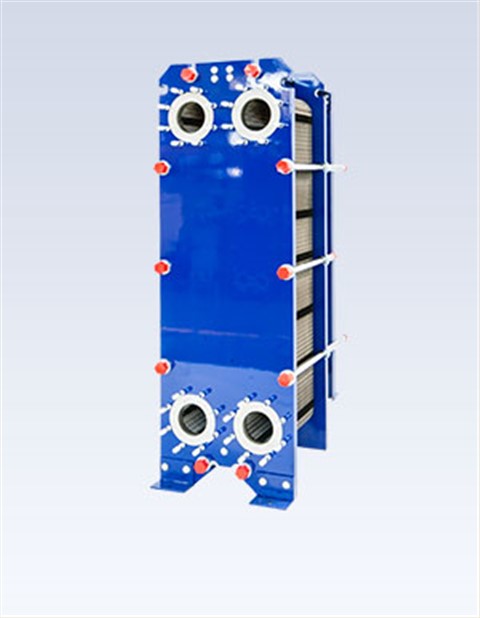 Food grade plate heat exchanger
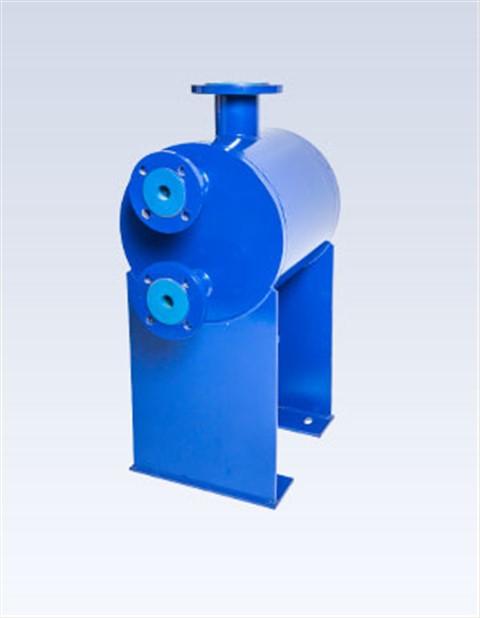 Plate And Shell Heat Exchanger