

Transit is a duty condition that never reaches the datasheet
A gasketed plate heat exchanger is specified for 6 bar and 90 degrees C, tested, painted, then closed up and loaded into a container. For the next four to eight weeks it lives in a different environment: internal temperatures past 55 degrees C under a tropical sun, humidity that swings through saturation twice a day, steady ship vibration, and a plate pack held compressed the whole time. None of that appears in the thermal design. Yet a large share of the damage found at site handover - rust in the port area, gaskets that weep on first pressurisation, dented plate edges - is created in transit and storage, not on the production line. This article covers what degrades a unit between the factory gate and installation, and the packing, documentation and inspection practice that answers it.
What actually fails on the way to site
Five mechanisms account for most transit and storage damage. They are worth separating, because each is prevented by a different measure, and inspecting for one tells you nothing about the others.
| Failure mode | Mechanism | First evidence at site | Prevention |
|---|---|---|---|
| Condensation inside the wrap | Warm humid air sealed in with the unit cools during the voyage; water condenses on plate and frame surfaces | Water on unpacking, white or brown bloom on plate edges, humidity card at saturation | Barrier bag plus calculated desiccant - never plain stretch film |
| Gasket compression set | Elastomer held compressed for weeks at 50 to 65 degrees C takes a permanent set | Pack dimension short of specification, weeping at the first thermal cycle | Close to the specified pack dimension only; respect storage limits |
| Plate edge and port damage | Movement in a loose pack, or loose plates handled by hand | Dents near the gasket groove, deformed port lips, plate order disturbed | Pack closed for the whole journey, plates strapped in bundles |
| Crevice corrosion under wet packaging | Sea-air chlorides plus trapped water in a crevice with no oxygen renewal | Rust staining at gasket grooves and port liners | Dry sealed environment, no tape on stainless surfaces |
| Frame paint and machined face corrosion | Paint chipped at lashing and lifting points, threads left bare | Rust runs from sling marks, corroded stud threads | Edge protection at sling points, touch-up kit in the crate |
Note what is not on the list: nothing here is a design fault, and nothing is fixed by adding alloy content. A 316L unit inside a saturated wrap will corrode in the gasket groove just as a 304 unit will. The variable that decides the outcome is water - and water in a sealed volume is a calculation, not bad luck.
Why a sealed container rains on its own cargo
The mechanism explains why wrapping a unit in plastic film can be worse than leaving it bare. Air holds water vapour in proportion to its temperature. When a unit is sealed inside a bag or a closed case at the loading port, the absolute amount of vapour inside is fixed. As the ship moves into cooler latitudes - or simply as night falls on a steel roof - the temperature drops, the capacity of that air falls with it, and the surplus condenses onto the coldest surface available: the plate pack and the frame.
Take air at 17 grams of water vapour per cubic metre, an unremarkable condition for cargo loaded in a tropical port. At 30 degrees C it sits at about 56 percent relative humidity. Cool the same air to 25 degrees C and it is at roughly 74 percent; just below 20 degrees C it reaches saturation, and below that the surplus turns to liquid water. Nothing was added - the water was already inside the packaging when it was closed.
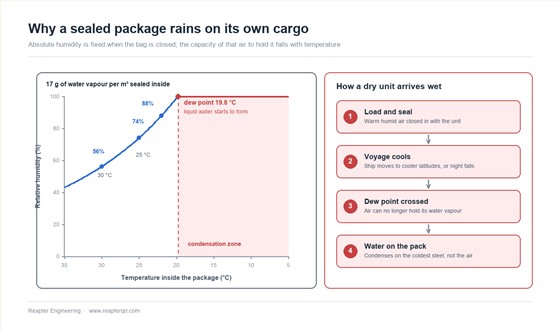
Two consequences follow. The dew point of the trapped air - not the humidity at the port - sets the danger threshold, so a unit packed on a dry day can still arrive wet. And anything that blocks drying without controlling moisture, such as stretch film or a closed plywood case without a barrier and desiccant, simply traps the air that will later condense.
Holding the plate pack for transport
Plates are thin - commonly 0.4 to 0.6 mm stainless - and a loose pack is a pack that works against itself under vibration. Transport practice follows from that:
- Close the pack to the specified dimension and record the measured value on the packing list. Taken at four points, the dimension is also the acceptance value at site: it tells the receiving engineer whether anything moved.
- Do not over-compress for the journey. A frame closed tighter than specification adds compression set to every gasket, and the bill arrives as a leak on first heat-up. For long closed storage, follow the OEM instruction, which may call for relaxing the pack.
- Use transport locks where the frame provides them, and remove them before commissioning - a unit left locked will not compress correctly when it heats.
- Handle plates as a bundle, never singly by the edge. Spare plates travel strapped in a stack with edge protection. A plate carried by one corner bends at the port and never seals properly again.
- Protect the ports. Caps on every nozzle keep grit, rainwater and nesting insects out of the flow passages.
Spare gaskets travel under different rules: flat, in sealed bags, in the dark, away from ozone sources such as motors and welding equipment.
Moisture control: barrier, desiccant and a card you can read
The answer to the dew point problem is not to remove all air but to remove the water from it, then keep it out. Industrial practice works in three layers:
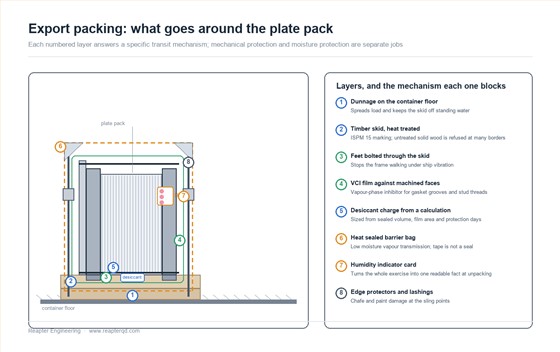
- Barrier. The unit is sealed inside a film with low moisture vapour transmission - typically an aluminium-composite laminate, heat-sealed rather than taped. The seal is the whole point: an unsealed bag is a humidity chamber with a lid that does not close.
- Desiccant charge. Drying agent is sized from the water load: the moisture already in the trapped air and packaging, plus what permeates the film over the protection period. Both scale with the sealed volume, the film area and the number of days. The standard method (DIN 55474) expresses the result in drying-agent units, one unit conventionally absorbing about 6 grams of water vapour at 23 degrees C and 85 percent relative humidity. Sizing by eye is how a three-month shipment ends up with a one-month charge.
- Verification. A humidity indicator card visible at unpacking converts the exercise into one readable fact: spots turned from blue to pink mean protection failed and the pack needs inspection before installation - not after the gaskets have been blamed.
Storage at site: the part of the journey nobody plans
On overseas projects the unit often arrives before the plant is ready, and six months in an open yard is harsher than the sea voyage: UV on the packaging, wind-driven rain, dust, and a construction site around a crate nobody owns. Storage instructions therefore belong in the delivery, not in an afterthought.
| Storage period | Pack compression | Moisture protection | Additional action |
|---|---|---|---|
| Up to 3 months | Hold at specified dimension | Barrier bag intact, indicator card checked monthly | Covered storage, off the ground |
| 3 to 12 months | Hold, or relax per OEM instruction | Inspect bag, renew desiccant if opened, re-seal | Quarterly visual check, log the readings |
| Beyond 12 months | Relax the pack | Full re-preservation, new barrier and desiccant | Plan re-gasketing before start-up; elastomer shelf life is being consumed |
Two details decide whether that table gets followed. The crate must be marked, in the language of the site, with what it is and what not to do to it. And the storage requirement must appear in the purchase order - a subcontractor who receives a crate with no instruction will store it wherever there is space.
Documentation that settles arguments later
For an international delivery the paperwork is part of the product, and a container held at a port in the rainy season is a container that condenses. The package that avoids most disputes contains: a packing list with weights and centre of gravity per crate, matching what is stencilled on the box; the nameplate data and pressure test certificate, so the unit can be confirmed without opening the pack; material certificates to EN 10204 3.1 where traceability is required; heat-treated wood marking (ISPM 15) on every crate and skid, since untreated solid wood is refused at many borders; and the plate arrangement drawing, ideally a copy inside the crate - once a pack is opened on site, the order and orientation of the plates, including any blind or flow-directing plates, is the difference between meeting duty and running 20 percent short.
Receiving inspection: what to do before signing
The delivery note is a legal document, and signing it unqualified is the most expensive habit in project logistics. A short routine protects both sides:
- Inspect the crate exterior before unloading, photograph any damage, and note it on the delivery note rather than accepting "signed clean".
- Open in dry weather or indoors, and keep the packaging until inspection is finished - the barrier bag and indicator card are evidence.
- Read the humidity indicator card first: pink means moisture entered, and the pack needs opening and inspection, not a wipe-down.
- Measure the pack dimension at four points and compare it with the packing list.
- Look along the plate edges for dents and check the port areas with a light. Denting at the gasket groove line is a rejection item; a dent mid-plate is usually cosmetic.
- Confirm nameplate, tag number and accessories against the order, and report exceptions in writing within the claim window, with photographs and the pack measurement.
Support after the crate is open
Packing and documentation only take a project as far as the site boundary. What closes the remaining gap for overseas work is practical: a commissioning pack in the project language (assembly sequence, torque values, pack dimension, start-up checklist, a fault table keyed to symptoms); remote support by video during pack assembly and first heat-up, with the camera on the pack and the instrument readings in frame; and a first-fill spares kit sized to the unit - one gasket per ten plates as a working rule plus the port gaskets - so a damaged gasket does not stop commissioning while an air freight shipment is arranged.
Common questions
Can a plate heat exchanger be shipped with the plates loose in the frame? No. A loose pack moves under vibration and the plate edges and port lips take the contact damage. Close the pack to the specified dimension for the journey and record the measured value; spare plates travel separately, strapped in a bundle.
Is a wooden crate enough protection for a sea shipment? A crate gives mechanical protection and nothing else. Without a sealed barrier film and a calculated desiccant charge, the crate becomes a humidity chamber and the plate pack condenses on the first cold night of the voyage.
How long can a unit stay in storage before the gaskets are a concern? Up to three months in covered storage at moderate temperature is normally straightforward. Beyond twelve months, plan on relaxing the pack and budgeting for replacement gaskets before start-up, and record the storage period so the decision is made on evidence rather than memory.
Conclusion
Transport and storage are the least glamorous part of a heat exchanger project and the easiest place to lose the value of a good unit. The fixes are unglamorous too: a sealed barrier with a sized desiccant charge, a pack held at its dimension, a humidity card somebody actually reads, and documentation that tells the site what to do with the crate it has just received. Reapter supplies gasketed plate heat exchangers to projects worldwide with export packing, test and material documentation, and commissioning support arranged around the site rather than the factory. If your delivery has a long sea leg or a long wait before installation, send us the route and the storage period - we will match the preservation schedule and the documentation package to it.
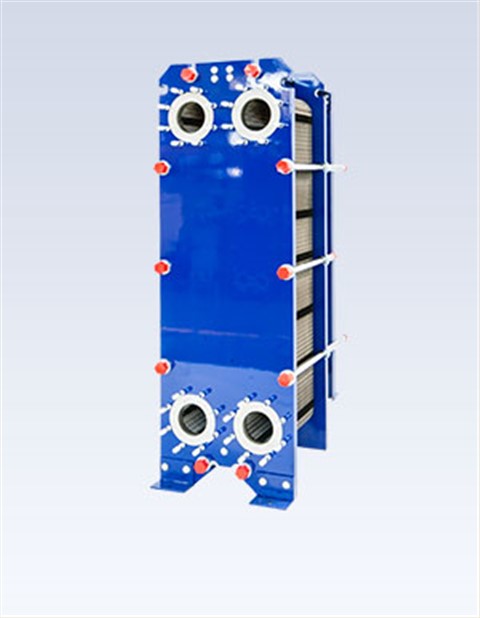 Food grade plate heat exchanger
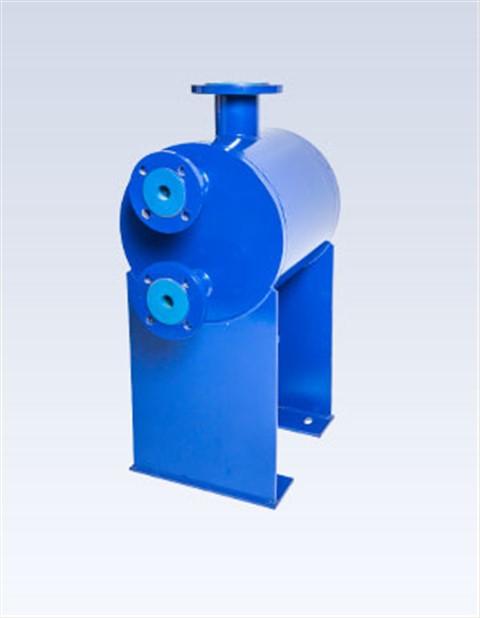 Plate And Shell Heat Exchanger