

Transcritical CO2 breaks most of the usual selection rules
Plate heat exchanger selection assumes a phase change: boiling on one side, condensing on the other, a saturation temperature that stays constant while the fluid gives up or absorbs latent heat. Above the critical point of carbon dioxide — 31.0 °C and 73.8 bar — none of that is true. The high-side exchanger becomes a gas cooler, the fluid stays single-phase, its specific heat varies strongly with temperature, and the pressure rating rather than the thermal duty becomes the first constraint on the design.
This matters commercially because transcritical CO? systems are now standard for European supermarkets, industrial refrigeration and increasingly for heat pumps producing domestic hot water above 65 °C. The exchangers in those systems are ordered to a different logic than an HFC system's, and specifying them as if they were conventional condensing duties produces units that either fail the pressure test or fail to deliver the duty at the design ambient.
What "supercritical" actually changes
Below the critical point, CO? condenses at a fixed temperature for a given pressure. Above it, there is no condensation. The fluid leaves the compressor as a dense supercritical gas and is cooled at constant pressure from perhaps 90–110 °C down toward 30–40 °C, giving up sensible heat the whole way. The exchanger is called a gas cooler for exactly that reason.
The consequence that catches designers is the shape of the cooling curve. Near the pseudo-critical temperature, CO?'s specific heat capacity rises sharply — by a factor of several — and then falls again. The result is a temperature–enthalpy curve that is S-shaped rather than straight, and heat transfer that is excellent in the pseudo-critical band and noticeably weaker on either side of it.
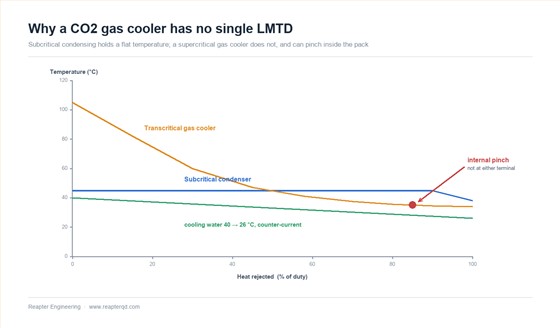
For practical selection this means a single LMTD figure is not adequate for the gas cooler. The duty has to be split into temperature bands — commonly five or more — each with its own local specific heat and heat transfer coefficient, and the limiting band identified. In many transcritical designs the pinch point sits inside the exchanger rather than at either end, so a unit that looks adequately sized on the terminal temperature difference can still be short of duty.
Pressure rating drives the design before area does
Transcritical high-side pressures are commonly in the 80–120 bar range, and systems are frequently designed and tested to 120 bar or higher to cover high ambient standby conditions. That is roughly three times the pressure of a conventional R410A condensing duty, and it changes the mechanical design of the exchanger completely.
| Item | Subcritical HFC condenser | Transcritical CO2 gas cooler |
|---|---|---|
| Typical design pressure, high side | 25–45 bar | 80–140 bar |
| Phase change | Condensing at constant temperature | None — single-phase cooling |
| Governing thermal profile | LMTD with a correction factor | Band-by-band integration; internal pinch possible |
| Structural driver | Plate area and port size | Plate thickness, brazing or weld integrity, frame and connection rating |
| Leak sensitivity | Moderate | High — small molecule, high pressure, high cost of loss |
| Standard construction | Copper-brazed or gasketed | All-welded, semi-welded or high-pressure brazed |
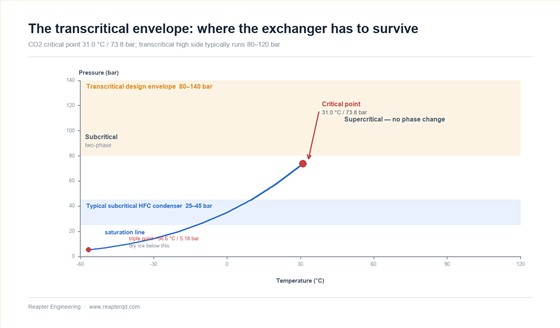
Gasketed construction is rarely appropriate on the transcritical high side: a gasketed joint that is acceptable at 25 bar is a different proposition at 120 bar, and the elastomer sees a far harsher environment. All-welded and semi-welded units are the norm, with the gasket, where present, confined to the low-pressure service side.
Pressure rating is also a documentation issue. Depending on the market, a 120 bar exchanger falls into a higher hazard category under the applicable pressure equipment directive, which brings material certification, design review, and witnessed pressure testing with it. Establish that early — it affects lead time more than the thermal design does.
Where plate exchangers sit in a CO2 system
Four duties recur, and each has a different governing constraint:
- Gas cooler — high pressure, no phase change, sensitive to the internal pinch. Often a brazed or welded plate pack, sometimes in a combined unit with the heat reclaim circuit.
- Evaporator — low pressure, boiling, and where the risk of dry-out at part load lives. Refrigerant distribution quality matters more here than in any other CO? duty.
- Oil cooler — small duty, but critical to compressor reliability; CO? systems with POE lubricant need the oil temperature held in a narrow band.
- Heat reclaim / domestic hot water — the duty that makes transcritical systems attractive in the first place, because the high discharge temperature allows water heating to 65–90 °C that a subcritical cycle cannot reach efficiently.
For heat reclaim, the exchanger is usually a stacked or multi-section arrangement: a desuperheater section taking the hottest gas, then the main gas cooler, then possibly a subcooler. Each section has its own local specific heat, and treating the stack as one exchanger is a common modelling error.
Temperature glide, approach and the part-load problem
Because the high side has no constant temperature, the "approach" of a gas cooler is not a single number. It is the minimum local temperature difference anywhere in the exchanger, and that minimum usually occurs somewhere in the middle of the pass, not at the CO? outlet.
Two practical rules follow. First, the water or air side should be arranged in true counter-flow to the CO? where the plate pattern allows it, because a co-current or multi-pass arrangement can create a pinch that no amount of extra area will remove. Second, the low-side approach targets that apply to conventional condensers do not transfer: a gas cooler with a 2 K terminal difference at the cold end may still be pinched at 0.5 K internally, and there is nothing left to gain by adding plates.
At part load, gas cooler pressure is actively controlled — the system floats the high-side pressure to whatever maximizes COP at the current ambient. That means the exchanger runs across a range of pressures and mass fluxes, not a single design point. A plate pack chosen to hit its best heat transfer coefficient at the rated point may be operating well outside that band for most of the year.
Materials, corrosion and the water side
The CO? side is normally 316L stainless, and the choice is rarely controversial. The water side is where the material decision actually lives, and it is the same decision as in any other duty: chloride content, temperature and the risk of concentration under evaporation set whether 316L is adequate or whether a higher-alloy grade or titanium is needed.
That said, CO? adds two specific concerns. The high CO? partial pressure in the event of a leak into the water circuit lowers pH and can accelerate corrosion, so brazing alloys and elastomers must be compatible with carbonated water rather than assumed from refrigerant compatibility alone. And because CO? leaks are invisible and the charge is often small, helium leak testing at the works is worth specifying rather than relying on the standard pressure test.
For chloride limits and grade selection, our article on materials and limits for seawater and brine cooling covers the boundary conditions, and material selection from 316L to Hastelloy gives the broader comparison.
Low temperature: the dry ice limit
At the triple point — 5.18 bar and ?56.6 °C — CO? stops behaving as a refrigerant and starts forming solid dry ice. Any evaporator operating anywhere near that region needs to be analysed for the possibility of local subcooling below the triple point, particularly during pump-down, defrost or a sudden load loss. Once dry ice forms in a plate channel, it blocks flow and the blockage does not clear by itself.
Most commercial transcritical systems sit well above this limit and never see the problem. Cascade systems, low-temperature industrial plant and test benches do. If the duty involves evaporating temperatures below about ?45 °C, that analysis belongs in the specification, not in the commissioning report.
A selection sequence for transcritical duties
- Establish the maximum high-side pressure including standby and high-ambient conditions, not just the design operating point. This sets the construction and the certification route.
- Split the gas cooler duty into temperature bands and check for an internal pinch. If the pinch is inside the exchanger, more plates will not fix it — the flow arrangement has to change.
- Confirm flow arrangement is counter-current on both gas cooler and evaporator, and verify it holds at the number of passes actually proposed.
- Check part-load behaviour across the floating high-side pressure range, and confirm the distributor turndown for the evaporator.
- Specify leak testing and material certification appropriate to the pressure category, before lead time becomes the problem.
- Re-check the low-temperature limit against the triple point if any operating or off-cycle condition approaches it.
Common questions
Can a standard brazed plate heat exchanger be used on the transcritical side of a CO2 system? Not a standard one. Conventional brazed units are rated for roughly 25–45 bar. CO? gas coolers need units specifically designed and certified for 80–140 bar, usually all-welded or semi-welded with stainless plates.
Why is LMTD not accurate for a CO2 gas cooler? Because the fluid has no phase change and its specific heat varies strongly near the pseudo-critical temperature. The temperature profile is non-linear, so a single mean temperature difference can mask a pinch inside the exchanger. The duty has to be integrated in bands.
Is a plate heat exchanger better than a microchannel gas cooler? For water-coupled duties, plate units generally win on approach and on compactness for a given duty. Microchannel units dominate air-cooled gas coolers where the sink is air. The dividing line is the secondary fluid.
Does CO2 attack stainless steel? Not in the dry refrigerant circuit. The corrosion risk appears on the water side, particularly if CO? leaks into the circuit and lowers pH, which is why brazing alloy and elastomer selection should be based on carbonated water compatibility.
What about oil cooling? It is a small duty with a large consequence. CO? systems using POE lubricant need oil temperature held within a relatively narrow band, and the oil cooler is usually a compact brazed plate unit on the high-pressure side.
Conclusion
Transcritical CO? is not a harder version of a conventional condensing duty — it is a different duty. Pressure rating, band-by-band thermal integration, internal pinch and true counter-current flow are the four things that decide whether the exchanger works, and none of them appear on a standard datasheet request.
Reapter supplies welded and high-pressure plate heat exchangers for CO? gas cooler, evaporator, oil cooler and heat reclaim duties, selected band-by-band against the actual pressure envelope. If you are specifying a transcritical circuit, send the pressure range, the water-side temperatures and the refrigerant mass flow — we will show you where the pinch falls before the unit is built. Talk to our engineering team.
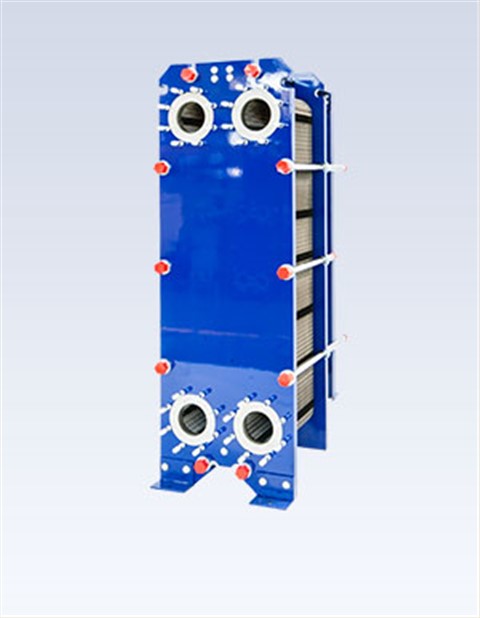 Food grade plate heat exchanger
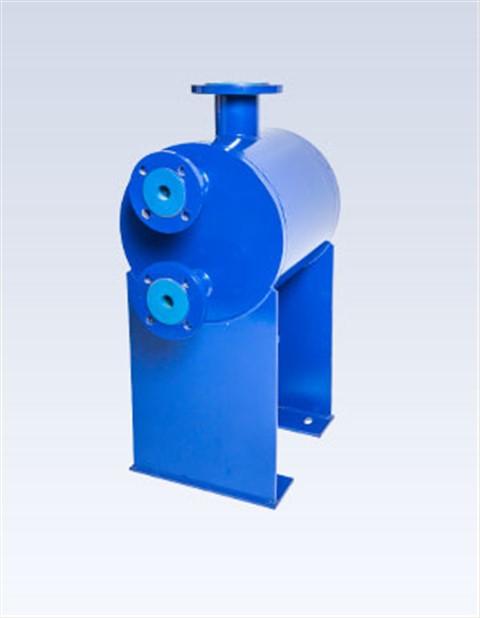 Plate And Shell Heat Exchanger