

The joint that fails is usually the one nobody measured
Most repeat leaks on a gasketed plate heat exchanger are assembly problems, not material problems. The pack was closed to a torque figure somebody remembered, on studs nobody cleaned, with a wrench nobody had calibrated that year - and no one measured the result. The unit ran, was thermally cycled twice, and in the third week the first drops appeared at a port corner. Replacing the gasket buys a few months; replacing the procedure fixes it for good.
The distinction that matters is this: sealing is set by how far the elastomer is compressed between two plates. Bolt torque is only the input that produces that compression, and a poor one - it is corrupted by friction that varies from stud to stud. Tighten in stages to a measured pack dimension, use torque only to get there evenly, and write both numbers into the maintenance file.
What the gasket is doing under the plates
A plate gasket sits in a groove around the plate periphery and seals against the back of the neighbouring plate, not against its own plate. That single detail explains most field behaviour. Each gasket is a ring compressed between a groove on one plate and a flat land on the next, and the whole pack is a stack of those joints held by the same tie bolts.
Two jobs are being done at once. The gasket has to close the channel to atmosphere, and at the port openings it has to separate the two media where gaskets from adjacent plates meet face to face. Those port junctions - the small double-seal areas around each port hole - carry the highest stress in the pack, and they are where the first weep almost always appears.
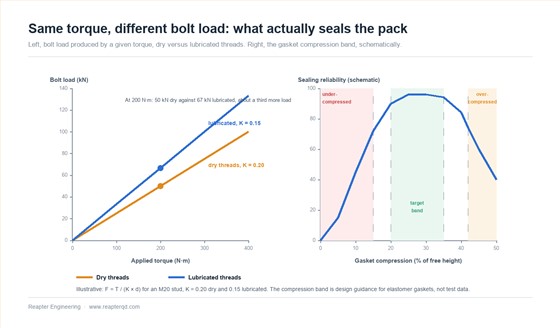
Elastomer profiles are designed to run at roughly 20 to 35 percent compression of their free height. Below about 15 percent, sealing depends on surface finish and luck: the rubber no longer fills the micro-profile of the plate, and a slow weep starts at the lowest-pressure corner. Above roughly 45 percent, the rubber is being extruded rather than compressed, and the plate lands around the ports begin to distort. Both limits are compression limits, and neither is visible if the only number recorded at assembly is torque.
Compression set is the other half of the picture. An elastomer held at temperature takes a permanent set, so a gasket that has seen two years of service no longer returns to its original height when the pack is opened. That is normal - and it is why a used pack closes to a shorter dimension than a new one, and why mixing new and used gaskets in the same pack never works. At one pack dimension the new gasket is under-compressed and the old one is over-compressed, and the joint between them weeps.
Torque is a proxy; the pack dimension is the measurement
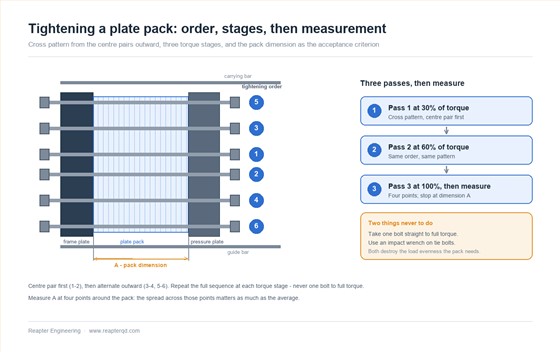
Every frame leaves the factory with a specified plate pack dimension - usually marked as A on the general arrangement drawing and on the nameplate, and measured across the pack between the frame plate and the pressure plate. On some designs the same information appears as exposed stud length. That dimension, not a torque figure, is what the mechanic should be checking: tighten in stages, measure at four points around the pack, and stop when the average matches, with the spread across those points inside a millimetre or two.
Torque tables still have a purpose, because a mechanic needs a number to set the wrench. The trap is treating that number as transferable. The same wrench setting produces very different bolt loads depending on thread friction, and the resulting compression can land outside the design band without anyone noticing. The pack dimension catches that error; torque on its own does not.
Why a torque figure from another frame will hurt you
Bolt load is what compresses the gasket; torque is a friction-distorted attempt to create it. Five things move that relationship, and every one of them is common on site:
| What changed | Bolt load at the same wrench setting | What you see afterwards |
|---|---|---|
| Threads lubricated that were specified dry | Up to 30% higher | Over-compression, gasket extrusion, distorted port lands |
| Dry, corroded or galled studs | Markedly lower | Pack never reaches its dimension, weep at the ports |
| Impact wrench or uncalibrated torque wrench | Scattered by 20% or more, bolt to bolt | Uneven compression, leak at one corner only |
| Reused studs stretched past yield | Falls away as the stud yields | Wrench reads correct, pack keeps relaxing |
| First thermal cycle after assembly | 10 to 15% relaxation is normal | Weep appears a few days after start-up |
Two consequences follow. First, use the frame-specific figure from the drawing or nameplate, never one borrowed from a similar-looking unit - bolt size, stud length, plate count and gasket profile all change the answer. Second, if lubricated threads are intended, the specification has to say so. A mechanic who greases the studs "to help them seat" has just added roughly a third more load to a pack that was already closed.
The order of operations in the field
- Depressurise, drain and vent both sides, and let the pack cool to ambient before touching a nut. Tightening a hot pack is how plates get distorted.
- Open the pack, clear rubber debris from the gasket grooves, inspect the plate lands for creep or cracking around the ports, and clean the studs and nut faces. Friction on a dirty thread makes every torque figure meaningless.
- Confirm plate order and gasket type against the drawing. A plate hung the wrong way round changes the pack dimension and the duty at the same time.
- Close the pack by hand, then run the first pass at about 30 percent of the specified torque, in a cross pattern from the centre pairs outward, alternating top and bottom.
- Repeat the same pattern at about 60 percent, then at 100 percent. Never take a single bolt straight to full torque.
- Measure the pack dimension at four points, check the spread, and continue on the outer pairs only if the average is still above the target.
- Record the final dimension, the torque actually used, the gasket batch and the date. That record is the baseline for the next opening - and the only way to tell a settling pack from a failing one.
- After the first thermal cycle under load, re-torque in the same pattern back to the recorded dimension. Most post-commissioning weeps are relaxation, not failure.
Five field errors that cause repeat leaks
Tightening until the leak stops. A weep caused by a cracked plate or a flattened port land cannot be closed by more load; the extra torque buries the real fault under a distorted pack and makes the next repair harder.
One-pass tightening. Taking each bolt to full torque in turn compresses one side of the pack first. The plates tilt, the port junction at the opposite corner stays under-loaded, and the leak appears where nobody tightened last.
Mixing old and new gaskets. Different free heights at one pack dimension mean one gasket is loose while the next is crushed. Change the whole pack, or accept that the joint will weep.
Greasing the studs to be helpful. Unless the specification asks for it, lubrication adds load the pack was not designed to carry. If it is specified, apply it consistently to every stud - a half-lubricated pack is worse than either extreme.
Skipping the pack measurement. Without it there is no way to separate under-compression from a damaged plate, so the next diagnosis starts from zero.
And the corollary: if the pack dimension is correct, the pattern was followed, and the unit still weeps, stop tightening. The fault lies in the plates, the gaskets or the alignment - a warped pressure plate, a cracked plate at a port, a gasket from the wrong batch, or a plate hung backwards. More torque only converts a repairable fault into a scrapped pack.
Supporting a fleet across sites and borders
For one unit in one plant, all of this lives in a maintenance manual that everyone can find. For a fleet spread over several countries it has to live on the equipment and in the documentation that travels with it: the pack dimension and frame-specific torque marked on the nameplate, the gasket type and plate order on the general arrangement drawing, and a spare gasket set from the same batch held with the unit rather than in a central store three weeks away.
This is the part of the work that is easy to underestimate at quotation stage. Reapter supplies gasketed units with tightening data marked on the frame and issued with the drawing set, plate and gasket sets compatible with the major installed brands so a mixed fleet can be maintained from one spares holding, and engineering support by drawing number for sites commissioning out of hours in another time zone. Send us the frame tag, the plate count and the current pack dimension, and we will confirm the gasket set and the tightening figure for that specific unit.
Common questions
What torque should I use on my plate heat exchanger? The figure for that frame, from its nameplate or drawing - not a generic table. If the documentation is missing, give the manufacturer the frame tag, plate count and measured pack dimension, and ask for the figure in writing.
How do I know when to stop tightening? When the measured pack dimension matches the specified value at four points around the pack, with a small spread between them. Torque is how you get there evenly; the dimension is how you know you have arrived.
Do I have to re-torque after start-up? After the first thermal cycle, yes. Ten to fifteen percent relaxation is normal for a new pack. Re-torque in the same cross pattern back to the recorded dimension, not to a higher torque.
Can I reuse gaskets after opening the pack? Sometimes, if they are undamaged and have taken little set - but never mix reused and new gaskets in one pack, and expect to close to a shorter dimension when you do.
Why does it leak at only one port corner? Almost always uneven compression or a distorted port land at that corner, which the four-point dimension check will show. If the dimension is even, look for a cracked plate.
Conclusion
A plate pack is a stack of compression joints, and compression - not torque - is what keeps them sealed. Measure the dimension, tighten in stages from the centre outward, record what you did, and re-torque once after the first heat cycle. Reapter builds gasketed plate heat exchangers for export and retrofit work with the tightening data marked on the frame and gasket sets supplied against the drawing number. Send us your duty, or the details of the frame you already have, and we will come back with the plate pack and the documentation to maintain it.
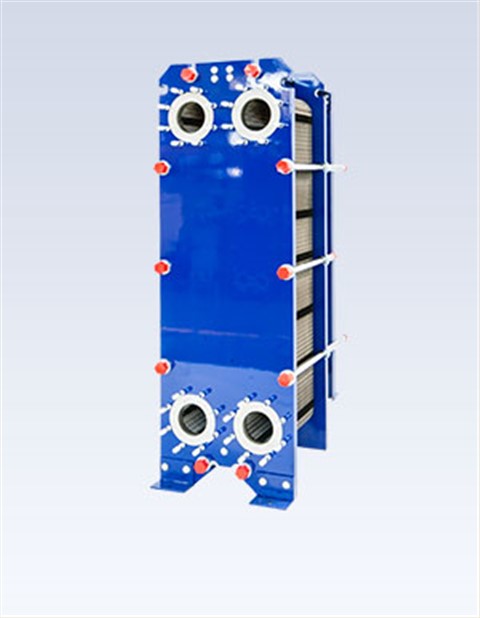 Food grade plate heat exchanger
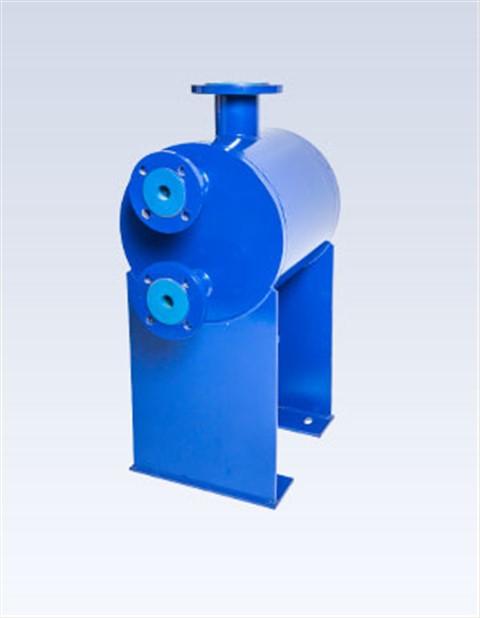 Plate And Shell Heat Exchanger