

A spare part you cannot get is a shutdown, not an inconvenience
A gasketed plate heat exchanger is one of the few items of process equipment that can be repaired in a single shift — provided the plate or gasket is already within reach. The same failure, on a plant that has nothing on the shelf, converts a two-day maintenance job into a four-to-ten-week outage while a pressed plate and a moulded gasket travel from a factory to a site that may be on another continent.
That asymmetry is the whole argument for a spares strategy, and it is why the strategy is not a purchasing question. It is a question about lead time: how long each class of part actually takes to reach your store, how much of the plant stops if it is missing, and how much of that wait a modest holding can delete. Plants that get this right rarely spend more on spares. They spend it earlier, on the items that sit on the critical path.
What actually fails, and in what order
Spares planning starts with an honest failure order, because the first wear item is the one worth stocking.
- Gaskets — the first item to go, and the one that decides most unplanned outages. The elastomer hardens and takes a permanent set under compression; eventually it stops following the groove as the pack breathes through thermal cycles. Field life is typically five to ten years on benign duties and considerably shorter on hot water, steam and aggressive media. A gasket failure shows up as a weep at the frame, a crossover between channels, or a visible bulge at the plate edge — all of which need the unit opened, not adjusted.
- Plates — lose performance to fouling long before they fail mechanically, and fouling is fixed by cleaning, not by stock. The spares case is different: pinholes from chloride corrosion, cracks radiating from the port area after water hammer, and erosion at the inlet where suspended solids concentrate. One perforated plate puts both media in contact and cannot be waited out.
- Port collars and liners — usually destroyed during disassembly rather than in service. Cheap, small, and the reason a planned two-day job runs into a third day.
- Tie bolts — rarely fail in service, but threads are easily damaged during a rebuild, and a single stretched or cross-threaded bolt keeps a torqued pack from being closed properly.
Note what is missing from that list: the frame. Frames are built to outlast several plate packs, which is precisely why the plates and gaskets must be treated as consumables with a stocking policy rather than as spares to be ordered when needed.
The three clocks you are really managing
Every spares decision is a comparison between three clocks that run at very different speeds.
Manufacturing. A plate pressed from an existing pattern is a matter of days once the order is released. A gasket moulded in an available mould is similar. Neither is true if the pattern or the mould has to be identified, drawn or made — and neither starts until someone has correctly established which plate the unit actually contains.
Freight and clearance. Air freight turns weeks into days at a cost that rarely matters against a stopped production line, but it still needs a commercial invoice, a customs code and a broker who is awake. Sea freight is the economical choice and the one that quietly sets the real planning horizon: port to port, plus inland legs, plus clearance, plus the site's own receiving routine.
The shutdown window. This is the shortest clock and the only one you control. Most plants can give a heat exchanger one to three days inside a planned outage; very few can give it six weeks at short notice. A part held on site collapses the first two clocks to zero, and that is the only reason holding stock works.
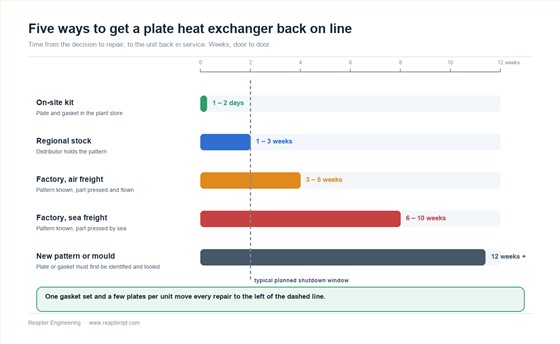
The lesson from that chart is not "hold everything". It is that there is a wide, cheap band in the middle: a single gasket set and a handful of plates move a unit from the right-hand end of the chart to the left, and cost a small fraction of the exchanger.
How many plates and gaskets to hold
Stocking levels should follow criticality, not the size of the unit. A small exchanger on a single-train process with no bypass is a far better candidate for a full kit than a large one that sits in a duplicate pair.
| Item | Working rule | Why this level |
|---|---|---|
| Gasket set | One full set per unit; add 10 % of plate count on critical units | First wear item, and the only part that stops the plant without damaging anything else |
| Plates | 2 – 5 % of installed plate count, minimum two per pass | Covers corrosion pinholes and handling damage; a damaged plate is replaced, not repaired |
| Port collars / liners | One set per unit | Consumed during disassembly, not in service; low cost, high nuisance value |
| Tie bolts | Two per unit, correct length | Thread damage during rebuild is the most common reason a pack cannot be closed |
| Complete spare pack | Single-train units without bypass only | The only configuration where a swap beats a repair, because there is no window to wait in |
Two disciplines keep those numbers honest. First, spares must be built to the installed pattern — a plate is interchangeable only if the corrugation, the port layout, the thickness and the gasket groove all match what is in the frame. Second, the kit has to be counted as inventory with a date on it, not treated as an untouchable shrine; a gasket set that has sat on a shelf for twelve years is not a spare, it is a delay waiting to happen.
Storage is where spare parts quietly die
Elastomers age in storage whether or not they are used. Oxygen, ozone, ultraviolet light and heat attack the polymer continuously, and a gasket that has spent a decade in a hot, sunlit store can be harder, less elastic and already set in the wrong shape before it is ever compressed.
The mechanism is the same one that ends a gasket's service life — oxidation of the polymer backbone, accelerated by temperature — which is why storage temperature dominates everything else. As a working rule of thumb, every 10 °C reduction in storage temperature roughly doubles the useful shelf life of an elastomer. A store held at 15 °C instead of a shed at 35 °C is not a marginal improvement; it is the difference between a spare and a decoration.
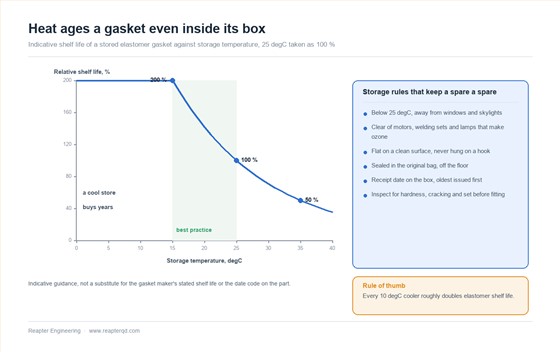
The practical rules are unglamorous and all of them matter:
- Cool and dark. Below 25 °C, away from windows and skylights. Heat and ultraviolet light both accelerate ageing.
- Away from ozone. Electric motors, welding sets, mercury lamps and some cleaning chemicals generate ozone that attacks elastomers at the surface.
- Flat, not hung. Gaskets and plate-and-gasket assemblies stored on hooks or leaning against a wall take a permanent set. Store flat, on a clean surface, with nothing stacked on top.
- In the original packing. Sealed bags keep out dust, oil mist and light, and keep the part identifiable.
- Dated and rotated. Write the receipt date on the box and issue oldest first. A spare that is never rotated is a spare that expires.
- Inspect before use. Check for hardness change, surface cracking, white bloom and permanent deformation. If the gasket no longer lies flat, it has already told you the answer.
Documentation: the part you cannot order without
The most common cause of a wrong spare is not a supplier error. It is a plant that cannot say what is inside its own frame. Record the following before you need it, not during the outage:
- Nameplate data — model, serial number, year of manufacture, design pressure and temperature, test pressure, surface area, connection sizes. One clear photograph of the plate, kept in the maintenance file and in the site's document system.
- Plate identification — pattern code, plate thickness, material grade, plate count per pass, and the elastomer specification. A photograph of the corrugation from both sides, taken at the last strip-down, answers most identification questions on its own.
- The pack dimension — the measured distance between the fixed and movable covers with the pack fully tightened, recorded before the unit is opened. Restoring that dimension on reassembly is the difference between a leak-free pack and a guessing game with a torque wrench.
- Gasket type and attachment — glued, clipped or snap-in, and the groove profile. These are not interchangeable, and the wrong one will not seat however hard it is pressed.
What a supplier across borders has to be able to do
Spares support is a service question before it is a price question, and the difference shows up in the parts of the job that happen before the part ships.
- Identify a plate from evidence. A nameplate photograph, a rubbing of the corrugation, or a few critical dimensions should be enough for a competent supplier to confirm the pattern and quote — without the original purchase order.
- Supply to the installed pattern, and say so in writing. A dimension report with the quotation removes the argument that follows a part that does not fit.
- Hold patterns and moulds, not just catalogues. A supplier who can press a plate and mould a gasket to an installed pattern converts a six-week replacement into days, and can keep the same part number valid across a fleet of identical units in different countries.
- Pack for the journey. Plates crated on edge and protected at the ports, gaskets flat and unweighted, plate-and-gasket assemblies tied as a unit. Freight damage is not covered by a warranty argument in the middle of an outage.
- Ship documentation that clears customs. Commercial invoice, packing list, country of origin and the customs code for the part, in a language the broker can read.
- Answer technical questions after the sale. Torque and pack-dimension guidance, review of photographs from site, commissioning support and a view on why the part failed in the first place — the last one being the only way a spares policy improves over time.
Common questions
How many spare gaskets should a plant keep for a plate heat exchanger? One full set per unit is the minimum on any exchanger that matters, plus around 10 % of the plate count on single-train units. Gaskets are inexpensive relative to the outage they prevent, and they are the item most likely to be needed first.
Can gaskets be stored for years? Yes, under the right conditions — cool, dark, dry, flat, away from ozone, in the original packaging. Under poor conditions the useful life is much shorter, because heat and light continue to age the elastomer in the box. Date every gasket and rotate stock oldest first.
Do I need spare plates or a complete spare pack? Spare plates cover the common case: a pinhole, a bent plate at reassembly, a fouled pass that cannot be cleaned. A complete spare pack is justified only where a single unit has no bypass and no duplicate, so that a swap is the only way to keep the plant running.
Can plates from a different supplier be mixed into my frame? Only if they are made to the same pattern, thickness and port geometry as the installed pack. Plates that look similar but carry a different corrugation angle will not share flow evenly, and the mismatch shows up as a duty shortfall or a local hot spot rather than as an obvious fault.
How do I order a plate when the nameplate is gone? Measure the plate — overall length and width, port spacing and diameter, corrugation depth and pitch, thickness — and photograph or rub the chevron pattern. That set of data identifies the pattern in most cases, and it is worth collecting once, calmly, rather than at the start of an outage.
Conclusion
A spares policy is a lead-time calculation disguised as a purchasing decision: identify what fails first, measure how long each class of part takes to arrive, and hold just enough to pull the repair back inside the shutdown window you actually have. The parts are cheap; the wait is not. Reapter supplies gasketed plate heat exchangers, replacement plates and gaskets built to the installed pattern, and works with operators worldwide on spares planning, plate identification from site evidence and pack-dimension records. If you are reviewing a spares list or trying to identify plates in an existing frame, contact us with the nameplate details or a photograph of the pack and we will come back with the pattern and a quotation.
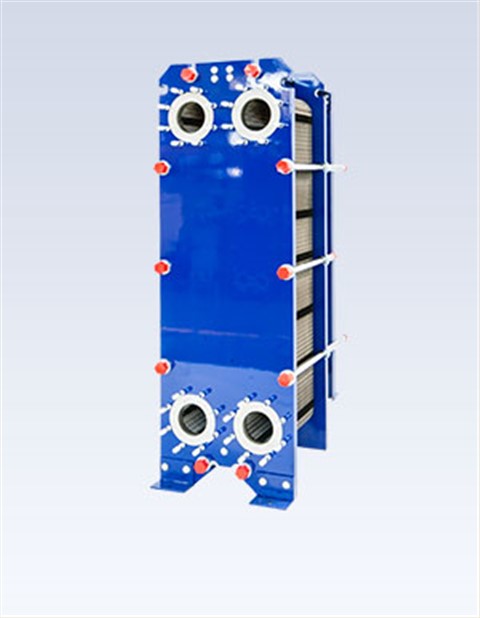 Food grade plate heat exchanger
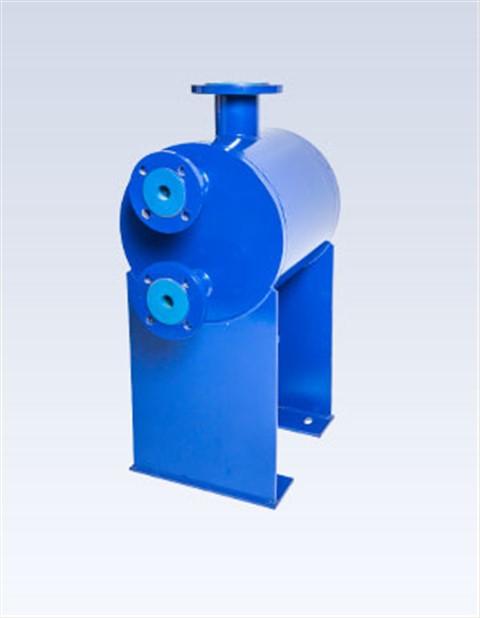 Plate And Shell Heat Exchanger