

Three symptoms, three different fault families
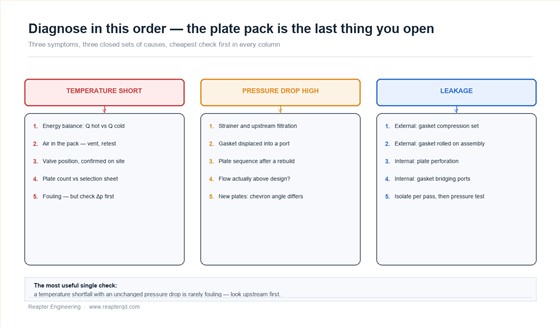
Almost every plate heat exchanger complaint arrives as one of three sentences: "it isn't reaching temperature", "the pressure drop has gone up", or "it's leaking". Each of them points at a small, closed set of causes — and the causes are not interchangeable. A unit that is short of temperature is rarely also short of flow, and a unit with rising pressure drop is almost never suffering from a plate perforation. Separating the symptom correctly at the start saves the most expensive step in any investigation: opening the pack.
This guide works through the three families in the order a plant engineer meets them, cheapest check first, and it flags the specific junctions where the wrong diagnosis leads to a wrong repair — the case where fouling is assumed, the unit is cleaned, and the shortfall remains because the real cause was a reverse-mounted plate or a swollen gasket bridging two ports.
Before anything: establish what changed
A heat exchanger does not drift. It either never worked, or something changed. That single question splits the whole investigation:
| History | Implies | First action |
|---|---|---|
| Never met duty since commissioning | Selection, installation or assembly error | Check plate count against the selection sheet; check flow direction against the drawing |
| Worked, then degraded gradually over weeks | Fouling, scaling or gasket swelling | Compare pressure drop and outlet temperature trend against the commissioning log |
| Worked, then failed suddenly | Blockage, valve, pump, or a mechanical event | Check strainers and valve positions before touching the exchanger |
| Worked, then failed after maintenance | Assembly error — plate order, gasket seating, or plate count | Compare the pack against the plate sequence drawing |
The fourth row is underrated. A large share of "the exchanger has failed" calls arrive within days of a regasketing or a cleaning, and the answer is usually a plate turned the wrong way round, an end plate swapped for a middle plate, or two gaskets of different hardness mixed into the same pack.
Symptom A: outlet temperature short of set point
The instinct is to blame fouling. Work through these in order instead, because three of the five cost nothing to check.
1. Is the primary side actually delivering what it says? Compare the hot inlet temperature and flow against the design. A heat exchanger cannot produce a cold outlet below what the hot inlet and the flow ratio allow — check the energy balance first: if the duty computed from the hot side does not match the duty computed from the cold side, the problem is upstream metering or a bypass, not the exchanger.
2. Is there air in the unit? High-point air pockets reduce effective area and produce a shortfall that looks exactly like fouling but appears and disappears with flow changes. Vent, then re-check. Symptoms that vary with pump switching are usually air.
3. Is the flow going where the drawing says? Reversed connections on a multi-pass unit, or a partly closed isolation valve left over from maintenance, both produce a clean-looking but underperforming unit. Confirm valve position physically, not from the control room screen.
4. Is the plate count what the selection specified? Count the plates. It takes twenty minutes and it settles the question permanently. A pack assembled one plate short, or with the two end plates missing, loses more area than a year of moderate fouling.
5. Only now suspect fouling. And when you do, confirm it from pressure drop rather than from temperature alone: fouling raises pressure drop and lowers U. A temperature shortfall with an unchanged pressure drop is rarely fouling.
That last point is the most useful diagnostic in this article. Fouling and reduced area both lower outlet temperature, but only one of them leaves the pressure drop alone.
Symptom B: pressure drop higher than design
Pressure drop reads the geometry of the flow path. When it rises, something has changed the path.
| Cause | Signature | Action |
|---|---|---|
| Scaling or fouling film | Gradual rise over weeks, U down at the same time, worse on the cooling-water side | Clean in place; review water treatment and velocity |
| Particulate blockage at the ports | Sudden rise, often on one side only, strainer also dirty | Backflush; check strainer mesh and upstream filtration |
| Gasket displaced into the port | Sudden rise after regasketing, one side | Open, reseat the gasket; replace if deformed |
| Plates installed reversed or in the wrong order | Rise from first start-up after maintenance | Rebuild to the plate sequence drawing |
| Flow actually higher than design | Rise with U also higher, temperatures better than expected | Not a fault — re-rate the unit or trim the pump |
| Wrong plate: different chevron angle | Rise after plates were replaced from a third party | Verify plate part number against the original |
The last two rows are worth separating from the rest, because both are frequently misdiagnosed as fouling. If a unit's pressure drop rose but its thermal performance improved, nothing is blocked. And if a unit's pressure drop rose immediately after replacement plates were fitted, the plates are the suspect — a harder chevron angle gives more turbulence, more U and more pressure drop, all at once.
Symptom C: leakage
Two different failures hide under one word, and they have nothing in common.
External leakage — fluid to atmosphere, visible at the frame or between plates. Causes are gasket-related: compression set after years at temperature, chemical swelling, a gasket rolled or pinched during assembly, or insufficient tightening after a rebuild. The diagnostic is visual and, in most designs, the leak appears at the lowest point of the plate pack. Tightening to the specified dimension rather than to a torque figure resolves most of these; over-tightening is a common second fault that deforms gaskets and makes the next rebuild harder.
Cross-contamination — one fluid entering the other. This is far more serious, and it is the one that damages product, not just equipment. Two mechanisms produce it: a plate perforation, usually chloride stress-corrosion cracking on stainless in a warm chloride environment, or a gasket that has failed between two adjacent ports so that the two circuits communicate internally without any external sign. Distinguishing them requires isolation and pressure testing per pass; the sequence is set out in diagnosing cross-plate leakage.
The operating condition that most often precedes a perforation is not a bad plate — it is a unit run outside its chloride and temperature envelope, or one that was repeatedly cleaned with an inappropriate chemical. Material selection is the prevention, and the boundaries are set out in material selection from 316L to Hastelloy.
What not to do
Do not open the pack to investigate a temperature shortfall. Confirm flow, air, valve position and plate count first. Opening costs gaskets, and a pack that has been opened twice in a season is more likely to leak than one that has not.
Do not clean as a first response to rising pressure drop. Confirm the cause. Cleaning a unit whose pressure drop rose because a gasket moved into the port will not change anything, and the chemical exposure costs gasket life.
Do not re-torque to stop a leak on a hot unit. Tighten at ambient, to the dimension on the drawing. Hot tightening produces uneven compression and a pack that leaks again on cool-down.
Do not replace plates one at a time. Mixed plate ages, mixed chevron angles and mixed gasket hardness in one pack produce a unit that behaves unpredictably and cannot be diagnosed afterwards.
FAQ
The outlet temperature is low but the pressure drop is normal. What is it? Look upstream: primary flow, primary temperature, air, or a bypass. A genuine loss of area — fouling or missing plates — almost always shows in pressure drop too.
Pressure drop rose after cleaning. Why? Usually plates reassembled in the wrong order or reversed, or a gasket partly covering a port. Occasionally the cleaning removed a fouling layer that had been acting as a smooth liner over a roughened surface.
Can I run with one plate removed to reduce pressure drop? No. Removing plates reduces area and changes the channel geometry; it will not restore the duty and it invalidates the pressure rating.
How often should gaskets be replaced? On condition, not on calendar, but expect 8–12 years at moderate temperature and considerably less above 130 °C. Track leak history per unit and replace when the interval starts shortening. Our note on spare parts strategy covers how to hold stock against real lead times.
Diagnose first, then buy parts
Reapter supplies replacement plates, gaskets and complete packs for gasketed, semi-welded and welded units, and we would rather help you confirm the cause than sell a pack that does not fix it. Send the symptom, the operating history and the plate sequence drawing if you have one — we will tell you what to check before anything is ordered. Send the details.
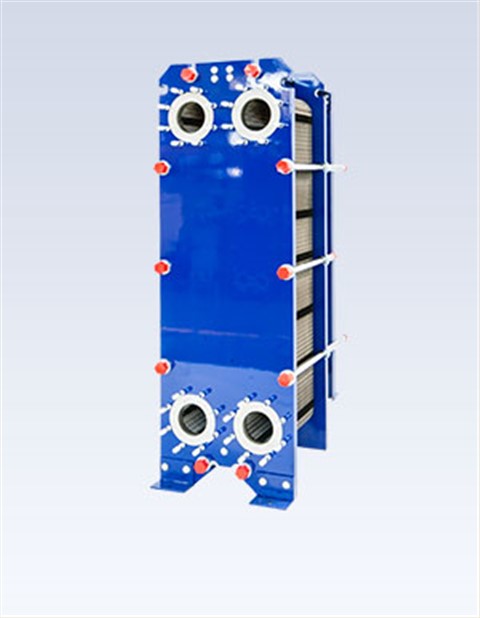 Food grade plate heat exchanger
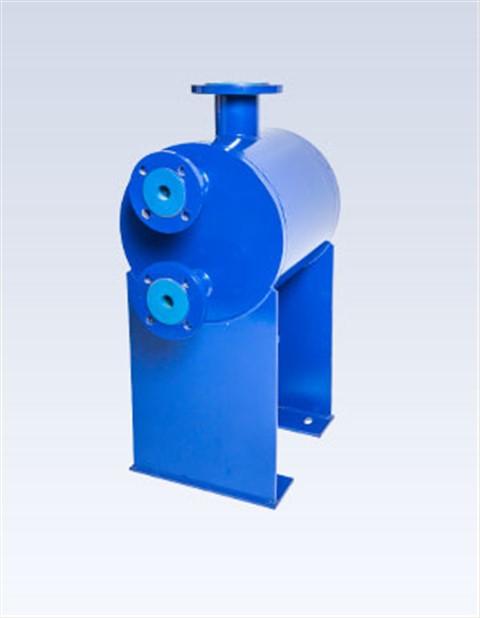 Plate And Shell Heat Exchanger