

The duty sets the area; the water sets everything else
Two enquiries can arrive on the same day with identical thermal duties — same flows, same temperatures, same kilowatts — and correctly end up with different plate materials, different channel geometry, different cleaning intervals and very different service lives. The difference is not the duty. It is the water. A plate heat exchanger has channels two to five millimetres wide and a gasket running the full perimeter of every plate, so it is far more sensitive to water chemistry than a shell-and-tube unit with 20 mm tubes and welded joints. That sensitivity is a design input, not a warranty conversation two years after start-up.
The water analysis is a specification document, not a formality
Most enquiries arrive with a duty sheet and, at best, the word "water" in the fluid column. Ask instead for a recent analysis — under twelve months old and taken from the actual circuit, not the plant's incoming mains — covering hardness and alkalinity as CaCO3, pH, chloride, sulphate, silica, iron, manganese, TDS or conductivity, suspended solids or turbidity, and any oxidant residual such as free chlorine. Add the operating temperature range for both circuits, because several of these parameters only become a problem when they meet a hot surface. Two cautions: water chemistry drifts as aquifers are drawn down, as surface sources turn turbid after storms, and as closed loops concentrate; and a unit on a treated closed loop is not the same application as one on once-through river water, even when the duty sheet looks identical.
Seven numbers that change the specification
Not every line of a lab report matters equally. In practice these seven drive most of the decisions, and each maps to a lever the designer can pull.
| Parameter | Why it matters | What it changes |
|---|---|---|
| Hardness and alkalinity | With pH and temperature they set the scaling potential at the plate surface | Velocity floor, hot-side temperature limit, cleaning interval |
| Chloride | Drives pitting and stress-corrosion risk, most severely at higher temperature | Plate alloy: 316L, duplex, high-alloy austenitic or titanium |
| Silica | Forms a glass-like scale that ordinary acid cleaning does not remove | Hot-side temperature limit, cleaning chemistry, pre-treatment |
| Iron and manganese | Precipitate as deposits that seed under-deposit corrosion | Upstream filtration, inspection frequency |
| Suspended solids | Physically bridge narrow channels; chemical cleaning alone will not clear them | Wide-gap plate pattern, strainers, backflush routine |
| Conductivity / TDS | Proxy for ionic load; high values raise corrosion rate and biological activity | Material grade, inhibitor programme, monitoring interval |
| Oxidant residual | Free chlorine and similar oxidants attack elastomers and can pit stainless steel | Gasket elastomer and maximum continuous residual |
Hardness is a concentration; scaling is a temperature problem
The most common error is to treat hardness as a stand-alone verdict: below a number the unit is "fine", above it the client is told to buy a softener. Hardness says how much scale-forming mineral is present; it does not say whether that mineral will deposit. Deposition depends on the saturation state of the water, commonly expressed as the Langelier or Ryznar index, which combine pH, calcium hardness, alkalinity, dissolved solids and temperature. A water can be hard and stable, or moderately hard and aggressively scaling, depending on the other five.
Temperature is the part routinely overlooked. Indices are usually calculated at bulk water temperature, but scale forms on the plate surface, and on the heating side the plate runs hotter than the bulk. Calcium carbonate becomes less soluble as temperature rises, so a water that is undersaturated in the bulk can be supersaturated at the wall — and the wall is the only place that matters.
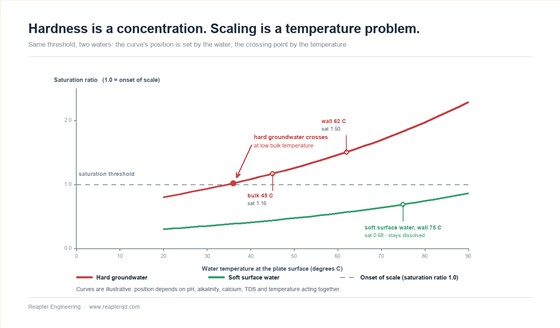
Where the analysis shows a water near saturation and the duty needs a high wall temperature, the specification should limit the hot-side temperature, raise velocity to keep the surface swept, or accept a shorter cleaning interval — and state which, so the operator knows what the design assumes.
Regional water profiles: the same unit, four different outcomes
Because Reapter supplies units into projects across Europe, the Middle East, Southeast Asia, Africa and the Americas, we see the same duty specified against very different waters. These patterns are general tendencies, not rules, but they explain why a design that performs well in one market can disappoint in another.
| Water source | Usual character | Typical consequence for the specification |
|---|---|---|
| Soft surface water (northern Europe, upland sources) | Low hardness, low chloride; seasonal turbidity and organic load | 316L normally adequate; fouling is particulate and biological, so strainers and backflush matter more than scale control |
| Hard groundwater (arid regions, parts of the North China plain, Middle East, US Midwest) | High hardness and alkalinity, elevated TDS, often measurable silica | Higher velocity floor, low hot-side wall temperature, planned chemical cleaning; silica rules out simple acid washing |
| Coastal, estuarine and brackish water | Chloride from a few hundred to several thousand mg/L, rising with temperature | High-alloy stainless or titanium, careful gasket selection, strict attention to stagnation and crevices |
| Well water with iron and manganese | Dissolved metals that oxidise on contact with air or oxidant | Upstream filtration, wider channels, frequent inspection for under-deposit corrosion |
| Softened, demineralised or condensate circuits | Very low hardness and conductivity, sometimes unstable pH | Scaling is not the risk; corrosion and erosion-corrosion are, so material and pH control get the attention |
| Cooling tower and recycled water | Cycles of concentration raise hardness, chloride and biological load together | Water treatment is part of the exchanger specification; oxidant residual must match the gasket |
This is where service geography becomes an engineering issue rather than a sales one. A unit specified for soft European surface water and installed on hard groundwater will not fail because it was badly built; it will foul because the specification was written for a different water. Collecting the analysis at enquiry stage — and asking again at order stage if months have passed — avoids that entirely.
Velocity and materials: the two levers the water actually sets
Once the plate pattern and duty are fixed, channel velocity decides whether deposits stay suspended or settle. A "low pressure drop" design running at 0.3 m/s meets its hydraulic guarantee on day one and then loses capacity steadily in any water carrying hardness or solids. As a working rule, fouling-prone waters call for roughly 0.5 m/s and, on the worst duties, closer to 0.8 m/s. The ceiling is set by erosion and corrosion: standard stainless packs are generally kept below about 2.5 to 3 m/s, lower where chloride is high or solids are abrasive. Velocity is bought with pressure drop and pumping energy, so it is a real trade-off — but it must be a deliberate one, resolved by whoever holds both the duty sheet and the analysis.
Type 316L is the sensible default for treated water and covers most HVAC, process cooling and district heating duties. It is not universal: as chloride and temperature rise together, pitting and chloride stress-corrosion cracking take over, and the answer moves to a higher-alloy austenitic, a duplex grade or titanium. Published chloride limits vary between sources and depend strongly on temperature, pH and oxygen, so compare the site analysis against the alloy supplier's charts at the actual wall temperature, not at ambient. Gaskets follow the same evidence: EPDM covers water and steam duties well, NBR is used where oils are present, and where continuous chlorination is part of the water treatment the elastomer's oxidant resistance — not its temperature rating — often sets its life.
What to trend after start-up
A water analysis predicts; instrumentation confirms. Two measurements tell you whether the specification matched the water: pressure drop across each circuit, and the temperature approach between the streams. Record both at commissioning, on a clean unit, at a known flow rate — that baseline is what every later reading is compared against. Without it an operator has a number but no reference.
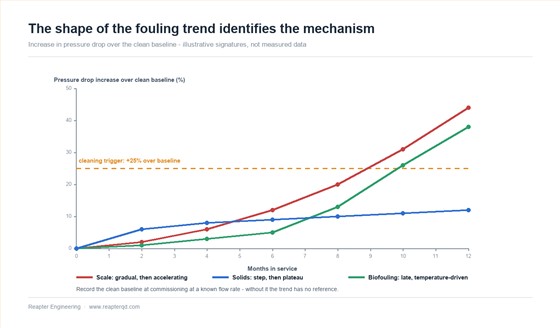
The shape of the trend identifies the mechanism, which in turn tells you whether cleaning will help. A common working trigger is to clean when pressure drop reaches about 1.25 times the clean baseline, or when the approach temperature has widened by two to three kelvin at the same duty — early enough to restore performance with a routine clean rather than a dismantling and re-gasketing job.
A practical sequence
- Get the analysis from the right point. Actual circuit, under twelve months old, sampling point stated, both circuits if they differ.
- Calculate saturation at wall temperature, not bulk temperature, using the real duty and hot-side conditions.
- Select the alloy against chloride and temperature together, never a single ambient-temperature limit.
- Set the velocity floor from the fouling risk, then check the resulting pressure drop is acceptable — and record the agreement.
- Select the elastomer against chemistry as well as temperature, and state the maximum continuous oxidant residual the specification assumes.
- Write the monitoring plan into the handover. Clean baseline, cleaning trigger, and who reads the gauges. A design that depends on cleaning only works if somebody is scheduled to notice.
Common questions
Can we install a water softener and use a standard unit? Often yes, and it is frequently the cheapest answer for a hard-water site — provided the softener is sized for full flow and maintained. Specify the exchanger for the softened water, not the raw water, and remember that softened water keeps its chloride while losing hardness, so it is not automatically less corrosive.
How often should we clean? Base it on the trend, not the calendar. A unit on soft surface water may run several seasons; a hard-water unit at high wall temperature may need one or two chemical cleans a year. The baseline and the 1.25 trigger turn this from a guess into a decision.
High chloride — do we have to go to titanium? Not automatically. Chloride acts together with temperature, pH and oxygen, and duties with several hundred mg/L can be served by a high-alloy austenitic or duplex grade. The decision needs the wall temperature and the alloy supplier's data; titanium is the conservative answer where chloride is high and temperature cannot be limited.
What if the client cannot provide an analysis? Then write the assumption into the specification: "316L with a 0.5 m/s velocity floor, pending analysis; re-check on delivery of the water report." Stating it protects both sides. Designing silently for unknown water is how a unit ends up oversized, undersized or fouled within a year.
Conclusion
A plate heat exchanger is only as good as the water it is asked to handle, and the water analysis is the document that connects the two. Read at wall temperature, it tells the designer what the plates should be made of, how fast the water must move, which elastomer can survive, and how often the unit will need attention — decisions that are cheap before the order and expensive afterwards. Reapter works with project teams from soft northern European surface water to hard groundwater and coastal sites, and we build the specification around the analysis rather than around a catalogue page. Send us your duty and your water report, and our engineering team will tell you what the combination actually requires.
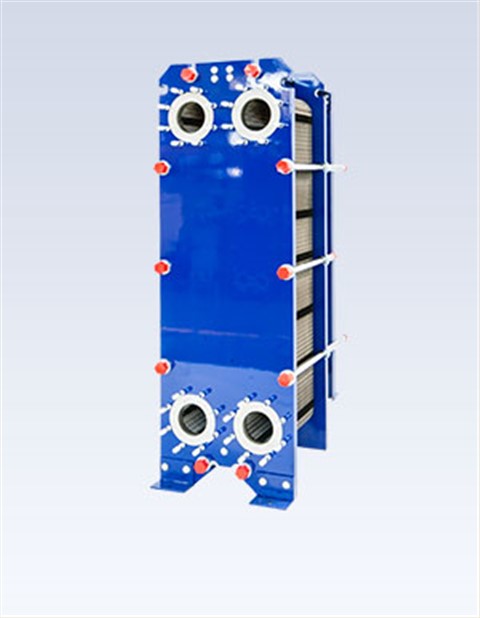 Food grade plate heat exchanger
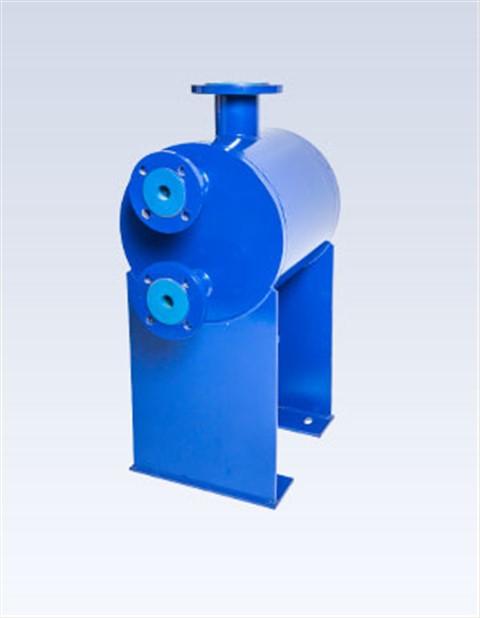 Plate And Shell Heat Exchanger