

Above 100 °C the constraint moves to the working fluid and the seals
Electrifying process heat is no longer a research question — it is a procurement question, and the temperature most industrial processes actually need sits between 100 and 200 °C: drying, pasteurisation, CIP, distillation reboilers, laundries, paper machine hoods. Below 100 °C the technology is mature and the argument is payback. Above 100 °C the argument changes: the compressor becomes a specialist item, the working fluid narrows to a handful, and the heat exchangers on both sides start to set limits that water-based heat pump design never had to consider.
Two of those limits are ours to talk about. The condensing side must deliver 120–180 °C into a fluid that may be water, steam or a thermal oil, and the seals and plates have to survive it for twenty years without being the reason the machine stops. The approach temperature also costs more here than anywhere else, because the lift being bought is large and every kelvin of it is paid for in compressor power at every operating hour.
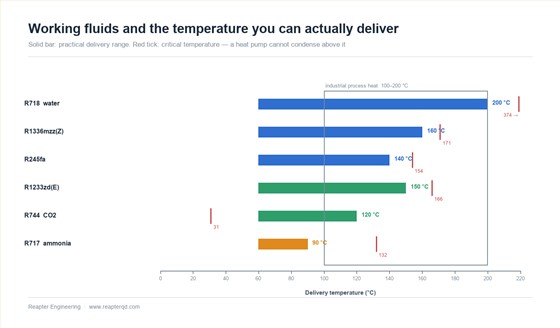
The fluids that can actually get you there
A heat pump cannot condense above its own critical temperature, so the deliverable temperature of any cycle is capped by the fluid. In practice you need 15–30 K of margin below the critical point to condense stably at all.
| Working fluid | Normal boiling point | Critical temperature | Practical delivery ceiling | Where it fits |
|---|---|---|---|---|
| R717 (ammonia) | ?33.3 °C | 132.3 °C | ~90 °C | Excellent efficiency, but the ceiling rules out most steam replacement |
| R744 (CO2) | ?78.5 °C (sublimes) | 31.0 °C | ~120 °C | Transcritical; large glides, high pressure, strong for high lift |
| R245fa | 15.3 °C | 154.0 °C | ~140 °C | Established HFC, being phased down in new equipment |
| R1233zd(E) | 18.3 °C | 165.6 °C | ~150 °C | Low pressure, low GWP, the current default for 120–150 °C |
| R1336mzz(Z) | 33.4 °C | 171.3 °C | ~160 °C | Higher ceiling, dry fluid, good high-side stability |
| R718 (water) | 100 °C | 373.95 °C | ~200 °C | Steam-generating; enormous volumetric flow, centrifugal or high-speed turbo compressor |
Values are the accepted reference figures; the delivery ceiling is an engineering judgement that leaves room for stable condensation and reasonable compressor pressure ratio, not a thermodynamic limit. It is also where most system studies stop being theoretical — above about 150 °C the practical choice narrows to steam-generating cycles or a small number of high-temperature organics, and the capital cost curve steepens accordingly.
Why the approach temperature matters more here than in a chiller
In a comfort chiller, 1 K of extra approach costs a fraction of a percent of efficiency and nobody notices. Here it is different, because the lift is large and the compressor is working across the whole of it. Two effects compound:
- The lift itself. A 150 °C delivery from a 60 °C source is a 90 K lift. Adding 3 K of approach on the condensing side adds 3 K to that lift — roughly 3 % more pressure ratio, and the power penalty scales with it.
- The location of the approach. On a high-lift cycle, condensing-side approach is worth more than evaporating-side approach in absolute COP terms, because the condensing pressure is the high-pressure side and the compressor work is proportional to the ratio, not the difference.
The consequence for selection is that a high-temperature heat pump should be specified with a tighter approach than the same duty in a chiller — 1–1.5 K on the condensing side is normal, not ambitious — and the exchanger cost that buys it is repaid in electricity. The general trade is set out in how close an approach is practical; at 150 °C delivery the answer is: closer than you would normally accept, and the plate is where you spend the money.
The three exchanger positions in a high-temperature cycle
The desuperheater. Compressor discharge leaves far above condensing temperature — 40 to 80 K of superheat is normal on a high-lift cycle. That superheat is 15–25 % of the total heat rejected and it is available at the highest temperature in the system, which makes it the cheapest heat to recover and the most valuable: it can preheat a process stream to within a few kelvin of delivery temperature without touching the condensing duty. A separate desuperheater exchanger, or a dedicated zone in the condenser, is almost always worth it at these temperatures.
The condenser. This is the unit that has to hold the delivery guarantee. Three selection points dominate:
- Pressure containment. Transcritical CO2 runs at 90–120 bar on the high side; HFOs run at 15–30 bar; water vapour runs at low pressure but with very large volumes. The construction follows the pressure, not the temperature.
- Thermal expansion and cycling. A high-temperature unit cycles more and hotter than a chiller. Gasketed construction with a 150 °C EPDM gasket is at its limit; above 130 °C the default should be semi-welded or fully welded, which removes the elastomer from the high-temperature boundary entirely.
- Two-phase distribution. Condensing in a plate pack distributes well over a wide flow range, which is why plate units are preferred over shell-and-tube here — but the port arrangement has to be checked for the vapour fraction at part load, not just at design.
The evaporator. Usually the simpler of the two, and the one where the source-side fluid matters most. Waste heat at 40–60 °C is often available as a dirty or fouling stream — cooling tower water, dryer exhaust condensate, plant cooling water — and a wide-gap or semi-welded unit may be needed to keep the pass available without frequent cleaning.
Seals and materials at 130 °C and above
This is where high-temperature projects fail in year three rather than year one. Elastomer life falls steeply with temperature, and the failure is not gradual.
| Gasket material | Continuous limit in water / steam | Comment |
|---|---|---|
| NBR | ~110 °C | Fine for the evaporator, not for the condenser |
| EPDM | ~150 °C | Best general high-temperature choice for water and steam; swells in oils and many organics |
| HNBR | ~160 °C | Better mechanical strength than EPDM at temperature; narrower chemical range |
| FKM (Viton) | ~180–200 °C | High cost; poor in hot water and steam, excellent in oils and many refrigerants |
Two rules follow. First, the gasket limit is a continuous-duty limit at the metal temperature, and in a condenser the metal sits within a kelvin or two of the fluid — there is no thermal hiding place. Second, above about 130 °C the right answer for most duties is not a better elastomer but no elastomer: semi-welded or fully welded construction moves the sealing problem to a weld that does not age.
On the plate side, 316L is adequate for clean high-temperature water and steam; the constraint is chloride, and high-temperature chloride is exactly the condition that produces stress-corrosion cracking. Where the water chemistry is uncertain, specify the higher-alloy plate rather than plan to monitor it. The boundaries are set out in material selection from 316L to Hastelloy.
Steam generation is a different problem
Producing hot water at 150 °C in a plate exchanger is routine. Producing steam in one is not: as the fluid crosses saturation, the volume expands by orders of magnitude inside a narrow channel, and the result is flow instability, dry-out and thermal fatigue unless the unit is designed for it. Practical steam-generating installations use falling-film evaporators, forced-circulation arrangements, or a plate unit operated with a controlled recirculation ratio and a separator — and they are specified by specialists, not selected from a catalogue.
If the process needs steam rather than pressurised hot water, the honest engineering question is whether it needs steam at all. A pressurised hot water loop at 150–180 °C replaces low-pressure steam in most drying, heating and CIP duties with a simpler, cheaper and more efficient system, and it keeps the heat exchanger inside the range where plate technology is straightforward.
FAQ
What is the realistic maximum delivery temperature for a plate heat exchanger in a heat pump? For gasketed units, about 150 °C with EPDM. Welded and semi-welded units reach higher on the exchanger side, but the practical ceiling is set by the working fluid, not the exchanger — roughly 120 °C with CO2, 150 °C with R1233zd(E), 160 °C with R1336mzz(Z) and up to 200 °C with water as R718.
Can I use a brazed unit for a high-temperature heat pump? Usually not above about 150 °C, and the copper-brazed construction is incompatible with ammonia. Brazed units suit smaller capacities and lower temperatures; see gasketed versus brazed for the boundary.
Does the condenser need to be a separate exchanger from the desuperheater? Not necessarily, but a divided condensing duty with a dedicated desuperheat zone gives better control and lets you recover the highest-grade heat separately. At large capacities the extra exchanger usually pays for itself.
How much does 1 K of condensing approach cost? Typically 2–3 % of compressor power at a 90 K lift. Run the number for your electricity price and operating hours before you decide the tighter, more expensive exchanger is not worth it — in most high-temperature projects it is.
Specify the exchanger for the cycle, not for the duty
Reapter supplies gasketed, semi-welded, fully welded and plate-and-shell exchangers for heat pump duties, including high-temperature condensing and desuperheat service. Give us the working fluid, the delivery temperature, the source temperature and the allowable pressure drop on each side, and we will select against the real operating envelope rather than a single rated point — including the part-load conditions where high-lift cycles spend most of their life. Request a selection review.
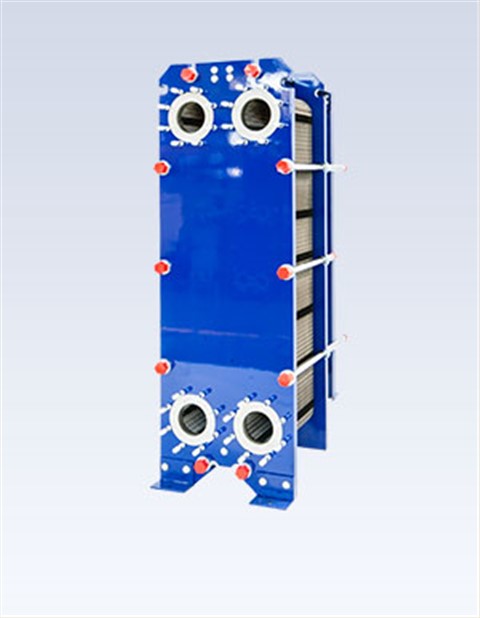 Food grade plate heat exchanger
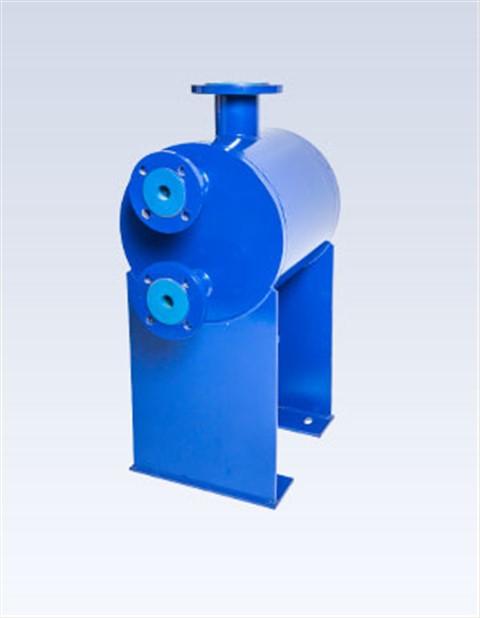 Plate And Shell Heat Exchanger