Semi-Welded Plate Heat Exchangers for Ammonia Refrigeration

Ammonia rules out copper, and that decides the construction
Ammonia is the default refrigerant in industrial refrigeration — cold stores, food plants, breweries, ice rinks — because it carries more cooling per kilogramme than any common alternative and has neither ozone depletion nor global warming potential. It is also the one refrigerant that eliminates the cheapest plate heat exchanger on the market. A brazed unit is held together by a copper-based filler and its port areas are copper-bearing; in ammonia service those surfaces are attacked, and the failure mode is a leak path through the brazing rather than a gradual loss of performance.
That single chemical fact leaves three options: gasketed, semi-welded, and fully welded or plate-and-shell. For most ammonia duties — condensers, brine evaporators, subcoolers, heat recovery — the semi-welded unit is the usual answer. It welds the refrigerant channel and leaves a gasket only on the service side, which is the only side that ever needs to be opened.
What a semi-welded cassette actually is
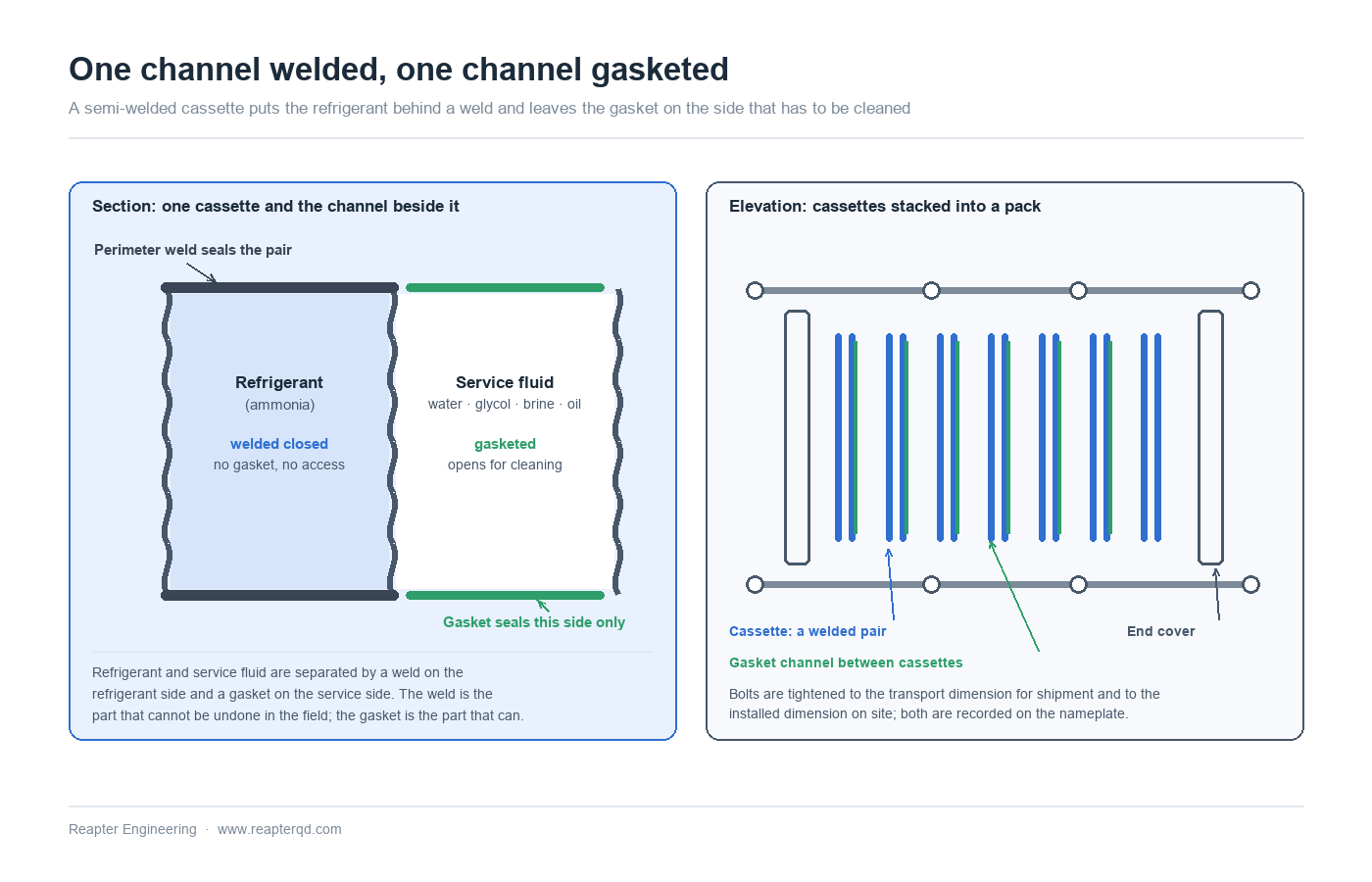
Almost every advantage and limitation follows from the construction. Plates are pressed and joined in pairs: two plates welded together around their perimeter form a cassette, and the narrow gap inside it is the refrigerant channel. The pack is a stack of cassettes with gaskets between them, sealing the service-fluid channel that runs between one cassette and the next.
- The elastomer never touches ammonia. Gasket selection is settled by the cooling water, glycol, brine or oil on the other side, not by the refrigerant — which removes the sharpest compatibility question in the design.
- Refrigerant charge falls sharply. The welded channel is narrow and there is no flooded shell around a bundle. Where the charge decides the machinery-room classification and the cost of the first fill, this is often the deciding argument rather than the thermal one.
- Leak paths are designed in, not hoped away. Some semi-welded designs provide a vented interspace between the twin plates, so a pinhole weeps to the outside instead of crossing into the brine loop; others rely on monitoring the secondary circuit. Specify which arrangement you are buying, and how a leak will be detected.
What you give up is access. The refrigerant side cannot be opened for mechanical cleaning, and if that channel ever plugs or corrodes through, the cassette is replaced rather than repaired. The rest of the specification should be arranged around that one constraint.
Where semi-welded units sit in an ammonia plant
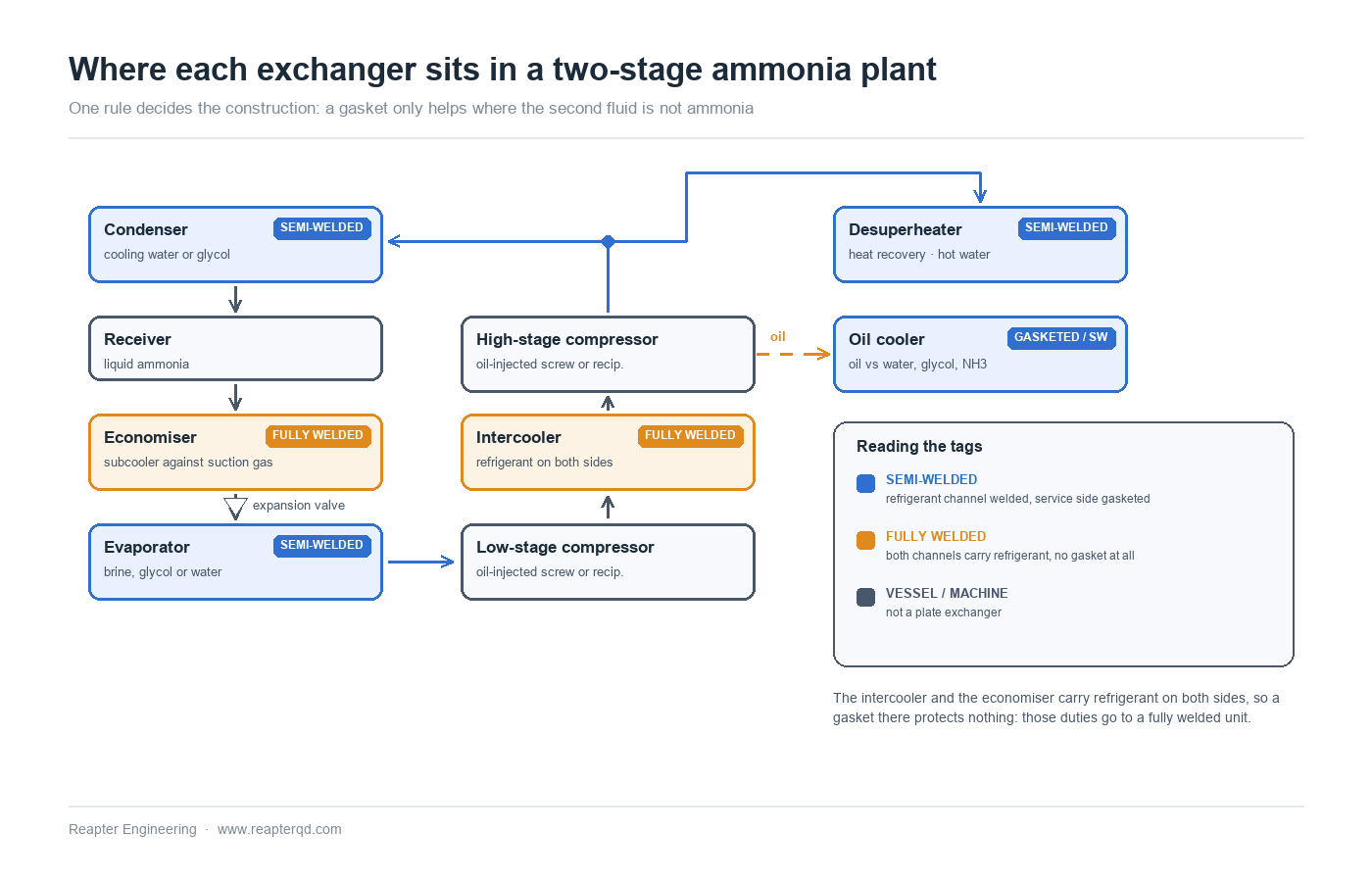
The rule is simple: a semi-welded unit helps only when one side of the exchanger is not ammonia. Where both channels carry refrigerant — an intercooler between stages, or a subcooler working against suction gas — there is no gasket to protect and the duty belongs to a fully welded or plate-and-shell unit.
| Duty | Refrigerant side | Service side | Usual construction |
|---|---|---|---|
| Condenser | Condensing ammonia | Cooling water or glycol | Semi-welded |
| Evaporator | Boiling ammonia | Brine, glycol or chilled water | Semi-welded |
| Intercooler between stages | Hot discharge gas | Boiling ammonia | Fully welded or plate-and-shell |
| Economiser / subcooler | Liquid ammonia | Suction gas, or water and glycol | Fully welded if both sides are refrigerant |
| Oil cooler | Lubricating oil | Water, glycol, or ammonia | Gasketed or semi-welded, set by the oil |
| Heat recovery desuperheater | Hot discharge gas | Hot water | Semi-welded |
The pressures are modest and worth stating precisely. Ammonia condenses at roughly 12 bar at a 30 °C condensing temperature and 15 bar at 40 °C, so a tropical-ambient condenser is a 16 to 20 bar design case with margin; the low stage of a two-stage plant runs at a few bar. Semi-welded frames cover this band comfortably, so the choice rarely turns on pressure rating — it turns on charge, cleanliness and access.
Plates, gaskets and the oil nobody asks about
Ammonia itself is benign to stainless steel, so the corrosion risk almost always arrives from the water side. 316L is the standard plate alloy; 304 appears in benign closed loops; a higher alloy such as 254 SMO, 904L or a nickel alloy is justified when the cooling water is brackish or the loop has a history of chloride attack. Spend the alloy budget on the side that sees chlorides, and do not assume both sides need the same plate.
The absolute rule is that nothing copper-bearing may touch the refrigerant: no brazing filler, no copper ports, no brass instrument fittings. That check belongs in the bill of materials, because the components most easily forgotten are the small ones — gauge snubbers, thermowells, drain valves.
On the service side, NBR covers water and glycol loops to about 100 °C, EPDM takes over for hot water and heat recovery, and HNBR is the usual choice where the gasket sees oil. On a semi-welded unit the ammonia side has no gasket at all, which is the whole point; on a fully gasketed unit NBR or HNBR is the normal selection. The lubricant deserves equal attention: mineral oil remains the usual charge with ammonia and does not dissolve in liquid ammonia, so it settles where velocity is lowest — often the evaporator and the low points of the suction line. A plate evaporator carrying a high oil load loses capacity long before it fouls, and the symptom, falling duty with a clean unit and normal pressure drop, is easily misread as a refrigerant problem.
What you give up, and what you gain
Laid against the alternatives, the semi-welded unit is not the best at anything except the combination it is designed for: no elastomer against the refrigerant, access to the dirty side, and a charge small enough to matter.
| Construction | Ammonia service | Openable | Charge | If it fails |
|---|---|---|---|---|
| Brazed | Not suitable — copper filler | No | Very low | Replace the unit |
| Gasketed | Yes, with NBR or HNBR | Both sides | Highest | Re-gasket, replace plates |
| Semi-welded | Yes | Service side only | Low | Replace the cassette |
| Fully welded / plate-and-shell | Yes | CIP only | Lowest | Return to factory |
Two rows carry a hidden cost. A gasketed unit on ammonia is legitimate and common, but every gasket face is a potential leak into the plant room and the charge is the largest of the four. A fully welded unit has no gasket at all, but when the water side scales there is nothing to open, and the whole unit leaves the site. Semi-welded deliberately sits between them: a weld protecting the refrigerant, a gasket protecting the maintenance budget.
Design details that decide whether it works on site
- Recirculation, not once-through. Pump-circulated evaporators normally run at a circulation ratio of roughly two to four times the evaporated mass flow, so the channel stays wetted and the outlet vapour fraction stays within what the port can pass. Thermosiphon circuits depend on a static head the layout has to provide. Specify the circulation ratio and outlet vapour fraction, not just the duty.
- Two-phase pressure drop. A boiling channel's pressure drop rises steeply as vapour fraction climbs, and the useful temperature difference shrinks with it. On a low-temperature evaporator, a tight approach at the selection point can be spent entirely on pressure drop at the operating point.
- Freeze protection. A service channel that stops flowing while the refrigerant side is still cold will freeze, and a frozen channel distorts plates. Glycol concentration, low-flow interlocks and drainability belong in the design, not in the operating manual.
- Baseline pressure drop. Record clean pressure drop on both sides at commissioning. Without a baseline, every later fouling judgement is an opinion.
Specifying for a plant far from the factory
Ammonia cold stores are built where the food is, which is rarely where the exchanger is made, and that changes what a good specification contains. Certification follows the destination, not the origin: a unit installed in Europe needs a PED assessment, in North America an ASME stamp and often a Canadian registration number, and most markets reference EN 378, ISO 5149 or IIAR practice for charge and machinery-room rules. Decide this at enquiry, because the answer changes plate thickness, test regime and paperwork.
Documentation is a deliverable: material certificates, pressure and leak test records, the assembled pack dimension, and third-party inspection where the project calls for it. On export projects that inspection is normally witnessed before crating, so the test schedule has to be agreed early enough to book the inspector.
Transport and storage follow the same logic. The pack ships at its transport tightening dimension, recorded on the nameplate and packing list, and is re-tightened on site to the installed dimension. Long voyages into humid climates need proper crating, desiccant and edge protection; a pack that arrives with loose bolts or a wet crate costs more to recover than the freight saved.
Spares should be sized to the consequence of failure. A gasket set on the shelf is standard. On a cold store where a stoppage stops production, one or two spare cassettes are cheap insurance, because a cassette can be lifted out and replaced with the unit in place — no welding, no crane-out, no factory return. That is the practical argument for the construction: the part that can fail without warning is also the part that can be swapped in a shift.
A practical decision sequence
- List every exchanger in the circuit and mark which channels carry ammonia. Any duty with refrigerant on both sides is automatically a fully welded or plate-and-shell case.
- Fix design pressure from the condensing condition at the site's design ambient, not from a generic plant figure, then add the margin the destination code requires.
- Decide the service-side fluid and its chemistry, and let that set both the plate alloy and the gasket. Do not upgrade both sides by default.
- Calculate the charge for each construction and compare it with the machinery-room threshold that applies on site. This step most often reverses an intuitive choice.
- State the operating envelope, not a single point: minimum and maximum load, circulation ratio, outlet vapour fraction, allowable pressure drop on each side.
- Put documentation, inspection regime and spare parts list in the same enquiry. They are part of the equipment, and the hardest part to add later.
Common questions
Can a brazed plate heat exchanger be used with ammonia? No. Brazed units are joined with a copper-based filler, and ammonia attacks copper and copper alloys. The joint is the failure point, and it fails as a leak rather than as a loss of performance.
Why choose semi-welded over fully gasketed for ammonia? Because the gasket no longer sees the refrigerant: the ammonia channel is welded, so the elastomer is chosen for water, glycol or oil, and the number of refrigerant leak paths drops to zero. The secondary gains are a much smaller charge and a higher pressure band; the cost is that the refrigerant side can no longer be opened.
How is a leak between the two circuits detected? It depends on the design. Some cassettes provide a vented interspace between the twin plates, so a pinhole weeps visibly at the plate edge; where that is not provided, detection moves to the secondary circuit — ammonia in the brine, a conductivity or pH shift, and pressure decay on the isolated refrigerant side. Agree the arrangement at specification, because retrofitting leak detection is far more expensive than ordering it.
Can the refrigerant side be cleaned in place? Only by circulation with a chemistry compatible with stainless steel and the welded seams, and only for soft deposits. Mechanical cleaning is impossible; if the channel plugs, the cassette is replaced. That is why the service side is the one designed to be opened, and why water treatment on the cooling or brine loop is part of the exchanger's maintenance plan.
Conclusion
Ammonia is unforgiving of the wrong construction and generous to the right one. A semi-welded unit keeps the elastomer away from the refrigerant, keeps the charge small, and keeps the fouling side accessible — three things that matter more in a working cold store than a marginally better heat transfer coefficient. Reapter builds gasketed, semi-welded, welded and plate-and-shell units for refrigeration, food processing, district energy and marine projects, with certification for the destination market, witnessed inspection where the project requires it, and cassette and gasket spares held for critical installations. If you are specifying an ammonia circuit, send us the duties, the refrigerant conditions and the site's code requirements and we will return the construction recommendation with the charge estimate alongside the thermal selection.
Related information
- A quick introduction to the classification and application of plate heat exchanger gaskets
- How to swap a cheap Alfa Laval plate heat exchanger gasket?
- Still worried about the corrosion of sulfuric acid heat exchange equipment - sulfuric acid industrial plate heat exchanger waiting for you!
- Model representation method of plate and frame heat exchanger
- Plate heat exchanger factory: Qingdao Ruipute's advantages-optimization design
- Which one is better to replace the plate gasket of plate heat exchanger imported from Shandong?
Relevant article
- Semi-Welded Plate Heat Exchangers for Ammonia Refrigeration
- Variable Flow and Part-Load Operation of Plate Heat Exchangers
- Factory Acceptance Testing of Plate Heat Exchangers: What to Witness
- Plate Heat Exchanger Spare Parts Strategy: Stocking Against Real Lead Times
- Plate Heat Exchangers for Seawater and Brine Cooling: Materials and Limits
- Cross-Plate Leakage in a Plate Heat Exchanger: Diagnose Before You Order Parts
- Hygienic Design for Food-Grade Plate Heat Exchangers: What the Standards Require
- Plate Heat Exchanger Flow Arrangement: Series, Parallel and Multi-pass
- Fouling Allowance in Plate Heat Exchanger Design: Sizing the Margin
- Close Temperature Approach in Plate Heat Exchangers: How Close Is Practical?
Latest information
- The original lubricant in the chemical plate heat exchanger plays so many roles!
- Heat exchanger station supporting plate heat exchanger or have to pay attention to these points, or easily go wrong
- Heat station supporting plate heat exchanger installation is a technical work, these points should be noted
- Improve the efficiency of industrial boilers with plate heat exchanger, these maintenance points to keep in mind
- The Integrated Heat Exchanger Unit: An Efficient Integration and Intelligent Control Solution for Thermal Energy Conversion
- Sulfuric acid and other corrosive media for industrial plate heat exchanger requirements are what
- Simple and effective chemical cleaning method of coal chemical plate heat exchanger, can effectively improve efficiency
- A high-quality petrochemical plate heat exchanger in the production of what to consider
- These causes of chemical plate heat exchanger gasket aging you may not know
- Chemical plant plate heat exchanger, sulfuric acid cooling needs attention