

The question is no longer whether it works, it is whether it pays at your distance
A modern liquid-cooled data centre rejects roughly 95 % of its electrical input as heat, and a growing share of it is available at 45–55 °C — a temperature that a generation ago would have had no use outside the building. Simultaneously, district heating networks across northern Europe and China's northern cities are being rebuilt to run cooler, precisely so that low-grade sources like this can connect. The technical match now exists.
What decides a project is not thermodynamics but three practical numbers: the return temperature of the network the heat is being sold into, the distance to the nearest adequately sized pipe, and how many hours a year the network can actually absorb the heat. Get those three wrong and the heat exchanger is irrelevant. Get them right and the exchanger becomes the component that fixes the whole scheme's efficiency, because at these temperature differences every kelvin of approach is paid for at the network pump.
Where the heat actually sits in a data centre
Recoverable temperature depends entirely on how the racks are cooled. The differences are not marginal.
| Cooling architecture | Heat rejection temperature | Recoverable fraction of IT load | Usable for district heating? |
|---|---|---|---|
| Room air, chilled water CRAC | 24–32 °C return air | ~90 %, but at unusable grade | Only with a large lift — rarely economic |
| Rear-door heat exchanger | 35–45 °C water | ~50–70 % | Marginal; needs a heat pump |
| Direct-to-chip cold plate | 45–55 °C TCS return | ~80–90 % | Yes — directly into a low-temperature network, or with a small lift |
| Single-phase immersion | 50–60 °C fluid | ~90 % | Yes — the best grade available |
| Two-phase immersion | 50–65 °C condensing | ~90 % | Yes, but fluid handling adds complexity |
The engineering conclusion is blunt: waste heat recovery from air-cooled halls is a marketing claim more often than a project. It becomes an engineering proposition at cold plate and above, where the source temperature approaches the return temperature of a modern network rather than sitting 30 K below it.
The two constraints that decide the configuration
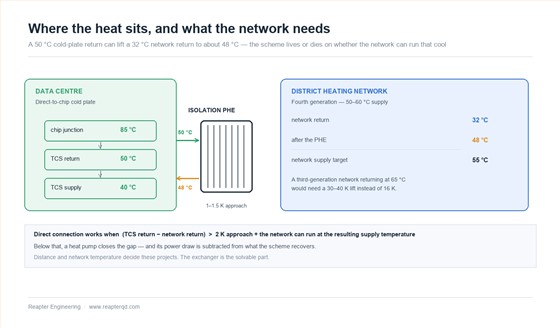
Constraint one: source temperature against network return temperature. A heat exchanger can only heat the network water to within an approach of the source temperature. So the useful question is not "how hot is the data centre" but "how cold is the network return".
- Third-generation networks (80–90 °C supply, 60–70 °C return) cannot take 50 °C heat directly. The return is hotter than the source, and the whole duty must go through a heat pump — a 30–40 K lift, which is a real power bill.
- Fourth-generation networks (50–60 °C supply, 30–40 °C return) are the natural home for this heat. A 50 °C source can lift a 35 °C return to about 48 °C at a 2 K approach. Whether that is enough depends on whether the network can run at 48 °C supply — many can in mild weather, and increasingly can all year with retrofitted substations.
- Fifth-generation or ambient networks (10–25 °C, distributed heat pumps at the buildings) decouple the problem entirely: the data centre only has to feed a 20 °C loop, and the lift happens where the heat is used.
Constraint two: hours of absorption. A data centre produces heat 8 760 hours a year at almost constant rate. A heating network needs it for perhaps 3 000–4 500 hours, concentrated in winter. The energy is not the problem; the mismatch is. Without storage or a summer sink, the recoverable annual energy is theoretical — and the exchanger-side implications are the same as in any waste heat recovery duty.
Three ways to handle it, in order of capital cost:
- Accept partial utilisation. Size the connection for winter peak and dump the rest. Cheap, and often the right first move — the recovered energy is still free.
- Thermal storage. Daily buffer tanks smooth the mismatch between data centre output and network demand curve; seasonal storage is rarely economic at this scale.
- A summer sink. Absorption chillers driven by the recovered heat, supplying cooling to the same campus, convert the summer surplus into a useful product and improve the scheme's overall economics substantially.
Distance is the real cost driver
Pre-insulated district heating pipe is expensive per metre and the cost is dominated by civil works, not the pipe. As a planning figure, a twin-pipe connection runs into the millions per kilometre once trenching, road crossings and permits are included, and the economics only close when the heat is dense and the run is short.
A 10 MW IT hall in a cold-plate design yields roughly 8 MW of recoverable heat. If the network absorbs it for 3 500 hours a year, that is about 28 GWh — a genuinely large quantity, and enough to justify a connection of a few kilometres. Halve the distance and the case improves far more than proportionally, which is why the viable projects are almost always data centres built inside or adjacent to an existing network area rather than in a greenfield industrial park 15 km out.
The heat exchanger station: where the scheme is won or lost
The interface between the data centre's technology cooling system — the CDU loop described in our article on CDU heat exchangers — and the district heating network is usually a single plate heat exchanger station, and it has four jobs.
It isolates two systems that must never mix. The data centre loop carries inhibited water or glycol at a controlled chemistry and, in many designs, at a pressure chosen to protect the servers. The network carries treated water with its own chemistry, its own pressure regime and a different owner. A physical barrier is mandatory, not a preference, and the pressure rating on each side must be checked against the other's worst case. A single-wall plate exchanger is normal practice, backed by pressure differential monitoring rather than a double-wall construction that would cost efficiency for a duty already short of it.
It holds a very tight approach. With a source at 50 °C and a network return at 35 °C, the total available difference is 15 K and the delivery target is 48 °C. An approach of 4 K — perfectly acceptable in a process duty — would leave the network at 46 °C and fail the specification. This duty needs 1–1.5 K, which means generous area, high turbulence and a plate with a hard chevron angle. The reasoning is the same as in any close-approach application, but the consequence here is a whole scheme's viability rather than a few percent of efficiency.
It stays inside a small pressure drop budget. Because the temperature difference is small, the flow is large: 8 MW at an 8 K drop moves around 860 m3/h. Pumping that at 100 kPa costs real electricity, and the pump power is subtracted directly from the recovered energy. 40–60 kPa per side is a sensible design target, and it must be written into the specification before selection rather than discovered afterwards.
It tolerates a source that never shuts down. Unlike a process duty, this exchanger runs continuously and its performance is monitored continuously. Design for cleaning in place, provide isolation valves on both sides and a bypass, and specify the plate material for the actual water chemistry — 316L is generally adequate for two clean closed loops, but the network side of an open or poorly treated system is where corrosion starts.
What the network side has to do
A data centre cannot supply a network designed for 90 °C. Connecting one is a decision to lower the network's operating temperature, which means the buildings on that network must be able to heat themselves at 50–55 °C flow. That is a building-side retrofit programme, not a pipe connection, and it is usually the longest lead item in the project.
The smart sequencing is the reverse of what is often attempted: build or extend the low-temperature network first — the sizing logic is set out in sizing PHEs for district heating substations — with substations capable of running at 55 °C, and connect the data centre when the network can absorb the heat. Schemes that try to force 50 °C heat into a 90 °C network end up paying for a heat pump that consumes much of what it recovers.
FAQ
Can data centre heat go straight into a district heating network without a heat pump? Yes, when the network return temperature is at least 10–15 K below the data centre's supply temperature and the network can run at the resulting supply temperature. In practice that means fourth-generation or ambient networks, not third-generation ones.
How much heat can actually be recovered? Around 80–90 % of the IT load in a cold-plate or immersion design, and effectively none at usable grade from a conventional air-cooled hall. The limiting factor is usually how many hours the network can absorb it, not how much is available.
Does the data centre loop need a double-wall exchanger? Rarely. Single-wall with pressure differential monitoring between the loops is standard, and a double-wall unit would cost approach on a duty that has none to spare. The protection comes from monitoring and pressure regime design, not from the wall.
What breaks these projects? Almost always distance and network temperature. The exchanger is a solvable engineering problem; a 12 km connection into an 85 °C network is not.
Design the interface for the temperature you actually have
Reapter supplies gasketed, semi-welded and welded plate exchangers for data centre cooling and heat reuse duties, including close-approach interface stations between technology cooling loops and district heating networks. Send the source and network temperatures, both flows, the pressure drop available on each side and the water chemistry of both loops — we will select the station and show the approach and pressure drop you would achieve, so the scheme's energy balance can be checked before the pipe is ordered. Request a selection review.
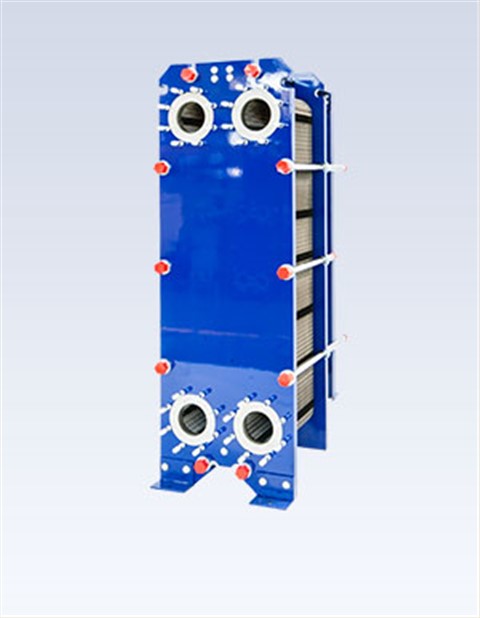 Food grade plate heat exchanger
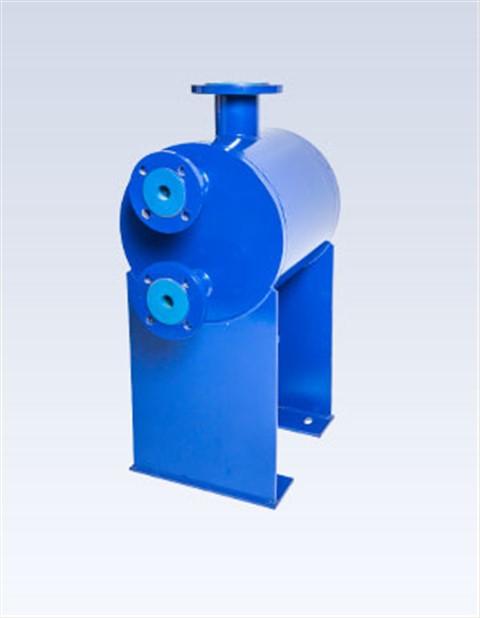 Plate And Shell Heat Exchanger