

The wort cooler sets the pace of the brewhouse
After the whirlpool, hot wort sits close to boiling and has to reach yeast pitching temperature in the time it takes to pump the batch out of the kettle — commonly 30 to 60 minutes. Miss that window and two things go wrong together: the wort lingers in a range where unwanted organisms can grow, and the protein–polyphenol haze that should form as cold break forms late or incompletely. The plate heat exchanger that does this job is small beside the kettle and the fermenters, yet it sets the rhythm of every brew that follows. It is also the brewhouse's clearest chance to move heat from a stream that must be cooled into one that must be heated. That is why most modern plants use a two-stage plate pack rather than a single pass.
Why a plate exchanger, and why two sections
Wort cooling is a liquid-to-liquid duty with a large temperature change, a tight outlet target and a product that cannot tolerate contamination. A gasketed plate exchanger fits all three. Alternating channels put wort and coolant in counter-current contact across thin stainless plates, giving heat-transfer coefficients roughly twice those of a shell-and-tube unit on the same duty and an approach temperature that can be as close as about 1 °C. The pack can be opened for mechanical cleaning, added to or trimmed as brewhouse capacity changes, and built with a connecting plate that splits one frame into two independent sections.
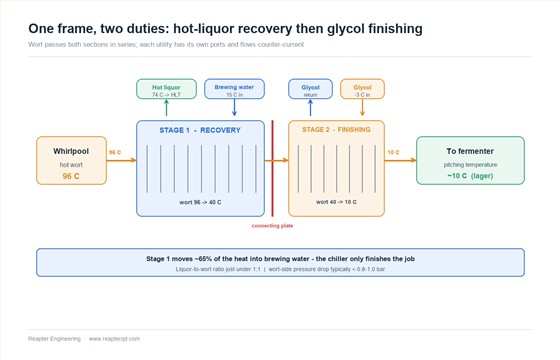
Those two sections are the whole point. In the first, incoming brewing water does the bulk of the cooling and leaves as hot liquor for the next brew. In the second, a much smaller duty is finished with chilled water or glycol. One frame therefore performs two jobs that would otherwise need two machines and two sets of pipework.
The temperature chain, in numbers
The table below compares the two arrangements using typical industry ranges. The figures are general engineering values, not measurements from any one plant. Pitching temperature depends on the yeast and beer style — roughly 8–12 °C for many lagers and 16–20 °C for many ales — and the exchanger must hit that target at the worst hour of the year, not the average.
| Parameter | Single-stage cooler | Two-stage cooler |
|---|---|---|
| Wort inlet after whirlpool | ~95–98 °C | ~95–98 °C |
| Intermediate wort outlet | — | ~35–50 °C |
| Wort to fermenter | ~7–12 °C | ~7–12 °C |
| Cooling utility | Chilled water 2–4 °C or glycol about ?3 to ?4 °C over the full duty | Stage 1: brewing water ~15 °C in; Stage 2: glycol ~?3 °C in for the finishing duty only |
| Recovered hot liquor | Usually warm, limited use | Typically ~65–85 °C, stored for mashing-in or cleaning |
| Share of duty on refrigeration | 100% | Typically ~30–40% |
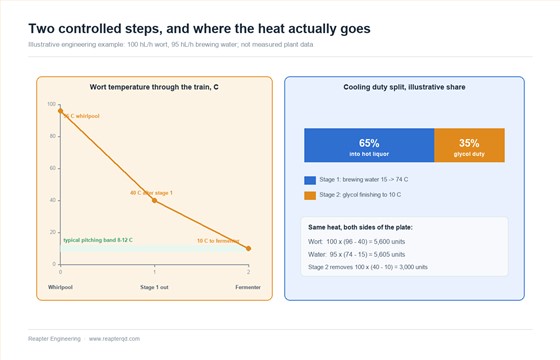
A single worked example makes the split clear. Take 100 hL/h of wort at 96 °C and 95 hL/h of incoming brewing water at 15 °C — a liquor-to-wort ratio just under 1:1, which is in the normal band. In stage one the wort falls to 40 °C while the water rises to about 74 °C. The heat moved is the same on both sides: 100 × 56 ≈ 95 × 59, so about 5,600 heat units out of the wort and into hot liquor. Stage two removes the remaining 100 × 30 = 3,000 units with glycol. Roughly 65% of the total sensible heat has been recovered before refrigeration is asked to do anything. These are illustrative arithmetic examples, not guaranteed performance figures.
Stage one: turning a cooling duty into hot liquor
The first section is where the operating cost is won or lost. Brewing water that would otherwise need to be heated by steam or gas leaves the exchanger ready for the hot liquor tank, the mash or cleaning. Recovery of 60–70% of the heat above mashing temperature is commonly quoted for a well-matched two-stage design, and it pays back in fuel as well as in chiller load. The economics improve when the plant brews many batches per day and has a steady demand for hot liquor, because the recovered heat is used immediately rather than stored until it cools.
The approach temperature in this section matters. Because the hot end of the plate pack is where protein fouling builds first, a design that chases an extremely close approach buys more plate area and a faster fouling rate at the same time. In practice the first stage is sized for a reasonable temperature program and cleaned on schedule, rather than for the smallest possible approach on day one.
Stage two: the glycol finishing duty
Once the wort is below roughly 40 °C, water alone can no longer reach pitching temperature, so a secondary coolant takes over. Chilled water at 2–3 °C or a glycol solution around ?3 to ?4 °C is standard, with the glycol set point held high enough to avoid freezing at the plate surface. Because this section handles only the finishing load, its plate count and pipe size are far smaller than the first stage. A plant that cools with a single pass instead pays to refrigerate the entire duty, which is why two-stage units are reported to cut refrigeration power by roughly 30–40% in comparable service.
Fast, gentle passage through this section is also a quality decision. Rapid cooling encourages clean cold-break formation and shortens the time the wort spends warm. The flow must still be gentle enough that the wort pump is not driven into cavitation — designers usually hold the wort-side pressure drop below about 0.8–1.0 bar.
Sizing starts with knockout time and the hottest week
Three inputs decide the plate count more than anything else. The first is knockout time: batch volume divided by the minutes allowed sets the wort flow rate through the plates. The second is the warmest brewing water temperature of the year, because a summer water inlet raises the first-stage outlet and pushes more work onto glycol. The third is how much trub and hop matter the cooler must pass. A unit sized on a mild spring day that is comfortable in January will miss pitching temperature in August. Specify against the worst credible case and trim the pack later if the plant proves to have margin.
Trub, plate gap and the pressure-drop ceiling
Hot wort leaving the whirlpool still carries fine break material and hop particles. Narrow high-chevrons channels give excellent heat transfer but trap solids, so wort-side plates are usually a standard or wider-gap chevron chosen for fouling tolerance rather than the highest possible coefficient. Whirlpool separation, a hop strainer or an inline filter upstream does more for run length than extra plate area does. The cleaning system should be designed at the same time as the plate pattern, not after the first fouled run.
Materials, gaskets and the hygiene boundary
The wort side is nearly always 316L stainless: phosphoric and nitric acid CIP and chlorinated sanitizers will pit 304L in the gasket groove over time. The brewing-water side can be 304 in many designs, and food-contact EPDM gaskets are the usual choice, with NBR considered where hop-oil loading is heavy. Connections on a brewery unit are normally sanitary tri-clamp fittings. Because the two sections share one frame, the connecting plate and its gasket arrangement must keep the potable utility streams strictly separate from product — a leak should vent to atmosphere, not cross into the beer.
Cleaning: the hot end fouls, the cold end infects
Fouling at the hot end cuts cooling efficiency, while the cold end carries the microbial risk, so the exchanger needs a cleaning regime that addresses both. Caustic wash at roughly 70–85 °C followed by a phosphoric or nitric acid rinse and a sanitizer is the common sequence. Many breweries clean every three to eight brews rather than after every batch, using a dedicated caustic tank so the cleaning circuit cannot contaminate product. A removable frame is worth specifying even on a CIP-friendly unit: when fouling does get ahead of the program, the pack must be openable without special tools.
A practical specification sequence
- Fix batch volume, knockout time and the target pitching temperature for each beer style.
- Record the warmest brewing-water inlet temperature and the available supply pressure.
- Choose a two-stage frame; set the first-stage wort outlet and the hot-liquor target together.
- Confirm liquor-to-wort ratio, hot-liquor demand and where the recovered water will be used.
- Size the glycol section for the finishing duty only, with a set point above the plate freezing risk.
- Select wort-side plate gap and upstream solids separation for the actual trub and hop load.
- Specify 316L wort-side plates, food-grade gaskets, sanitary connections and a cleanable frame.
Common questions
How much heat can a two-stage wort cooler realistically recover? Around 60–70% of the sensible heat above mashing temperature is a common design figure when hot-liquor demand matches the recovered flow. The exact number depends on inlet water temperature, the chosen intermediate wort temperature and how much of the hot liquor can be used immediately.
Is a single-stage cooler ever the better choice? Yes, where space and simplicity dominate, where sparging water demand is high, or where the plant wants to avoid a glycol circuit altogether. It costs less to install but sends the whole duty to chilled water and usually fouls faster because of the large one-pass temperature difference.
Why does the wort side need 316L rather than 304? The cleaning chemistry, not the wort itself, drives the choice. Acid CIP and chlorine sanitizers attack the gasket groove of 304 over repeated cycles; 316L stands up to that regime far better on the product side.
How often should the plate pack be cleaned? Every three to eight brews is typical, depending on trub carry-over and the hot-end approach. Trend the cooling performance and the first-stage pressure drop: a rising approach at constant flow is the earliest reliable sign that the pack needs attention.
Conclusion
A wort cooler is a small machine with an outsized effect on brewery output, beer stability and utility cost. Splitting the duty into a hot-liquor recovery stage and a glycol finishing stage is what turns it from a necessary expense into a heat-recovery asset, provided the plate gap, materials and cleaning regime are chosen for the real wort and the real water. Reapter builds two-section gasketed plate coolers for breweries, supplying 316L product-side plates, sanitary connections, upstream strainers and spare plate sets as part of export projects, with the section layout marked so a local team can reassemble it correctly. Contact us with your batch volume, knockout time and summer water temperature to discuss a cooler for your duty.
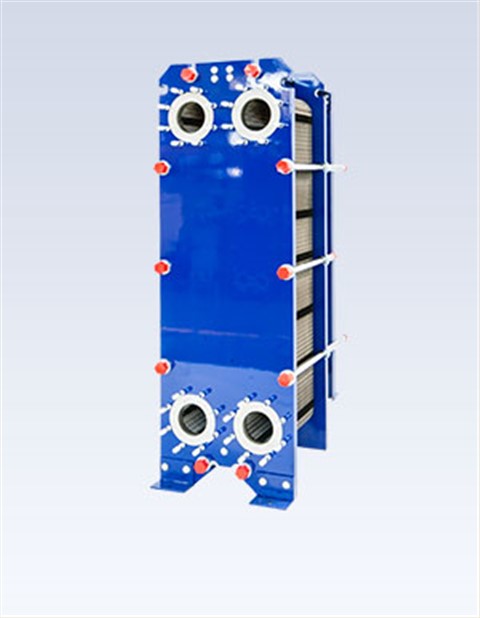 Food grade plate heat exchanger
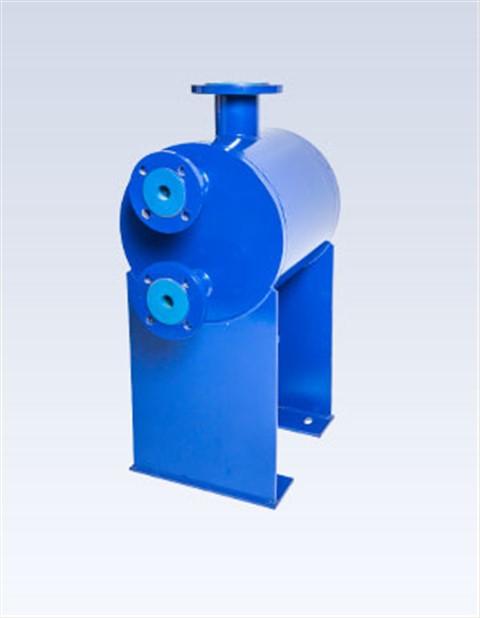 Plate And Shell Heat Exchanger