Plate Heat Exchangers in MVR Evaporation: Designing Around a Small Driving Force

Mechanical vapour recompression moves the difficulty into the exchangers
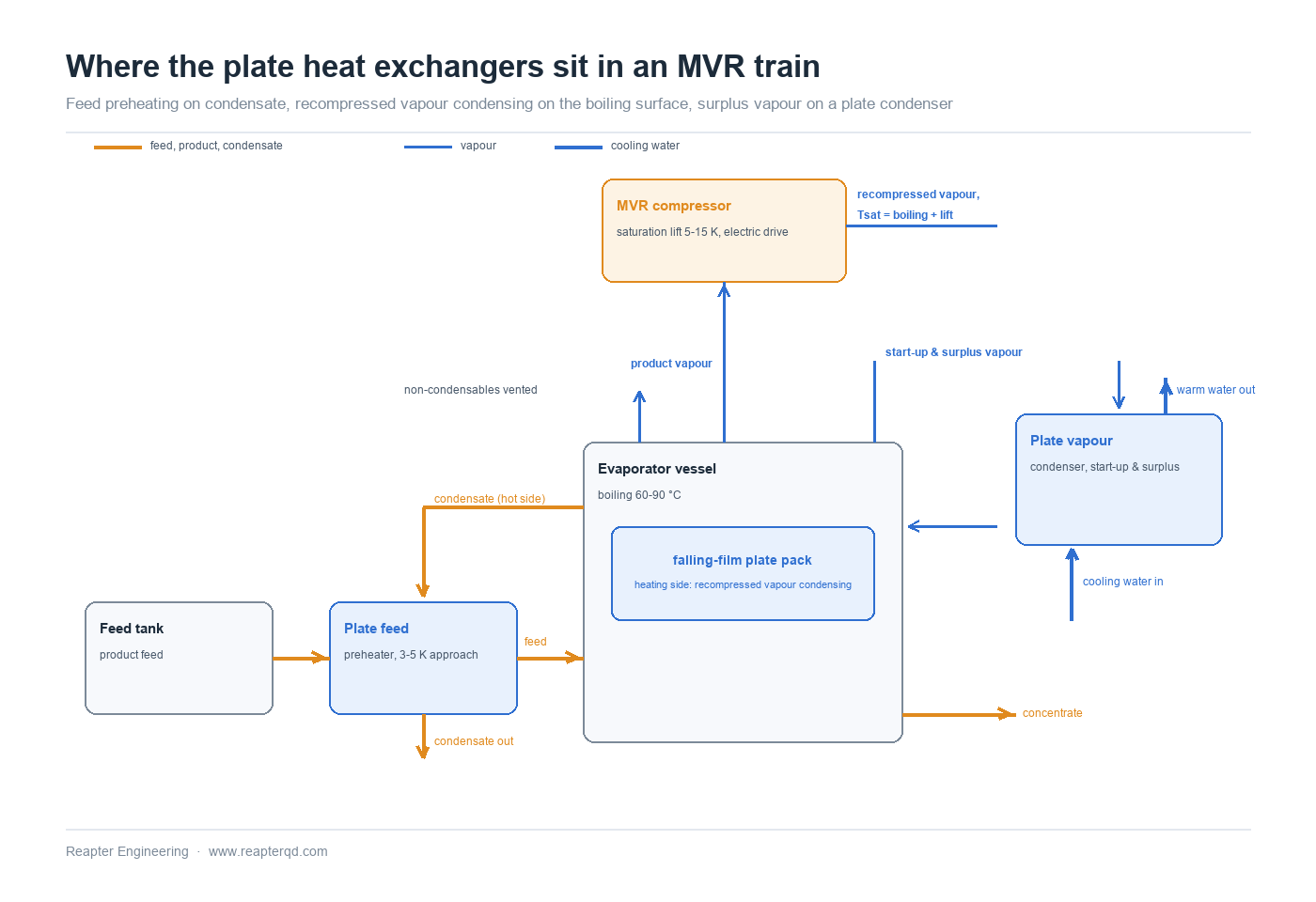
Mechanical vapour recompression (MVR) has become the reference layout for low-cost evaporation: instead of venting the vapour boiled off a product, a compressor raises its saturation temperature by a few kelvin and condenses it on the heating side of the same evaporator. The energy for evaporation then comes from an electric motor rather than live steam, and a well-run train evaporates water at a specific energy that steam-heated effects cannot approach. The engineering difficulty moves into the heat exchangers. A compressor only lifts the saturation temperature by a small amount, so every exchanger in the train has to work on a driving force of just a few kelvin. That is exactly the regime where the plate heat exchanger is strongest — high film coefficients, close approach temperatures and a compact frame — provided the whole temperature budget is engineered deliberately.
What the compressor gives, and what the budget takes back
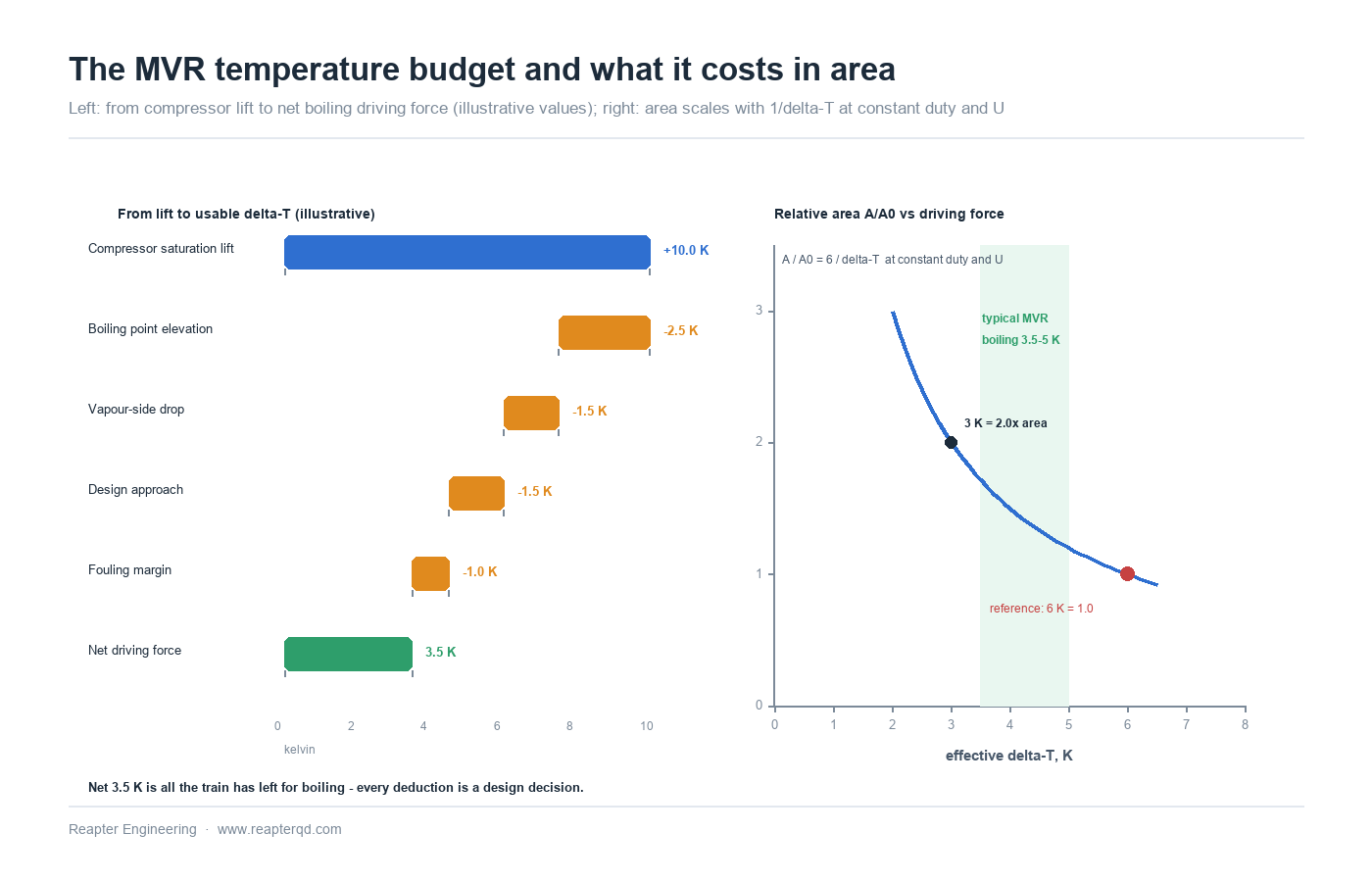
A single-stage fan or centrifugal compressor in MVR service commonly delivers a saturation temperature lift of roughly 5 to 15 K; higher lift is possible but the compressor absorbs proportionally more power. The lift looks generous until the deductions are counted. The heating-side saturation temperature is the boiling temperature plus the lift, and from that gross figure the design must subtract: the boiling point elevation of the product, the saturation loss caused by pressure drop along the vapour ducts and through the condensing side of the exchanger, the design approach temperature of the exchanger itself, and a fouling margin so the train still meets duty between cleaning stops. After these deductions, the net driving force actually available for boiling is typically only 3 to 8 K. Every one of those deductions is a design decision, and the plate heat exchanger is involved in most of them.
Where the plate heat exchangers sit in an MVR train
An MVR plant uses several plate exchangers, each with its own duty and its own constraint. The feed preheater recovers heat from hot condensate before the product reaches the boiling surface, which directly reduces the vapor flow the compressor must handle. The boiling surface itself may be a falling-film plate pack inside the vessel or a welded plate evaporator, selected for fouling behaviour rather than for thermal rating alone. A plate vapour condenser handles start-up vapour and any surplus the compressor does not take, and a condensate exchanger recovers sensible heat on the way out. Typical duty ranges are summarised below.
| Position | Hot side | Cold side | Typical approach | Plate choice notes |
|---|---|---|---|---|
| Feed preheater | Hot condensate | Incoming feed | 3-5 K | Standard chevron; fouling depends on product |
| Boiling surface | Recompressed vapour, condensing | Boiling product | 2-4 K | Falling-film pack or welded plates for fouling duty |
| Surplus vapour condenser | Start-up and excess vapour | Cooling water | 2-3 K | Large corner ports for low vapour-side drop |
| Condensate heat recovery | Hot condensate | Feed or process water | 3-5 K | Standard duty; check condensate quality first |
| Product cooler | Concentrated product | Cooling water | 3-5 K | Wide-gap if viscosity is high at the outlet |
Boiling point elevation takes the first bite
Boiling point elevation (BPE) is fixed by the product chemistry, not by the equipment. Water-like duties sit near zero; fruit juices and sugar syrups typically climb from under 1 K at low concentration to 1-3 K or more near final concentration, and dissolved salts can push it higher. The consequence for design is important: the worst case is the end of the batch or the final concentration stage, when BPE is largest and the compressor still delivers the same lift. Sizing the temperature budget at average conditions is a common way MVR trains end up short of duty when the product is nearly finished. The budget calculation should therefore use final-concentration BPE, and the figures that remain after it — approach temperature and fouling margin — are the only real levers left.
Vapour-side pressure drop is paid in kelvin
At the evaporating temperatures typical of MVR service, roughly 60 to 90 °C, saturation temperature changes by about 1.4 to 1.8 K per kilopascal. A two-kilopascal loss through ducts, bends and the vapour side of the condensing exchanger therefore consumes around 3 K of the compressor lift — often more than the entire design approach of the exchanger. This is why MVR-rated plate condensers and evaporators are built with generously sized corner ports and dedicated vapour connections, and why the specification should state the vapour-side pressure drop allowance in kilopascals rather than as a percentage. Short, straight vapour ducts with large cross-sections, and a mist eliminator upstream of the compressor, protect both the compressor and the temperature budget.
A small driving force is paid for in area
For a given duty and heat transfer coefficient, the required area is inversely proportional to the effective temperature difference: halve the driving force and the area doubles. This relationship is the economic heart of MVR exchanger sizing. It is also why the high heat transfer coefficients of chevron-corrugated plates matter so much here — a higher U keeps the area growth of a 3 K design within a frame that can still be shipped, installed and opened for cleaning. It cuts the other way, too: an unnecessarily conservative approach margin multiplies area and cost quickly, so the margin belongs in the fouling allowance where it is monitored, not hidden inside an oversized plate pack.
Materials, fouling and plate style
Material selection follows the fluid envelopes, not the MVR label. 316L is the default for neutral food and water-like duties; higher-alloyed austenitic or duplex grades, and titanium where chloride and temperature demand it, apply on the cooling-water and brine sides just as in any other service. On the product side, fouling behaviour drives the plate style: protein or calcium-bearing products that plate out quickly call for wide-gap plates or welded plate packs that open for mechanical cleaning, and hygienic duties may require the product circuit to be fully welded or semi-welded so that no elastomer touches the food. Where the condensing side carries clean vapour, a gasketed construction remains the economical choice and keeps spare-part logistics simple.
Running the train: start-up, part load and non-condensables
An MVR train cannot start on its own vapour. Until the evaporator is boiling and the compressor is primed, the plant needs auxiliary steam, an electric trim heater, or the plate vapour condenser operating in reverse as a starter circuit. Once running, compressor speed control handles turndown smoothly, and plate exchangers follow part-load behaviour well because their effectiveness stays high at reduced flow. The quiet capacity killer is non-condensable gas: even a small accumulation of air or CO2 on the condensing side blankets the surface and collapses the condensing coefficient, and a train running on 4 K of driving force loses far more duty to blanketing than a steam-heated effect would. Venting positions and purge routines deserve the same engineering attention as the thermal design itself.
What to put in the specification
- Duty and boiling point elevation quoted at final concentration, not average, with the BPE source stated.
- Evaporating temperature range, so vapour-side saturation losses can be evaluated in kelvin.
- Vapour-side pressure drop allowance for every exchanger in kilopascals, including duct losses.
- Approach temperature target and fouling margin stated as separate line items, not merged.
- Chloride concentration and temperature envelope for cooling water, brine and product circuits.
- Plate style and gasket material per circuit, with cleaning method (CIP or mechanical) declared.
- Thermal performance guarantee expressed at design driving force, with the test tolerance defined.
Common questions
Can a gasketed plate heat exchanger be used directly as an MVR evaporator? The condensing side of an MVR train is routine work for a gasketed plate exchanger — clean vapour, modest pressure, high coefficient. The boiling product side is the limiting case: falling-film plate packs or welded plate evaporators are preferred where hygiene, foaming or fouling make open gaskets unsuitable, and the choice should be made circuit by circuit.
How much energy does MVR actually save compared with live steam? Industry experience commonly quotes on the order of 15 to 50 kWh of electricity per tonne of water evaporated, against the several hundred kilowatt-hours of thermal energy a single-effect steam plant would consume. The exact figure depends on compression lift, boiling point elevation and insulation discipline, so it should be evaluated per project rather than quoted generically.
Why not simply add more plate area to make up for a larger approach? Area multiplies the heat transfer coefficient times the driving force; it cannot create driving force that BPE and pressure losses have already consumed. If the temperature budget is exhausted, the plant needs either a higher compressor lift — and will pay for it in electricity — or lower vapour-side and approach losses. Area alone is the most expensive of the three options.
What approach temperature is realistic for MVR plate exchangers? One to three kelvin is achievable on clean, water-like media between well-designed plates; fouling products typically settle at two to four kelvin when the fouling margin is stated and maintained separately. Anything tighter than 1 K should be treated with suspicion unless the vendor has supported it with reference plants on the same medium.
Conclusion
MVR rewards the plant that engineers its temperature budget honestly: compression lift minus boiling point elevation, vapour-side losses, approach and fouling margin is all the driving force the train will ever have. Plate heat exchangers are the natural hardware for that regime, on the boiling surface, the vapour condenser and every heat recovery position around them. Reapter supplies gasketed, semi-welded and welded plate heat exchangers for MVR and evaporation duty, supports model selection against your product data, and ships spare plate and gasket packages worldwide. Contact us with your duty and we will return a sizing proposal with the temperature budget stated line by line.
Related reading
Related information
- Gasket Selection for Plate Heat Exchangers
- Industrial Plate Heat Exchangers: Custom Design
- Waste heat recovery plate heat exchanger manufacturers
- What should i pay attention to when choosing a wide gap plate heat exchanger?
- What is a heat exchanger and how is it classified?
- Transcritical CO2 Systems: Selecting Plate Heat Exchangers for High Pressure
Relevant article
- Wort Cooling with Plate Heat Exchangers: Two-Stage Design, Heat Recovery and Hygiene
- Insulating a Plate Heat Exchanger: Heat Loss, Condensation and Removable Covers
- PED vs ASME for Exported Plate Heat Exchangers: A Practical Compliance Guide
- Plate Heat Exchangers in Desalination: Feed Preheating, Brine Cooling and Material Limits
- HTST Pasteurization with Plate Heat Exchangers: Regeneration, Holding Time and Pressure Differential
- Steam Stall in Plate Heat Exchangers: Why a Steam Heater Loses Control at Part Load
- Gasketed, Semi-Welded or Fully Welded: Choosing Plate Heat Exchanger Construction for the Duty
- Gasket Shelf Life and Storage: Keeping Spare Plate Heat Exchanger Gaskets Fit for Duty
- Plate Heat Exchangers in MVR Evaporation: Designing Around a Small Driving Force
- Plate Heat Exchangers in Sugar Mills: Juice Heating, Evaporation Support and Molasses Cooling
Latest information
- Chemical Plate Heat Exchanger: Lubricant Roles & Care
- Heat Station Plate Heat Exchangers: Design & Application
- Heat Station Plate Heat Exchangers: Installation Guide
- Boiler Plate Heat Exchangers: Maintenance Guide
- The Integrated Heat Exchanger Unit: An Efficient Integration and Intelligent Control Solution for Thermal Energy Conversion
- Sulfuric Acid Plate Heat Exchangers: Design & Application
- Coal Chemical Plate Heat Exchangers: Cleaning & Maintenance
- Petrochemical Plate Heat Exchangers: Design & Application
- Chemical Plate Heat Exchangers: Gasket Ageing
- Sulfuric Acid Plate Heat Exchangers: Design & Application