PED vs ASME for Exported Plate Heat Exchangers: A Practical Compliance Guide

A plate exchanger crosses a border as pressure equipment first
Ask what makes an exported plate heat exchanger acceptable in a new country, and most people talk about thermal duty, plate material or gasket grade. Those decide whether the unit works. They do not decide whether it can be legally installed. In the receiving jurisdiction the same unit is classified as pressure equipment, and a buyer's first technical gate is a set of calculations, certificates and a nameplate — not a performance curve. A supplier who cannot produce that file will lose the order at the documentation review, regardless of how well the exchanger is built. This is why compliance belongs at the enquiry stage, alongside the duty specification.
Compliance is a design input, not paperwork added at the end
Pressure-equipment rules are triggered by three things: the maximum allowable pressure, the volume or size of the pressure boundary, and the hazard class of the fluid. All three are properties of the design, not of the shipping crate. Change a design pressure from 6 bar to 12 bar, switch a service from water to a flammable or toxic fluid, or increase the volume above a classification threshold, and the required assessment route can change with it. Retrofitting a certificate onto a finished machine is impossible, which is exactly why the framework has to be settled before metal is cut.
A gasketed plate heat exchanger deserves particular care here. Unlike a welded vessel, its pressure boundary is the stack of thin plates, held in compression by the frame. Which parts count as pressure-equipment components, and how the pack is assessed, should be confirmed with the notified body or authority early in the project rather than assumed from vessel rules. That single clarification removes a great deal of downstream ambiguity.
The European route: PED 2014/68/EU in brief
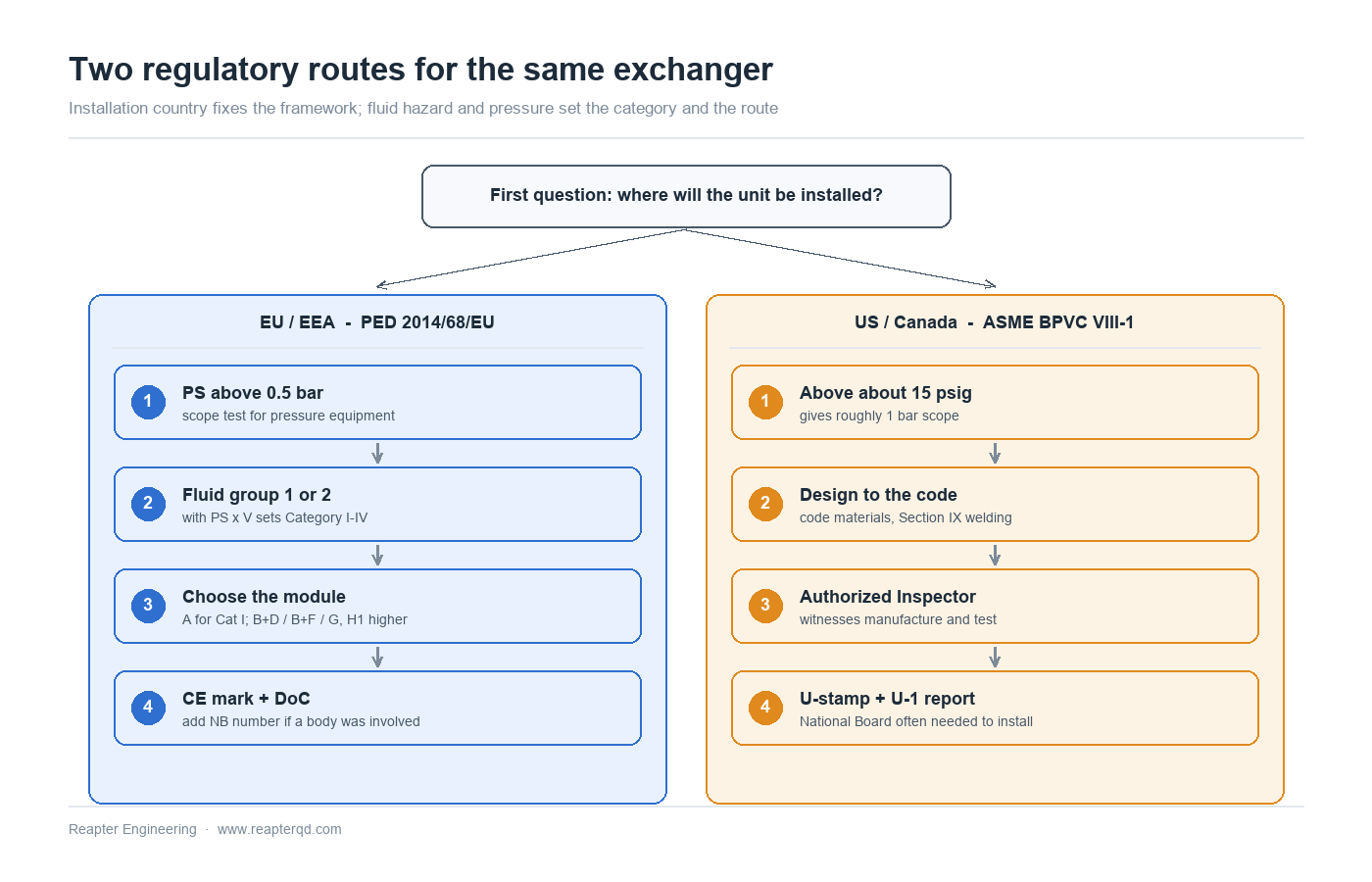
For the EU and EEA, the governing framework is the Pressure Equipment Directive 2014/68/EU. It applies to equipment with a maximum allowable pressure PS above 0.5 bar, covering vessels, piping, valves and exchangers. Equipment is placed in one of four categories (I to IV) using two inputs: whether the fluid is in Group 1 (dangerous — flammable, toxic, etc.) or Group 2 (non-dangerous, such as water or air), and a pressure–volume term, PS·V, or an equivalent size parameter. Higher category means stricter assessment.
The assessment modules scale with that category. Module A (internal production control) is the self-declaration route for the lowest category; categories II and III typically draw on combinations such as B+D, B+F or module G; category IV generally requires full quality-assurance modules such as H1, with a notified body involved. Design is normally made to harmonised standards — EN 13445 for unfired pressure vessels and EN 13480 for industrial piping are the common references. The outcome is CE marking on the equipment or nameplate, accompanied by an EC Declaration of Conformity signed by the manufacturer. When a notified body has been involved, its identification number appears next to the CE mark. The supporting technical file must be retained and available for market surveillance, typically for ten years.
The North American route: ASME BPVC Section VIII
In the United States and Canada the reference is the ASME Boiler and Pressure Vessel Code, most commonly Section VIII Division 1 for general industrial pressure vessels. It applies above roughly 15 psig (about 1 bar). Here the emphasis is less on hazard categories and more on a prescriptive construction code: design by code formulas, code-accepted materials (for example SA-240 for stainless plate), welding qualified to ASME Section IX, and mandatory inspection by an Authorized Inspector during manufacture. A hydrostatic test at 1.3 times the maximum allowable working pressure is the standard proof, with a lower pneumatic-test ratio where water cannot be used.
When the rules are met, the vessel receives the ASME U-stamp (or UM for the small-vessel provisions), and manufacturing data is recorded on U-1 or U-1A forms. Many US states and Canadian provinces additionally require registration with the National Board of Boiler and Pressure Vessel Inspectors before the unit can be installed. A buyer who asks for "an ASME exchanger" usually means the stamped unit plus its data report and registration — not simply a unit designed to code.
PED and ASME side by side
The two frameworks solve the same safety problem with different mechanics. Neither is universally "stricter"; the right one is set by where the unit will be installed and, in some markets, by the purchaser's own engineering standard. This comparison is a general guide for typical industrial water and process duties — the exact classification must be confirmed for the specific design.
| Aspect | PED 2014/68/EU (EU / EEA) | ASME BPVC VIII-1 (US / Canada) |
|---|---|---|
| Trigger | PS above 0.5 bar | Above about 15 psig (~1 bar) |
| Classification basis | Fluid group (1/2) + PS·V → Category I–IV | Prescriptive design rules; fewer hazard tiers |
| Design standards | Harmonised EN standards (e.g. EN 13445, EN 13480) | ASME code formulas and code-listed materials |
| Assessment | Modules A–H1; notified body for higher categories | Authorized Inspector throughout manufacture |
| Marking | CE mark + EC Declaration of Conformity | U-stamp / UM + U-1 data report |
| Registration | Not applicable in the same form | National Board in many jurisdictions |
What actually arrives in the document pack
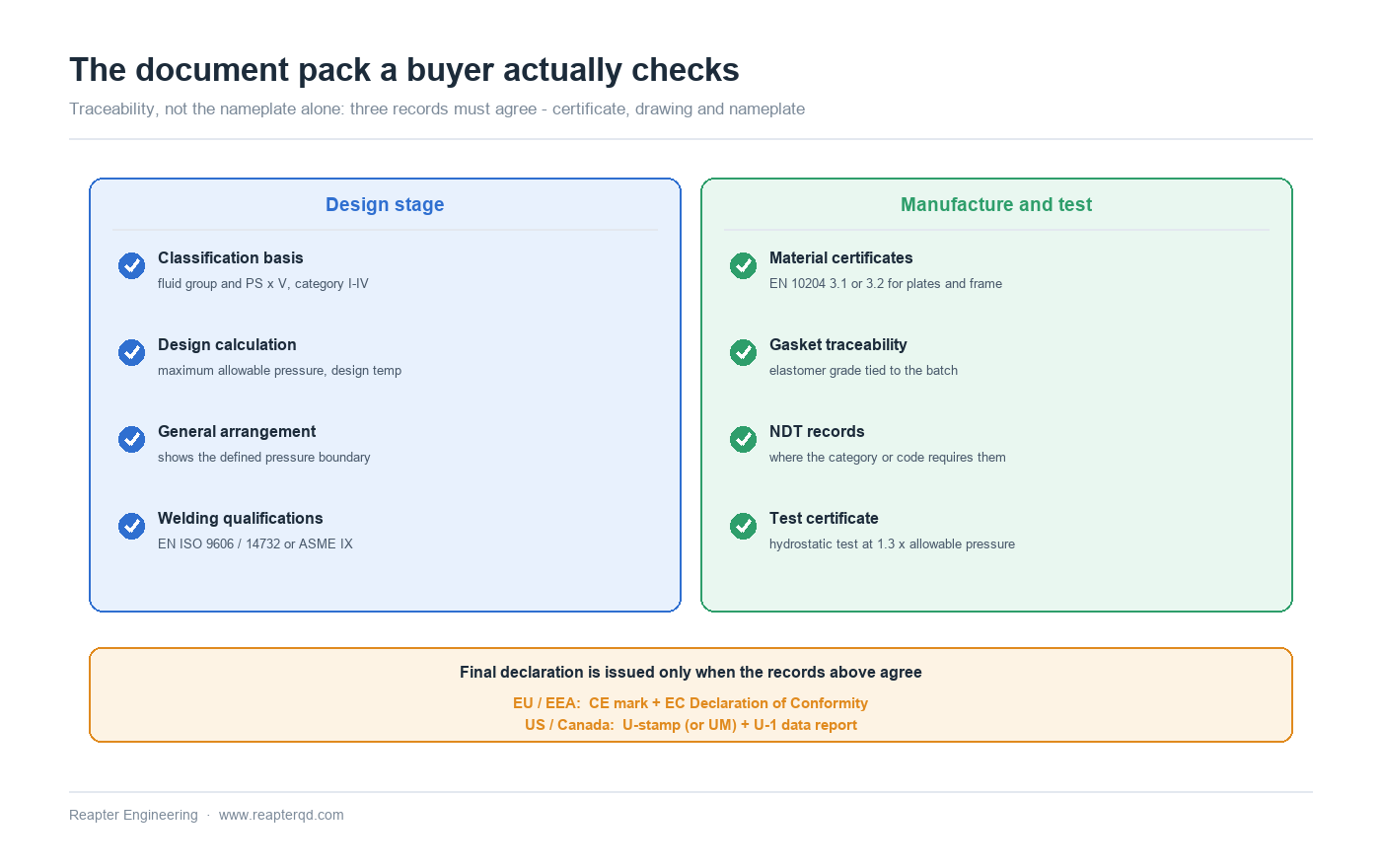
Experienced buyers do not take the nameplate at face value. They ask for a dossier that lets them trace every safety-critical claim back to a record. For a plate exchanger that pack normally includes: the design calculation and classification basis; a general arrangement drawing showing the pressure boundary; material certificates — typically EN 10204 3.1 or 3.2 — for plate and pressure-retaining parts; welding procedure and welder qualifications (EN ISO 9606 / 14732 or ASME IX as applicable); non-destructive test records where required; the hydrostatic test certificate with the actual test pressure and date; and the signed declaration or data report. Gasket material traceability deserves its own line, since the elastomer is a safety-relevant component even though it is not a pressure boundary.
Where export projects go wrong
Most documentation failures trace back to a handful of repeatable mistakes. The fluid group is recorded as non-dangerous when the process fluid is actually flammable or toxic, which puts the unit in the wrong category. PS·V is calculated on operating pressure instead of maximum allowable pressure, understating the classification. A notified-body number is omitted from the CE mark even though a notified body performed the assessment. The nameplate pressure, temperature or serial number disagrees with the declaration. Material certificates cover the frame but not the plates, or cover a plate grade that differs from the one on the bill of materials. Each of these is correctable on paper before shipment and expensive to resolve once the unit is on site.
A practical specification sequence
- State the country of installation and the authority or purchaser standard that applies — this fixes the regulatory route.
- Fix maximum allowable pressure and design temperature, then identify the fluid and its hazard group.
- Confirm how the gasketed plate pack is classified, with the notified body or authority if there is doubt.
- Agree the assessment module or stamping route, the inspection points and who witnesses the pressure test.
- List the required document pack in the purchase order, including certificate type and language.
- Set acceptance criteria for the nameplate, data report and marking before manufacture begins.
- Reserve a final document review at dispatch, so discrepancies are caught before the unit ships.
Common questions
Is CE marking the same as a quality certificate? No. The CE mark is a manufacturer's declaration that the equipment meets the applicable directive; it is not an independent endorsement of product quality. Its evidential weight depends on the category and on whether a notified body was involved.
Can one unit be supplied for both PED and ASME markets? Sometimes, but not by assumption. The two routes have different design rules, inspection regimes and documentation. Where a single machine must satisfy both, that should be engineered and agreed from the start rather than claimed after manufacture.
Does a plate exchanger need the same certification as a welded vessel? Not necessarily — but the answer depends on how the pack and frame are classified in the destination jurisdiction. Treat the pressure boundary definition as an open question to resolve with the authority, not a given.
What is the fastest way to check a supplier's documentation? Ask for a sample document pack from a comparable unit and compare certificate numbers against the nameplate and bill of materials. Consistency across those three documents is a reliable sign of a controlled process.
Conclusion
Export compliance is not a barrier to a good plate exchanger; it is the language in which a supplier proves the unit is safe to install. Understanding both the PED and ASME routes, and delivering a traceable document pack with the machine, is what turns technical competence into a deliverable a buyer can accept anywhere. Reapter supplies gasketed plate units with traceable material and test documentation for export projects and works with buyers to align the document pack with the destination authority. Request a quotation with your installation country and fluid data, and we will confirm the compliance route with you.
Related reading
Related information
- Heat Station Plate Heat Exchangers: Cleaning & Maintenance
- Fault Diagnosis for Heating Plate Heat Exchangers
- Industrial Plate Heat Exchangers: Price Factors
- Plate Heat Exchanger Key Advantages
- Application of Plate and Shell Heat Exchanger in Steam Generator Industry
- NT50M Compatible PHE Plates & Gaskets in Stock
Relevant article
- Wort Cooling with Plate Heat Exchangers: Two-Stage Design, Heat Recovery and Hygiene
- Insulating a Plate Heat Exchanger: Heat Loss, Condensation and Removable Covers
- PED vs ASME for Exported Plate Heat Exchangers: A Practical Compliance Guide
- Plate Heat Exchangers in Desalination: Feed Preheating, Brine Cooling and Material Limits
- HTST Pasteurization with Plate Heat Exchangers: Regeneration, Holding Time and Pressure Differential
- Steam Stall in Plate Heat Exchangers: Why a Steam Heater Loses Control at Part Load
- Gasketed, Semi-Welded or Fully Welded: Choosing Plate Heat Exchanger Construction for the Duty
- Gasket Shelf Life and Storage: Keeping Spare Plate Heat Exchanger Gaskets Fit for Duty
- Plate Heat Exchangers in MVR Evaporation: Designing Around a Small Driving Force
- Plate Heat Exchangers in Sugar Mills: Juice Heating, Evaporation Support and Molasses Cooling
Latest information
- Chemical Plate Heat Exchanger: Lubricant Roles & Care
- Heat Station Plate Heat Exchangers: Design & Application
- Heat Station Plate Heat Exchangers: Installation Guide
- Boiler Plate Heat Exchangers: Maintenance Guide
- The Integrated Heat Exchanger Unit: An Efficient Integration and Intelligent Control Solution for Thermal Energy Conversion
- Sulfuric Acid Plate Heat Exchangers: Design & Application
- Coal Chemical Plate Heat Exchangers: Cleaning & Maintenance
- Petrochemical Plate Heat Exchangers: Design & Application
- Chemical Plate Heat Exchangers: Gasket Ageing
- Sulfuric Acid Plate Heat Exchangers: Design & Application