Plate Heat Exchanger Connections: DN vs NPS, PN vs Class, and What Goes Wrong on Site

A correct thermal selection can still fail at the flange
Thermal design gets all the attention; connection detail is what stops a plant from starting up. A plate heat exchanger selected for a project in Rotterdam, Houston, Sao Paulo or Jakarta has to meet the pipework standard of that project, and the standard in the datasheet is not always the one in the yard. Three interface problems account for most of the trouble: DN and NPS sizes that are described as "the same" but do not bolt together, a pressure class quoted as though it were a rating at ambient temperature, and a nozzle layout that leaves no room to open the plate pack. None of them is a heat transfer problem. All three are cheap at the requisition stage and expensive at commissioning.
Two standard worlds, one nominal size
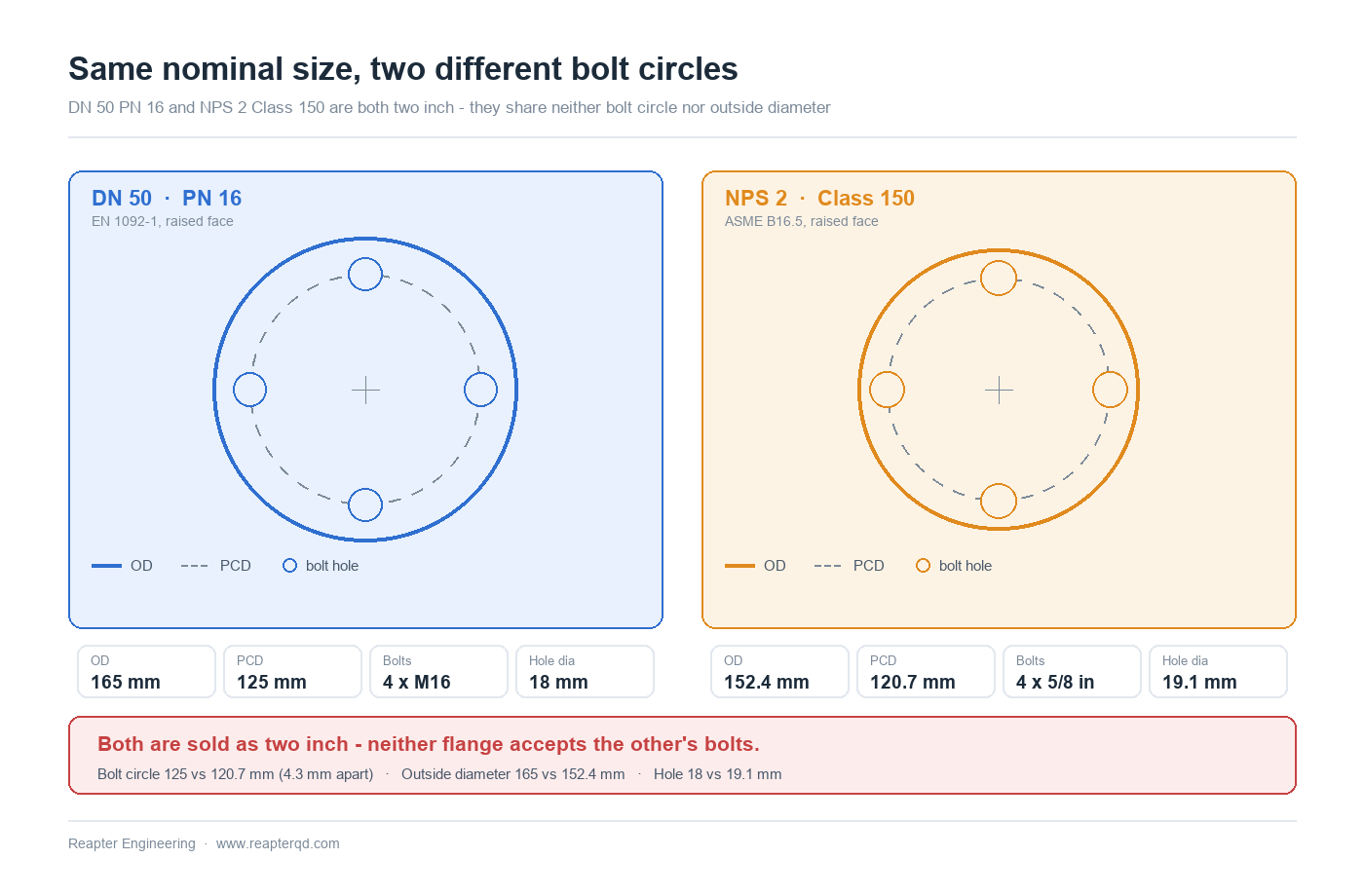
European pipework is sized by DN and rated by PN; North American pipework by NPS in inches and by Class. For the sizes that dominate plate heat exchanger duty the nominal bore really is the same - DN 50 is 50 mm, NPS 2 is 50.8 mm - so the words "two inch" cross between the two worlds without friction. The flanges do not. EN 1092-1 and ASME B16.5 were built on different bolt-circle conventions, with different outside diameters and, at several sizes, a different number of bolts. A DN 50 PN 16 flange and an NPS 2 Class 150 flange are both two inch, and they will not accept each other's bolts.
Where DN and NPS part company
The differences are small, systematic, and worth memorising, because they are what a fitter discovers at seven in the morning with the exchanger already on the deck.
| Nominal size | EN 1092-1 PN 16: OD / PCD / bolts | ASME B16.5 Class 150: OD / PCD / bolts | Will they bolt together? |
|---|---|---|---|
| DN 50 / NPS 2 | 165 / 125 / 4 x 18 mm | 152.4 / 120.7 / 4 x 19.1 mm | No - 4.3 mm bolt-circle offset |
| DN 80 / NPS 3 | 200 / 160 / 8 x 18 mm | 190.5 / 152.4 / 4 x 19.1 mm | No - different bolt count |
| DN 100 / NPS 4 | 220 / 180 / 8 x 18 mm | 228.6 / 190.5 / 8 x 19.1 mm | No - different OD and PCD |
| DN 150 / NPS 6 | 285 / 240 / 8 x 22 mm | 279.4 / 241.3 / 8 x 22.2 mm | No - 1.3 mm bolt-circle offset |
The DN 150 / NPS 6 pair is the one to watch. A 1.3 mm bolt-circle offset and a 5.6 mm outside-diameter difference are small enough to be forced: a fitter can usually drag the two flanges together with a podger and a longer bolt. The joint that results has uneven gasket seating, bolts loaded in shear rather than tension, and a leak that appears weeks later in the middle of a production run. Where the bolt count differs outright - DN 80 has eight, NPS 3 has four - the error is caught in the laydown yard. The near-miss sizes are the ones that reach the operating floor.
A class designation is not a pressure rating at temperature
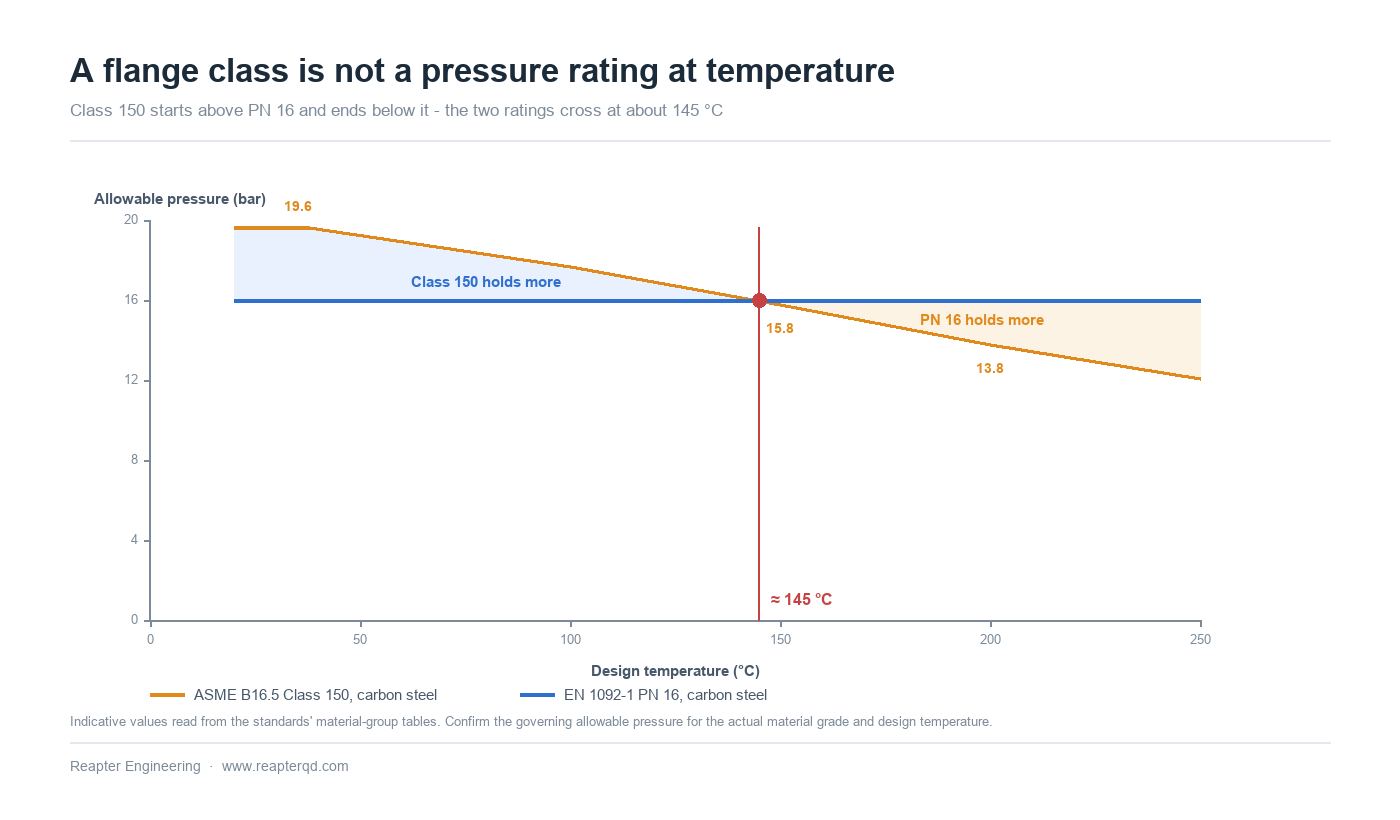
The second trap is arithmetic rather than geometry. PN 16 and Class 150 are routinely treated as equivalent because 16 bar is roughly 230 psi and 150 lb is roughly 285 psi, and the assumption is that the American flange is simply a little stronger. At ambient temperature it is: a carbon-steel Class 150 flange allows about 19.6 bar at 38 degrees C, against 16 bar for PN 16. Then the curves cross. Both standards derate with temperature, on different curves and at different rates, and above roughly 145 degrees C a carbon-steel Class 150 flange holds less pressure than a PN 16 flange of the same nominal size - about 13.8 bar at 200 degrees C against 16 bar.
Most plate heat exchanger duty sits well below that band, which is why the error survives for years and then surfaces on a district-heating substation or a high-temperature heat pump running above 100 degrees C. Read the allowable pressure from the standard table for the actual material group at the actual design temperature, and read it for both standards before deciding that a Class 150 unit can replace a PN 16 one.
Nozzle layout: the part the drawing never shows
Connection size is one line of the interface; position is the other. In a single-pass arrangement on both sides, all four connections sit on the frame plate and the pipework is fixed. In a pass arrangement on one side, one or two connections move to the pressure plate - the plate that travels when the pack is opened. Pipework to the pressure plate needs a removable spool piece or a flexible section, and the route must not cross the space the pressure plate needs to travel through. That space belongs on the layout drawing with a dimension on it: opening a pack for cleaning or re-gasketing takes clear floor in front of the frame of roughly the plate pack length, plus room to work the tightening gear. Plants piped hard against a wall pay for the mistake with a crane and a shutdown.
Velocity belongs in the same conversation. The port diameter of a plate heat exchanger is set by the plate pattern, not by the pipe schedule, so the connection is often the narrowest point in the circuit; keeping water velocity in the 2-3 m/s band limits erosion and vibration. Where the plant pipe is larger than the connection, use an eccentric reducer, flat side up on horizontal runs, so air does not pocket at the step. Where the plant pipe is smaller, do not neck down at the connection to save a fitting - the port is already the constraint, and a smaller connection simply moves the pressure drop to the worst available place.
What to fix before the enquiry goes out
- State the flange standard, not the nominal size. "DN 100" is ambiguous; "DN 100 PN 16 to EN 1092-1, raised face" is a specification.
- Give design pressure and design temperature together. A flange class without a temperature is half a rating.
- Say which connection is which. Hot and cold sides are often different sizes; label them with the fluid, not only the line number.
- Confirm the facing. Raised face is the default on both standards, but a flat-face or ring-joint request changes the flange and the gasket together.
- Reserve the pack-opening space. Put it on the layout, with a dimension, before the piping is modelled.
- Agree the bolting. Metric and imperial studs are not interchangeable; supply the stud set with the exchanger, in the matching standard, grade and material.
When the plant is already built
Most real projects do not get that luxury, and the exchanger has to meet pipework that already exists. There are four routes out, with different costs and different risks.
| Option | What it involves | Best for | Watch-outs |
|---|---|---|---|
| Adapter spool piece | Short pipe section with one standard on each end | One or two mismatched connections in a retrofit | Adds length to the run - check the space before ordering |
| Dual-standard drilling | One flange drilled for both bolt patterns | Small offsets at low pressure | Slotted holes cut into the seating area; not acceptable at high pressure or in cyclic duty |
| Re-flange on site | Cut and weld a new flange to the project standard | Large sizes where adapters are costly | Needs a qualified welder, NDT and a re-test; changes the pressure boundary |
| Order the connection to the project standard | Frame supplied with the project's flanges from the factory | New builds | Must be in the requisition - it is not a field fix |
Two smaller items belong in the same bundle. Bolt grade and gasket selection have to match the duty, not the flange: stainless studs running in a stainless flange gall and seize, so an anti-seize compound or a different stud grade is normal practice, and where a stainless flange meets a carbon-steel one on a coastal site, a dielectric kit prevents the small galvanic cell that quietly eats the bolt holes. And the gasket has to match the facing the plant actually has - a raised-face gasket on a flat-face flange will not seal, however well the exchanger was built.
Common questions
Can a DN 50 flange be made to fit an NPS 2 flange? Not properly. A 4.3 mm bolt-circle offset cannot be absorbed by the bolts, and slotting the holes removes the seating area the gasket needs. An adapter spool with one standard at each end is the correct answer and costs far less than the downtime.
Is PN 16 the same as Class 150? No. At ambient temperature Class 150 allows more pressure - about 19.6 bar for carbon steel against 16 bar - and above roughly 145 degrees C it allows less, about 13.8 bar at 200 degrees C against 16 bar. The nominal numbers coincide only by coincidence.
Should the exchanger connection match the pipe size? Match it where you can, but remember that the port inside the plate pack is the real restriction. Necking the connection down to the pipe size to save a reducer usually costs more in pressure drop than the fitting saves.
Why does the pressure plate need a flexible connection? Because it moves. Opening the pack for cleaning or re-gasketing shifts the pressure plate along the frame, and rigid pipe attached to it either blocks the movement or cracks at the weld. A removable spool or a short flexible section is standard practice on pass arrangements.
Conclusion
Connection detail is unglamorous and decisive: it determines whether an exchanger that meets its duty datasheet also meets the plant it is bolted to. Reapter supplies gasketed plate heat exchangers with connections to EN, ASME or project-specific flange standards, and ships matched bolting and gaskets with the unit so a site is never left hunting for imperial studs in a metric yard. Our engineering team works from the project's pipework standard and layout drawing rather than assuming a default, and supports installations worldwide from requisition through commissioning. If you are matching an exchanger to existing pipework, or checking a flange schedule before you order, send us the line list and we will confirm the interface.
Related information
- Detachable plate heat exchanger plate corrosion and gasket aging causes, the reason you want to know is here
- How to improve the heat transfer efficiency of plate heat exchanger
- Structural features of circular plate shell and plate heat exchanger
- Plate heat exchanger for chemical industry
- Qingdao Ruipute plate heat exchanger to provide solutions for the ship's thermal system
- GEA plate heat exchanger plates with high precision and wide range of models
Relevant article
- Plate Heat Exchanger Connections: DN vs NPS, PN vs Class, and What Goes Wrong on Site
- Free Cooling with Plate Heat Exchangers: Design and Changeover
- Multi-Section Plate Heat Exchangers: Two Duties, One Frame
- Retrofitting a Shell-and-Tube with a Plate Heat Exchanger: Fitting the Duty into an Existing Plant
- Packing a Plate Heat Exchanger for Ocean Freight: Preservation, Storage and Site Handover
- Plate Heat Exchangers Under Vacuum: Operating on the Negative-Pressure Side
- Gasket Compression Set and Bolt Torque Management in Plate Heat Exchangers
- Parallel Plate Heat Exchanger Banks: N+1 Redundancy and Flow Balancing
- Reading a Water Analysis Before You Specify a Plate Heat Exchanger
- High-Temperature Heat Pumps Above 100 °C: Exchanger Selection for Steam Replacement
Latest information
- The original lubricant in the chemical plate heat exchanger plays so many roles!
- Heat exchanger station supporting plate heat exchanger or have to pay attention to these points, or easily go wrong
- Heat station supporting plate heat exchanger installation is a technical work, these points should be noted
- Improve the efficiency of industrial boilers with plate heat exchanger, these maintenance points to keep in mind
- The Integrated Heat Exchanger Unit: An Efficient Integration and Intelligent Control Solution for Thermal Energy Conversion
- Sulfuric acid and other corrosive media for industrial plate heat exchanger requirements are what
- Simple and effective chemical cleaning method of coal chemical plate heat exchanger, can effectively improve efficiency
- A high-quality petrochemical plate heat exchanger in the production of what to consider
- These causes of chemical plate heat exchanger gasket aging you may not know
- Chemical plant plate heat exchanger, sulfuric acid cooling needs attention