Plate Heat Exchangers Under Vacuum: Operating on the Negative-Pressure Side

Why vacuum duty deserves its own checklist
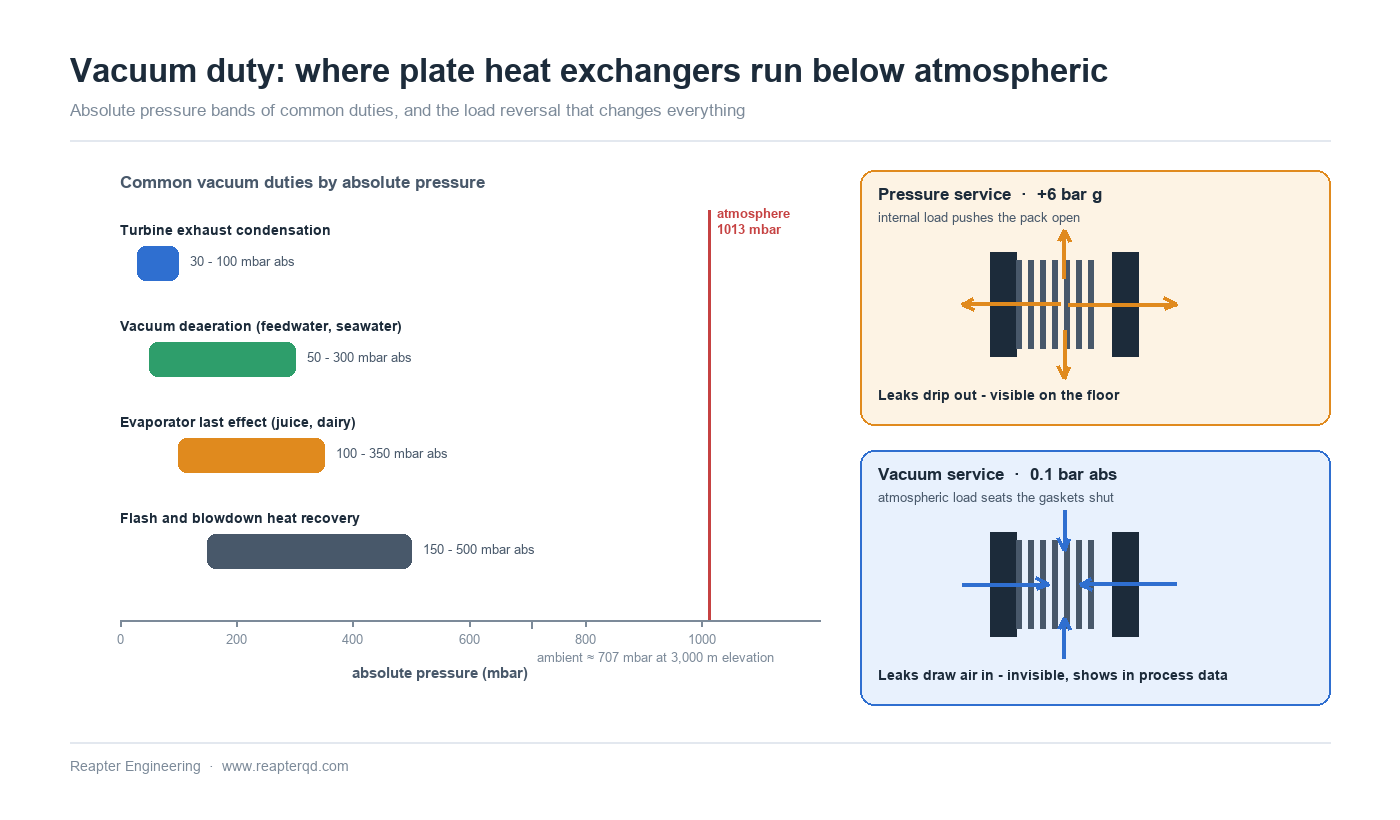
Most plate heat exchanger guidance assumes the medium pushes outward. A meaningful share of installed units do the opposite: they run below atmospheric pressure, where the mechanical load reverses, leaks travel inward instead of out, and the symptoms of a fault look nothing like the familiar drip on the floor. Turbine exhaust condensers, vacuum deaerators, last effects of low-temperature evaporators and flash recovery vessels all sit somewhere between 30 and 500 mbar absolute. Specify, test and maintain such a unit with pressure-service habits and the real failure modes stay invisible. This article sets out what actually changes on the negative-pressure side, and how to prove a unit is tight.
Where plate heat exchangers meet vacuum
Vacuum operation is rarely the headline duty; it is usually a consequence of thermodynamics. Water boils at a lower temperature under reduced pressure, so any process that must run cold pulls its exchanger below one atmosphere:
| Application | Typical absolute pressure | Why it sits below atmospheric |
|---|---|---|
| Turbine exhaust condensation | 30 to 100 mbar | Condensing steam at 25 to 45 °C requires sub-atmospheric saturation pressure |
| Vacuum deaeration of boiler feed or seawater | 50 to 300 mbar | Oxygen stripped at low temperature without heavy chemical dosing |
| Last effect of low-temperature evaporation | 100 to 350 mbar | Product temperature held at roughly 40 to 60 °C to protect the medium |
| Flash and blowdown heat recovery | 150 to 500 mbar | Hot condensate flashed to recover latent heat at a usable level |
| High-altitude sites above about 2,500 m | Ambient 700 to 750 mbar | The whole loop can fall below one atmosphere at the pump suction |
None of these duties is exotic. What is unusual is how rarely the datasheet, the test procedure and the maintenance routine are aligned to them.
What negative pressure changes mechanically
Start with the datasheet. A unit intended for such service carries a design pressure written as full vacuum plus a positive rating - FV/6 bar, for example. Both halves are real design cases: the frame, the nozzle loads and the plate pack each see a different worst case in each direction, and a unit is only qualified if both are stated.
The load direction is the next difference. In pressure service the medium tries to open the pack and push past the gasket lips. Under vacuum, atmospheric pressure presses the frames together and seats the gaskets - a helping direction. The gasket rarely blows out in vacuum duty. Instead the risk migrates to a different population of joints: instrument tappings, vent and drain valves, blanked-off connections, port liners, and machined contact faces under paint or light corrosion. A unit that was tight at 6 bar can still breathe at 100 mbar, because the contact stress and the leak path direction are simply not the same problem.
The pack itself also sees a new case. Plates are supported at their contact points, and sub-atmospheric loading across the full plate area is a compression case the frame has to react. Deep vacuum with one circuit drained is a harsher configuration than vacuum with both sides wet, so a unit should not be pulled down empty unless its design explicitly allows it. Reputable frames state a permitted full-vacuum rating per model and pack size; that number belongs in the specification, not in an assumption.
Air ingress: the leak you cannot see
In pressure service a leak announces itself as a puddle. Under vacuum the pressure gradient points inward, so the exchanger quietly swallows air, and the first evidence appears in the process data rather than on the floor:
- The vacuum will not pull down, or degrades slowly over days.
- Capacity falls out of proportion to any visible change. A thin blanket of non-condensable gas on a condensing surface acts as an insulating film; at a few percent by volume the effective steam-side film coefficient can be cut by half or more.
- Condensate temperature drifts away from the saturation temperature that corresponds to the measured absolute pressure - the gap is the size of the air blanket.
- In water systems, ingressed oxygen drives corrosion products downstream, and pump suction margins shrink as the liquid approaches its saturation pressure.
Because none of these produces a drip, plants often respond by adding capacity or chemistry. The cheaper first move is to treat the symptom as a tightness problem and test for it directly.
Leak testing under vacuum
Three test families cover the field, and they are not interchangeable:
| Method | What it does | Where it fits |
|---|---|---|
| Pressure decay | Pressurize the circuit, isolate, watch the pressure fall | Standard for positive-pressure service; can pass a unit that still leaks under vacuum |
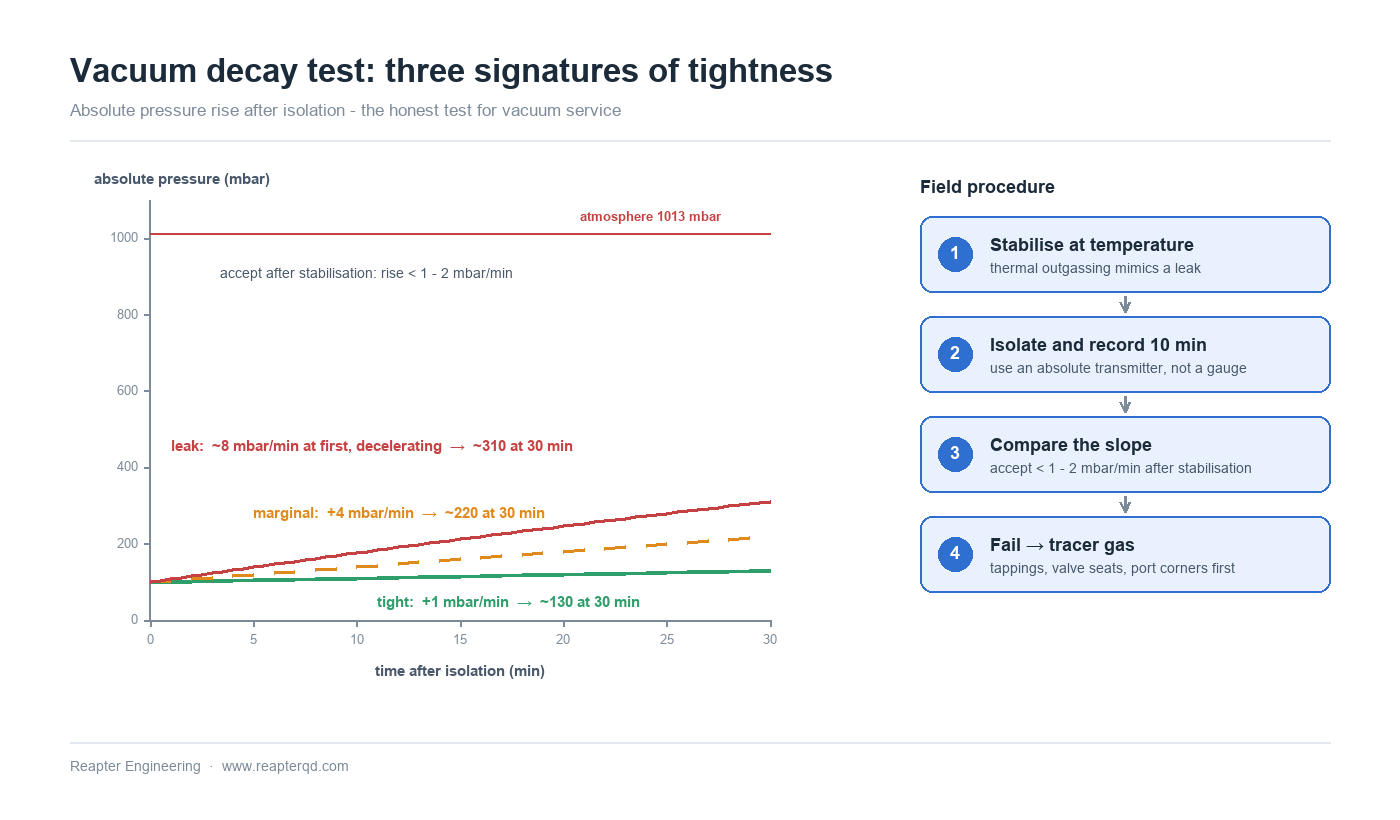
| Vacuum decay | Pull the circuit to service vacuum, isolate, watch the pressure rise | The honest test for vacuum duty - load direction matches service |
| Tracer gas | Pressurize with helium or forming gas and sniff joints | Locates the leak once a decay test has proven one exists |
Direction matters more than most teams expect. A gasket lip that was nicked at assembly may seat shut under internal pressure and still weep when the gradient reverses, which is exactly the condition the plant runs in. For a vacuum-service unit, a vacuum decay test is the acceptance test; a pressure decay result alone is evidence about a different load case.
Practice that avoids false alarms: bring the unit to operating temperature first, because thermal outgassing and residual condensation mimic a leak; stabilize, isolate, then record the rise. A common acceptance figure after stabilization is a rise below 1 to 2 mbar per minute, tightening to the OEM or process specification where one exists. A clear failure calls for a tracer gas pass across tappings, valve seats and port corners - in that order, because that is where these leaks live.
Gasket and assembly practice for vacuum service
Elastomer selection follows the same medium-based rules as anywhere else - NBR, EPDM or FKM according to the fluid and temperature. Three additions make the difference in vacuum work:
- Write full vacuum into the datasheet line and the order confirmation, not just the positive rating.
- Close the pack to the specified pack dimension, measured at four points, and re-torque after the first thermal cycle. Assembly discipline is identical to pressure service; the acceptance value is still the dimension, not the wrench reading.
- Audit the quiet paths. Replace blanked tappings with sealed plugs, prove vent and drain valve seats, and inspect the machined faces where the gasket lands for paint, pitting or a washed-out groove. A vacuum test after re-gasketing is cheap insurance, because the leak it finds will never drip.
Instrumentation and operating practice
Running below atmospheric also changes what the instruments must do:
- Fit an absolute pressure transmitter on the vacuum side. A conventional gauge reads zero all the way down, which is no information at all between 0 and 1 bar.
- Track condensate temperature against the saturation temperature at the measured absolute pressure. A growing gap is the earliest reliable sign of air ingress, well before capacity figures move.
- Vent non-condensables continuously on condensing duty rather than waiting for the weekly reading to look wrong.
- Re-check pump NPSH. Liquid at 100 mbar absolute is close to its saturation point, so static head that looked generous at sea level can vanish - literally so at altitude, where the ambient pressure itself is 700 mbar or less.
Common questions
Can a gasketed plate heat exchanger run at full vacuum? Yes, provided the datasheet states full vacuum as a design condition alongside the positive rating. Frame models differ in their permitted vacuum case, and the pack should not be pulled down with one circuit empty unless the design allows it. Confirm both points against the general arrangement drawing before the duty is finalized.
What is an acceptable vacuum decay rate? After thermal stabilization, a rise below about 1 to 2 mbar per minute over a ten-minute window is a common acceptance level for a full pack; follow the OEM or process specification where one exists. A faster or accelerating rise justifies a tracer gas survey before the unit returns to service.
Capacity has dropped but there is no visible leak - where do I look first? Look for non-condensables. Compare the measured absolute pressure with the condensate temperature: if the condensate is colder than saturation at that pressure, gas is blanketing the surface. Vent, then run a vacuum decay test to find the entry path.
Conclusion
Vacuum duty is not a special case to be avoided; it is a normal consequence of running processes cold, and it rewards teams who align the specification, the test method and the maintenance routine to the negative-pressure load case. Reapter designs and supplies gasketed plate heat exchangers rated for full vacuum service, stocks replacement gaskets for vacuum-duty rebuilds, and supports commissioning, tightness testing and on-site diagnosis for projects worldwide. If your duty runs below atmospheric, share the absolute pressure and the medium - request a thermal selection with a tightness test plan to match.
Related information
- Application of boiler plate heat exchanger
- Experienced technical workers tell you: how to detect the plate heat exchanger gasket:
- As for the price of plate heat exchanger, you should consider these factors
- Introduction of heat transfer equipment of several major categories
- Industrial plate heat exchanger custom-made, the right one is really good
- Calculation method of wall temperature of heat exchanger
Relevant article
- Plate Heat Exchanger Connections: DN vs NPS, PN vs Class, and What Goes Wrong on Site
- Free Cooling with Plate Heat Exchangers: Design and Changeover
- Multi-Section Plate Heat Exchangers: Two Duties, One Frame
- Retrofitting a Shell-and-Tube with a Plate Heat Exchanger: Fitting the Duty into an Existing Plant
- Packing a Plate Heat Exchanger for Ocean Freight: Preservation, Storage and Site Handover
- Plate Heat Exchangers Under Vacuum: Operating on the Negative-Pressure Side
- Gasket Compression Set and Bolt Torque Management in Plate Heat Exchangers
- Parallel Plate Heat Exchanger Banks: N+1 Redundancy and Flow Balancing
- Reading a Water Analysis Before You Specify a Plate Heat Exchanger
- High-Temperature Heat Pumps Above 100 °C: Exchanger Selection for Steam Replacement
Latest information
- The original lubricant in the chemical plate heat exchanger plays so many roles!
- Heat exchanger station supporting plate heat exchanger or have to pay attention to these points, or easily go wrong
- Heat station supporting plate heat exchanger installation is a technical work, these points should be noted
- Improve the efficiency of industrial boilers with plate heat exchanger, these maintenance points to keep in mind
- The Integrated Heat Exchanger Unit: An Efficient Integration and Intelligent Control Solution for Thermal Energy Conversion
- Sulfuric acid and other corrosive media for industrial plate heat exchanger requirements are what
- Simple and effective chemical cleaning method of coal chemical plate heat exchanger, can effectively improve efficiency
- A high-quality petrochemical plate heat exchanger in the production of what to consider
- These causes of chemical plate heat exchanger gasket aging you may not know
- Chemical plant plate heat exchanger, sulfuric acid cooling needs attention