Multi-Section Plate Heat Exchangers: Two Duties, One Frame

Two duties in one frame is a packaging decision, not a thermal one
A multi-section plate heat exchanger puts two independent thermal duties into a single frame: one set of tie rods, one footprint, two plate packs divided by a solid plate, and two independent gasket fields. The best-known example sits in district heating substations, where one unit heats domestic hot water in the first section and the space heating circuit in the second. The same arrangement appears in refrigeration packages with a condenser and a desuperheater, in heat pump units with a source side and a load side, and on process skids where a preheat and a final heater are bought together.
It is worth being precise about what the arrangement does. It does not raise the heat transfer coefficient, cut the surface, or buy a closer approach. Each section is sized as if it were a separate unit, with its own duty, its own fouling allowance and its own pressure drop budget. What the shared frame saves is floor area, pipework, insulation, one set of tie rods and one pressure test. What it costs is that both duties go offline for the same maintenance window.
How the pack is divided
The plate stack runs the length of the frame in the usual way, clamped between a fixed cover and a pressure plate. The difference is a divider plate partway along. It is solid — not a channel plate — with gasket grooves machined on both faces, so it terminates the first pack and starts the second. No fluid passes through it and no heat crosses it.
Everything else follows from that one detail:
- Two separate gasket fields. Each section seals against its own ports. A leak in one does not pressurise the other.
- The divider is the pressure boundary between the duties. It sees the difference between the two sections, not the full design pressure of either.
- One rod set clamps both packs. Total pack length plus divider thickness sets the rod length, and gasket compression is set for the stack as a whole. Neither section can be released on its own.
- The plates must share a geometry. Same plate size and port pattern, because both packs sit in one frame. Corrugation angle, plate material and gasket elastomer can differ from section to section.
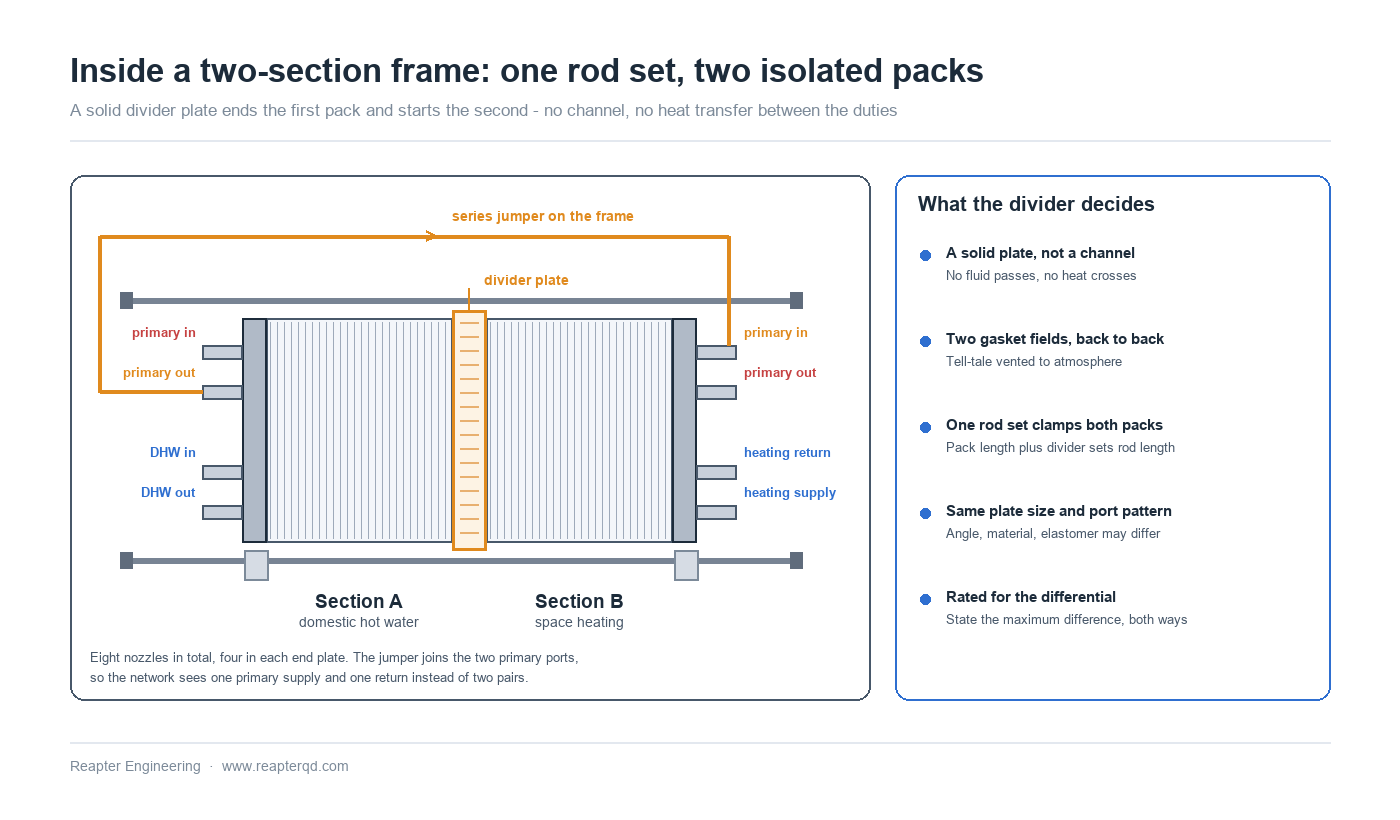
The divider plate is where the engineering sits
Three details around the divider decide whether the unit behaves for twenty years.
A tell-tale between the gaskets. The divider carries two gasket rings back to back, one facing each pack, with a groove vented to atmosphere between them. Leakage from either duty then appears as a drip at the frame instead of as cross-contamination between a potable circuit and a heating circuit. On domestic hot water duty this is not a refinement — it is the reason the arrangement is accepted at all — and the vent has to stay open and visible after the insulation goes on.
Differential pressure, stated in both directions. The divider is designed for the pressure difference across it, including upsets such as a pump trip on one circuit or a valve closed on the other. A divider rated for 3 bar and asked to hold 10 will bow, and a bowed divider unloads the gasket across the middle of the pack. The leak then appears at the divider but originates in the selection.
Ports at the ends, not in the middle. Each section's four connections are arranged in its own end plate: section A in the fixed cover, section B in the pressure plate. Every nozzle is then reachable from outside the frame and the series jumper runs along the side or over the top. A nozzle in the middle of the pack is possible, but it makes both the pipework and the insulation detail harder than they need to be.
Sizing each section on its own duty
Each section is a plate heat exchanger in its own right and is sized as one: its own duty, its own mean temperature difference, its own fouling factor and its own pressure drop budget. Two habits cause most of the trouble.
The first is splitting a single duty into two equal sections in the hope of reducing pressure drop. That is a series arrangement of one duty — the packs sit in the same circuit and heat passes between them — not a multi-section unit. In a genuine multi-section unit the two packs are thermally isolated, and the outlet of one has no influence on the other except through the shared circuit. If the problem is pressure drop, split the flow or add passes; if there are two duties, use sections.
The second is budgeting plates by habit. Plate counts in the two sections are rarely equal, because the duties are not. The frame only cares about the total: pack A plus divider plus pack B must fit the rod length with the gasket compression still in range. Adding plates to one section later is possible only if the rods have thread to spare — an argument for ordering the frame one size long at the start rather than discovering the shortage at the first re-rate.
One sizing point is easy to miss. A single counterflow pass cannot take a cold outlet past the hot outlet; the approach at that end has to stay positive. Where one end of a duty needs a very close approach and the other end is relaxed, two sections let each half be arranged and sized for its own end of the curve, instead of compromising one pack for both.
Hydraulics: eight nozzles, six connections to the plant
Two sections of four connections each means eight nozzles — the same count as two separate units. What changes is how many of them reach the plant. In the usual substation arrangement the primary runs in series: network supply into section A, out of A, across a jumper on the frame into section B, out of B and back to the network. The network then sees two primary connections instead of four, and the jumper is the only extra pipe in the package.
That shared primary is the operational price. Primary flow is common to both sections, so opening the heating control valve lowers the primary temperature entering the domestic hot water section, and the DHW outlet follows it. Two control valves on one series primary interact. The usual remedies are to put the faster, tighter duty downstream so it receives the primary at the temperature the heating section left it, to accept a small reset on the heating curve, or — where the interaction cannot be tolerated — to feed the two sections from a parallel primary header, which gives back part of the pipework the shared frame was meant to save.
Two details are worth fixing at the drawing stage: size the jumper for the full primary flow rather than one section's share, and give each section its own isolation so one duty can be valued off while the other keeps running.
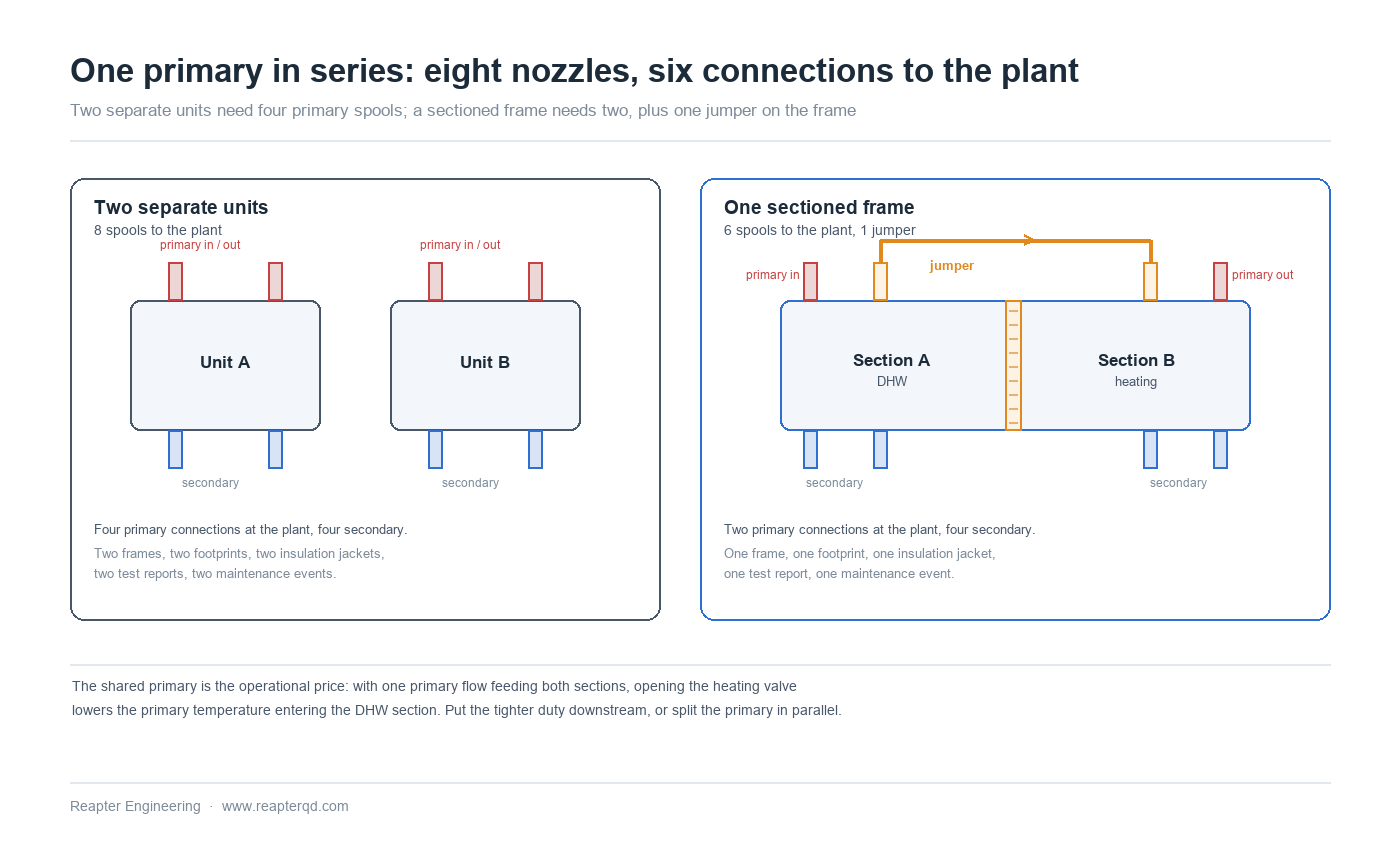
What one frame saves, and what it costs
| Item | Two separate units | One two-section frame |
|---|---|---|
| Frames and tie rods | Two | One |
| Floor area | Two footprints, access in front of each pack | One footprint, access at the pressure plate |
| Connections to the plant | Eight | Six, with a series primary |
| Insulation | Two jackets | One jacket, with a divider detail |
| Plate packs | Two | Two, total plate count unchanged |
| Gasket replacement | Per unit | Per section, but the pack opens as a whole |
| Maintenance | One duty keeps running | Both duties stop together |
| Pressure rating | Independent per unit | Set by the frame, divider rated for the differential |
| Spare plates | One pattern per unit | One pattern for both sections |
| Testing and documentation | Two tests, two certificate sets | One test, one nameplate, one report |
The last two rows are the ones buyers underestimate. A single frame means one pressure test, one nameplate, one set of material certificates and one factory acceptance test instead of two — real savings in paperwork and in the witness schedule. On the other side, a single frame means a single failure point in the maintenance plan: when the pack is released, both duties stop.
When two separate units are the better answer
Multi-section is the wrong choice in five situations:
- Very different fouling rates. If one side needs opening twice a year and the other once every three years, tying them together means servicing the clean duty to reach the dirty one.
- Different plate sizes or port patterns. The sections cannot share rods, so the point of the single frame disappears.
- Very different design pressures. A 25 bar duty next to a 6 bar duty means paying for the higher rating twice and loading the divider in a way that has to be engineered explicitly.
- Independent availability requirements. Where the plant must keep one duty running while the other is serviced, two units are the only honest answer.
- Strongly asymmetric duties. When one section is four times the other, the shared frame is mostly carrying the big one: the packaging benefit shrinks while the coupling cost stays.
Common questions
Can a single-section unit be converted into two sections later? No. The divider plate, the second port set and the second gasket field are part of the frame and the plate stack; adding them means a new unit. If a second duty is plausible within the plant's life, order the sectioned version now.
Do both sections need the same gasket material? No, and often they should not be. A domestic hot water section is usually EPDM; a heating section on treated water may be NBR. What they must share is the plate geometry, and the compression range of both gaskets has to be compatible with one clamping force.
Can the sections use different plate materials? Yes. Titanium in a seawater or brine section and 316 stainless in a clean section is a normal combination, provided the plates are dimensionally identical. The spare-plate strategy then needs two part numbers rather than one.
How is the divider tested? The unit is pressure tested as a whole at the specified test pressure, then each section is tested separately with the tell-tale open and observed. Witness both, and have the tell-tale observation written into the test report rather than accepting a general statement that the unit is tight.
Does a multi-section unit carry one nameplate? Yes, and it should list each section's design conditions separately: pressure, temperature and test pressure per section, plus the maximum differential across the divider. A nameplate giving one set of figures for a two-duty unit is a documentation defect worth rejecting.
Conclusion
Multi-section packaging is a small idea with a narrow, well-defined payoff: one frame, one footprint, one test and one maintenance event, paid for with a shared primary circuit and coupled downtime. It works when the two duties share a hydronic system, sit at similar pressures, foul at similar rates and are maintained together. It becomes a liability when any one of those four conditions fails, and the first sign is usually a control interaction rather than a mechanical fault.
Reapter designs and builds divided-pack gasketed units to order. The section split, the divider rating and the nozzle layout are fixed on the approval drawing before the frame is cut, and the test report treats the two sections as separate pressure boundaries rather than reporting the unit as a whole. If you are weighing one frame against two, send both duties and the primary arrangement — series or parallel — and we will return a sectioned selection with the plate count of each pack and the divider pressure stated. Contact us to start that review.
Related information
- Many people were killed in the Aegean earthquake. How can seawater plate heat exchangers be accident-free?
- Does heating plate heat exchangers really need to be cleaned once a year?
- Application of imported plate heat exchanger in waste heat recovery of large particle medium production line
- What are the advantages of industrial plate heat exchangers in applications
- Shandong detachable plate heat exchanger manufacturers interpret the factors affecting the compression and permanent deformation of vulcanized rubber
- How to swap a cheap Alfa Laval plate heat exchanger gasket?
Relevant article
- Plate Heat Exchanger Connections: DN vs NPS, PN vs Class, and What Goes Wrong on Site
- Free Cooling with Plate Heat Exchangers: Design and Changeover
- Multi-Section Plate Heat Exchangers: Two Duties, One Frame
- Retrofitting a Shell-and-Tube with a Plate Heat Exchanger: Fitting the Duty into an Existing Plant
- Packing a Plate Heat Exchanger for Ocean Freight: Preservation, Storage and Site Handover
- Plate Heat Exchangers Under Vacuum: Operating on the Negative-Pressure Side
- Gasket Compression Set and Bolt Torque Management in Plate Heat Exchangers
- Parallel Plate Heat Exchanger Banks: N+1 Redundancy and Flow Balancing
- Reading a Water Analysis Before You Specify a Plate Heat Exchanger
- High-Temperature Heat Pumps Above 100 °C: Exchanger Selection for Steam Replacement
Latest information
- The original lubricant in the chemical plate heat exchanger plays so many roles!
- Heat exchanger station supporting plate heat exchanger or have to pay attention to these points, or easily go wrong
- Heat station supporting plate heat exchanger installation is a technical work, these points should be noted
- Improve the efficiency of industrial boilers with plate heat exchanger, these maintenance points to keep in mind
- The Integrated Heat Exchanger Unit: An Efficient Integration and Intelligent Control Solution for Thermal Energy Conversion
- Sulfuric acid and other corrosive media for industrial plate heat exchanger requirements are what
- Simple and effective chemical cleaning method of coal chemical plate heat exchanger, can effectively improve efficiency
- A high-quality petrochemical plate heat exchanger in the production of what to consider
- These causes of chemical plate heat exchanger gasket aging you may not know
- Chemical plant plate heat exchanger, sulfuric acid cooling needs attention