Applications for Industrial Plate Heat Exchangers

Industrial plate heat exchangers are used in a wide range of applications, they are used in air conditioning heating systems or as components of cooling systems. So what are its advantages? Let me explain briefly for you
1?High heat transfer coefficient. Different corrugated plates form a complex channel, so that the fluid between the plates is a three-dimensional rotational flow, in the low Reynolds number will produce turbulent flow, so the heat transfer coefficient is high.
2. Logarithmic mean temperature difference is large, and the end temperature difference is small. Most industrial plate heat exchangers are parallel or counter-current flow, the correction factor is generally around 0.95.
3. Small footprint and compact structure. No need to reserve maintenance position for the extraction of the tube bundle
4. It is easy to change the heat transfer area or process combination. The purpose of increasing or decreasing the heat transfer area can be achieved by increasing or decreasing the number of plates. The required process combination can be achieved by changing the plate layout or replacing multiple plate types.
5. Light weight The plate thickness is only 0.4-0.8 mm, while the tube thickness of the shell-and-tube type is 2.0-2.5 mm. Shell and tube type is much heavier than plate type. The plate type generally accounts for only about 1/5 of the weight of the shell.
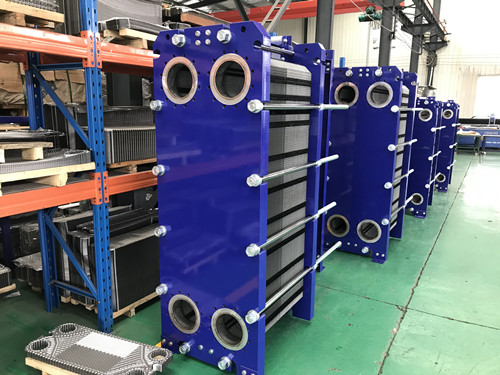
7. Easy to clean The frame plate can be loosened as long as the pressure bolt is loosened, and the tube bundle can be removed for mechanical cleaning.
8. Small heat loss. Only the plywood is exposed to the atmosphere, the heat loss is negligible so there is no need to take insulation measures.
Related information
- Plate Heat Exchanger Applications
- Plate Heat Exchangers in District Heating Projects
- Data Centre Waste Heat to District Heating: Matching Low-Grade Heat to a Network
- What are the causes of scaling in plate heat exchangers?
- How PHE Model Codes Are Structured
- How exactly does a plate heat exchanger last up to 10 years?
Relevant article
- Chemical Plate Heat Exchanger: Lubricant Roles & Care
- Heat Station Plate Heat Exchangers: Design & Application
- Heat Station Plate Heat Exchangers: Installation Guide
- Boiler Plate Heat Exchangers: Maintenance Guide
- The Integrated Heat Exchanger Unit: An Efficient Integration and Intelligent Control Solution for Thermal Energy Conversion
- Sulfuric Acid Plate Heat Exchangers: Design & Application
- Coal Chemical Plate Heat Exchangers: Cleaning & Maintenance
- Petrochemical Plate Heat Exchangers: Design & Application
- Chemical Plate Heat Exchangers: Gasket Ageing
- Sulfuric Acid Plate Heat Exchangers: Design & Application
Latest information
- Chemical Plate Heat Exchanger: Lubricant Roles & Care
- Heat Station Plate Heat Exchangers: Design & Application
- Heat Station Plate Heat Exchangers: Installation Guide
- Boiler Plate Heat Exchangers: Maintenance Guide
- The Integrated Heat Exchanger Unit: An Efficient Integration and Intelligent Control Solution for Thermal Energy Conversion
- Sulfuric Acid Plate Heat Exchangers: Design & Application
- Coal Chemical Plate Heat Exchangers: Cleaning & Maintenance
- Petrochemical Plate Heat Exchangers: Design & Application
- Chemical Plate Heat Exchangers: Gasket Ageing
- Sulfuric Acid Plate Heat Exchangers: Design & Application