Plate Heat Exchangers in Sugar Mills: Juice Heating, Evaporation Support and Molasses Cooling

Where plate heat exchangers earn their place in a sugar factory
Sugar factories run on low-grade heat. Vapour boiled off the juice in the evaporation station carries only a few tens of degrees of usable temperature, and every heater downstream has to squeeze its duty out of that narrow window. Gasketed plate heat exchangers suit this constraint better than almost any other hardware: a close temperature approach in a compact frame, easy to open for a periodic wash, and modular enough to re-rate when the crushing rate changes. This article maps the duties where plates are used in a cane or beet factory, what those streams do to the hardware, and the numbers that decide plate style, alloy and cleaning plan.
Juice heating: low-grade vapour demands a close approach
Mixed juice leaving the mills sits at roughly 25-35 °C and has to reach 95-105 °C for clarification, while clarified juice is reheated ahead of the first evaporative effect. The heat source is almost never live steam - factories bleed vapour from the first or second effect of the evaporation station, saturated at roughly 65-100 °C. Subtract the boiling point elevation of the juice (about 1-3 K) and a practical exchanger approach (2-4 K), and only a small temperature difference remains to drive the duty. That is precisely the plate heat exchanger's regime: a 2-3 K approach that would need an impractical shell-and-tube bundle is routine work for a chevron plate pack.
Two stream details shape the design. First, raw mixed juice carries fine bagacillo or beet tissue, so free-flow or wide-gap plates are worth considering, and velocities stay in the conventional 0.4-0.8 m/s design band. Second, heating must be gentle: wall temperatures far above the juice temperature promote sucrose degradation and colour formation, so the vapour level chosen sets both the achievable outlet temperature and the product quality risk.
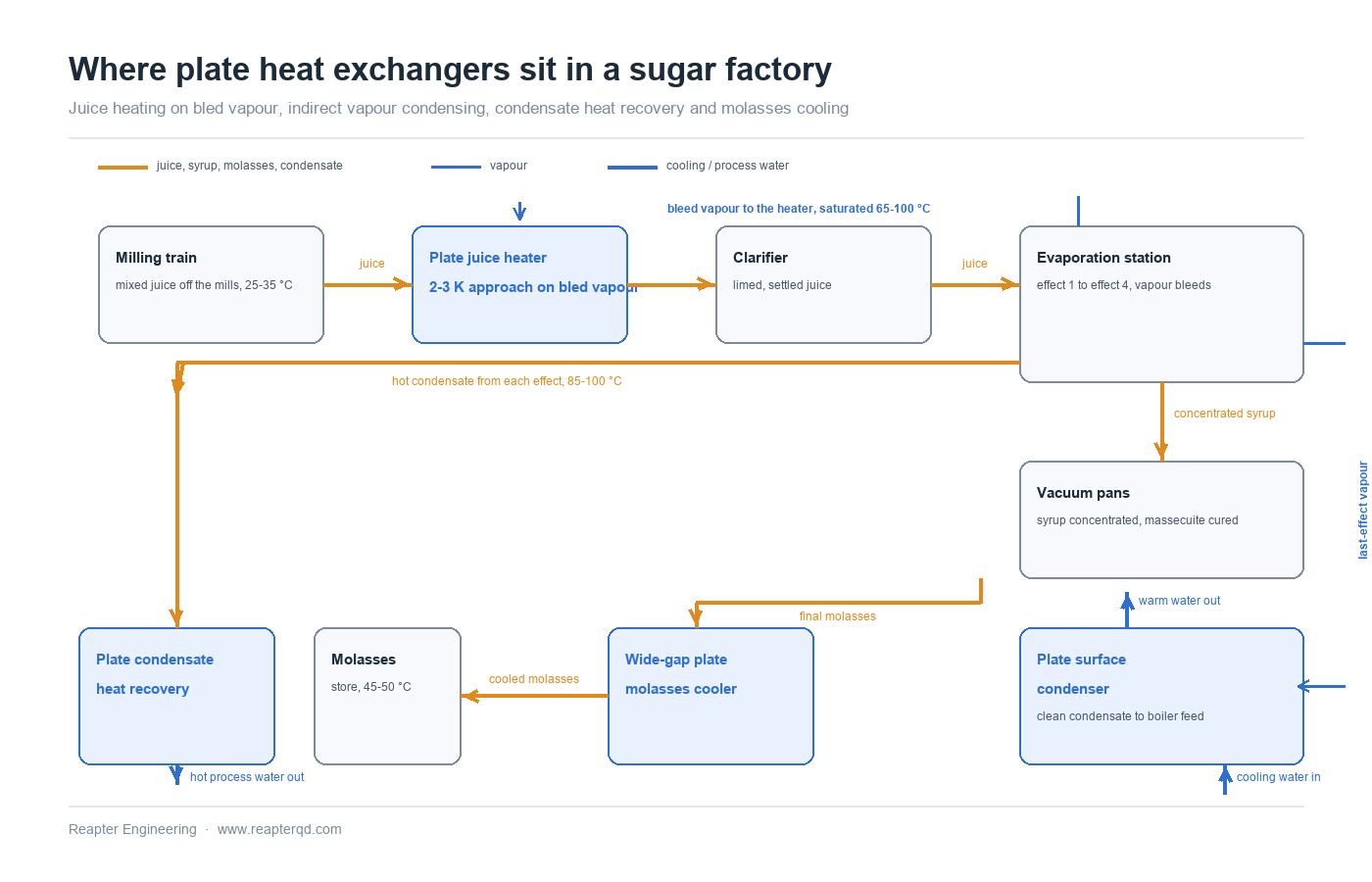
The duty map at a glance
| Duty | Streams involved | Typical service window | Plate choice driver |
|---|---|---|---|
| Mixed and clarified juice heating | Juice vs effect-1/2 vapour or vapour condensate | 25-105 °C juice, 65-100 °C vapour | Close approach; wide-gap on raw mixed juice |
| Condensate heat recovery | 85-100 °C condensate vs clean fresh water | Hot water for washing, diffuser and dilution | Clean duty - standard plates, 316L |
| Surface condensing of last-effect vapour | Vapour vs cooling water | 50-70 °C saturated vapour | Alloy set by cooling-water chlorides |
| Molasses cooling | Final molasses vs cooling water | 55-65 °C down to 45-50 °C | Wide-gap plates; viscosity sets passes |
| Pan and floor hot-water heating | Condensate or vapour vs process water | 60-95 °C water | Standard duty, modulating control |
Condensing vapour and recovering condensate heat
Two related jobs sit behind the condenser label. First, vapour from the final effect - saturated at roughly 50-70 °C - has to be condensed, and a plate surface condenser does it indirectly: vapour condenses on one side, cooling water flows on the other, and the condensate leaves clean enough to join the boiler feed train instead of being diluted into a cooling pond. Replacing a barometric (direct-contact) condenser with a plate surface condenser is a common retrofit precisely because it recovers the condensate rather than losing it.
Second, condensate from the intermediate effects, typically 85-100 °C, still carries useful heat. A plate exchanger transfers that heat to clean fresh water, producing the hot water that mills, diffusers and molasses dilution stations consume. This is the cleanest duty in the factory - no fibre, no scale beyond trace hardness - so a standard plate pack with 316L plates and ordinary gaskets does the job for decades of crush seasons.
Molasses cooling: viscosity is the design constraint
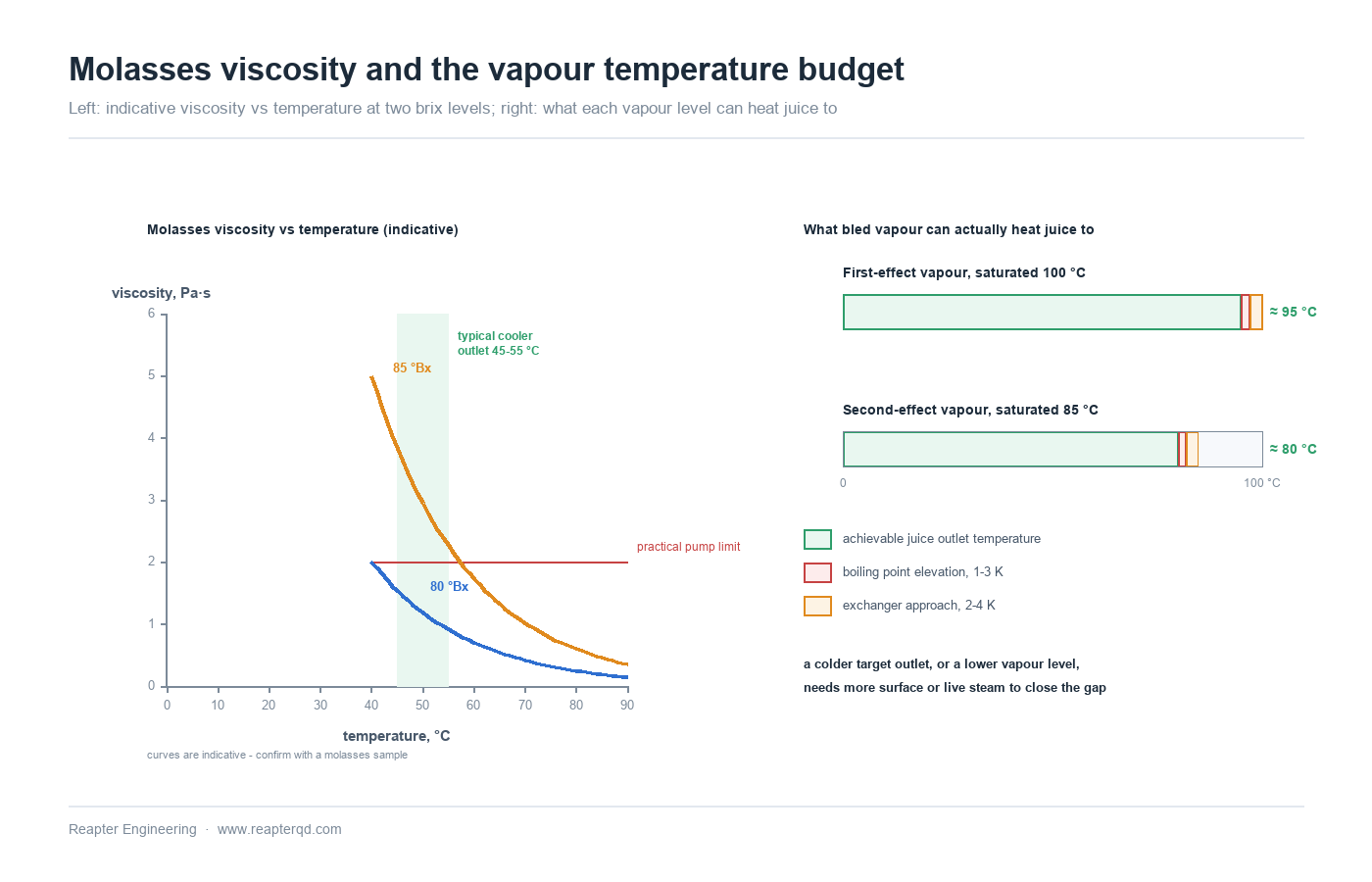
Final molasses leaves the vacuum pans at 55-65 °C and should be cooled to roughly 45-50 °C for storage and tanker dispatch. At 80-85 °Brix the fluid is thick and its viscosity climbs steeply as temperature falls, which makes molasses cooling a pressure-drop and flow-distribution problem as much as a heat-transfer problem. Wide-gap or free-flow plates, fewer passes and a generous channel gap keep the viscosity gradient across the plate pack from starving some channels while others race. The chart below shows why the outlet temperature target matters: every degree cooler raises viscosity disproportionately, and below a certain point the exchanger and the downstream pump simply cannot move the product.
Scale and sucrose fouling: the cleaning plan
Sugar juice fouls from two directions. Dissolved calcium carbonate, calcium phosphate, magnesium salts and silica precipitate as the juice concentrates, so scale grows fastest in the heaters and later effects where concentration peaks - and, like most inverse-solubility salts, it deposits preferentially on the warmest surfaces. On top of that, any excursion that overheats the juice burns sucrose onto the plate wall as colour and deposit at once. Neither family responds to wishful thinking: the working pattern in most factories is a caustic-based circulation wash on a weekly or per-shift cycle during the crush, acid cleaning between campaigns or when the temperature approach trends upward over weeks, and a full open-and-inspect in the off-season. Scraping the gasket face is never part of the plan - a nylon brush and the right chemistry are - and the tie-bar compression is re-checked after every reassembly, as with any gasketed pack.
Materials for juice, condensate and molasses service
316L is the workhorse plate alloy for juice, condensate and molasses duties; sugar juice itself is not aggressive to stainless steel at these temperatures. The alloy decision usually hinges on the cooling water instead. A factory drawing river, estuary or seawater for its surface condenser faces chloride levels that push the envelope from 316L to a 254 SMO-class super-austenitic or titanium, following the same logic used in seawater-cooled exchangers generally. Gaskets follow temperature: nitrile serves the ordinary juice and molasses duties, while higher-temperature condensate loops justify an FKM grade. One caution from the trade: molasses is hygroscopic and sets hard on drying, so a molasses cooler taken out of service for weeks without flushing will greet the next campaign with partially blocked channels - always water-flush and fill before an extended idle.
Planning service around the crush season
A sugar factory concentrates its whole year into a crush season of a few months, and that rhythm dictates how exchanger service is bought. The off-season overhaul is the only window for opening packs, replacing gaskets, cleaning plates and re-rating duties, so serious users hold a spare plate pack - assembled and pressure-tested - and a gasket kit in the store, sized so that a failed pack can be swapped in a shift rather than a week. For factories in remote growing regions, the logistics matter as much as the hardware: drawings, torque tables, spare-part lists and the spares themselves should arrive in one coordinated shipment, and any retrofit - a barometric-to-surface condenser change, a capacity re-rate, a molasses-cooler addition - belongs in the off-season plan with the delivery booked months ahead.
Common questions
Can the same plate heat exchanger heat juice with vapour from any effect? No - the achievable juice outlet temperature is set by the vapour saturation temperature minus the boiling point elevation and the exchanger approach. First-effect vapour near 100 °C can bring juice to about 95 °C; second-effect vapour near 85 °C tops out around 80 °C. Match the heater to the vapour level the target temperature needs.
Why replace a barometric condenser with a plate surface condenser? A direct-contact condenser mixes vapour into the cooling water, so the condensate is lost. A plate surface condenser keeps the condensate clean for the boiler feed train and recovers its sensible heat, at the cost of cooling-water pumping and an additional pack to clean.
How viscous a fluid can a plate molasses cooler handle? Gasketed plates handle final molasses routinely when the design respects it: wide-gap or free-flow plates, few passes, moderate channel velocities and realistic outlet temperatures. Push the outlet a few degrees colder than the pumpable range and the pressure drop - not the heat transfer - becomes the limit.
How often do sugar juice heaters need cleaning? During the crush, a caustic circulation wash every week or per shift is typical, driven by approach-temperature trend rather than a fixed calendar. Acid descaling and a full mechanical inspection are off-season work, unless the approach trend says the scale has won earlier.
Conclusion
Sugar is a close-approach, seasonal-duty business, and the plate heat exchanger is the hardware that matches it: juice heating on bled vapour, clean condensate heat recovery, indirect vapour condensing and wide-gap molasses cooling, all serviceable inside a short off-season window. Reapter supplies gasketed and wide-gap plate heat exchangers with spare plate packs, gasket kits and retrofit engineering for cane and beet factories worldwide, and supports seasonal overhaul planning for remote sites. Contact us with your duty, streams and vapour levels for a sizing proposal.
Related information
- Gasket Ageing for Plate Heat Exchangers
- What should i pay attention to when choosing a wide gap plate heat exchanger?
- Price Factors for Industrial Plate Heat Exchangers
- Don't you know what are the benefits of using semi-welded plate heat exchanger plates?
- PHE Selection for Food Industry Duties
- Plate Heat Exchangers: Corrosion Analysis
Relevant article
- Plate Heat Exchangers in Sugar Mills: Juice Heating, Evaporation Support and Molasses Cooling
- Plate Heat Exchangers in Pulp and Paper Mills: Duties, Fibre, Fouling and Materials
- Flow-Induced Vibration in Plate Heat Exchangers: Causes, Damage Patterns and Fixes
- Plate Heat Exchangers in Thermal Oil Systems: Seals, Film Temperature and When to Weld
- Water Hammer and Pressure Surges in Plate Heat Exchangers: Causes and Countermeasures
- Plate Heat Exchanger vs Shell-and-Tube Cleaning: Where the Lifetime Cost Diverges
- Plate Heat Exchanger Connections: DN vs NPS, PN vs Class, and What Goes Wrong on Site
- Free Cooling with Plate Heat Exchangers: Design and Changeover
- Multi-Section Plate Heat Exchangers: Two Duties, One Frame
- Retrofitting a Shell-and-Tube with a Plate Heat Exchanger: Fitting the Duty into an Existing Plant
Latest information
- Chemical Plate Heat Exchanger: Lubricant Roles & Care
- Heat Station Plate Heat Exchangers: Design & Application
- Heat Station Plate Heat Exchangers: Installation Guide
- Boiler Plate Heat Exchangers: Maintenance Guide
- The Integrated Heat Exchanger Unit: An Efficient Integration and Intelligent Control Solution for Thermal Energy Conversion
- Sulfuric Acid Plate Heat Exchangers: Design & Application
- Coal Chemical Plate Heat Exchangers: Cleaning & Maintenance
- Petrochemical Plate Heat Exchangers: Design & Application
- Chemical Plate Heat Exchangers: Gasket Ageing
- Sulfuric Acid Plate Heat Exchangers: Design & Application