Flow-Induced Vibration in Plate Heat Exchangers: Causes, Damage Patterns and Fixes

Quieter than a shell-and-tube — until something changes
Shell-and-tube exchangers announce vibration with drama: a singing bundle, a tube worn through at a baffle in weeks. A plate heat exchanger is the opposite character. The pack is short, stiff and heavily damped — thousands of metal contact points between plates, no long unsupported spans — and a well-built unit on a clean, single-phase liquid can run silently for decades. That silence is why vibration in a plate pack deserves immediate attention: when noise appears, one of the machine's working assumptions has broken. The velocity rose, the fluid changed phase, the pack lost compression, or external shaking found a path in through the pipework. And unlike a pressure surge, which is a single event, flow-induced vibration accumulates damage gradually — as fretting wear, groove erosion and loosening bolts — until a gasket groove finally gives way. This article maps the sources of plate-pack vibration, the damage patterns each one leaves, and the fixes that actually hold.
What excites a plate pack
Six mechanisms account for nearly every rattling or knocking plate pack we are asked to diagnose:
- Turbulence buffeting at excess velocity. Above the design band, the turbulent wake behind each chevron crossing pushes on the plates with a fluctuating pressure field. The load rises roughly with the square of velocity — the same dynamic-pressure logic that governs wind loading.
- Vortex shedding at the corrugations. Flow across the chevron crossings sheds periodic vortices, so each plate sits in a pulsating pressure field. In the design band this is harmless dither; at high velocity it becomes a drumbeat.
- Two-phase flow and slugging. Vapor pockets and liquid slugs arriving at a gasketed pack carry far higher impact loads than liquid alone — condensate carryover on a steam side, flashing on a hot side, or an incompletely vented circuit all produce it.
- Maldistribution. A partly blocked channel or a badly throttled side turns some channels into local jets, raising velocity far above the port average.
- A loose pack. Compression set, a regasket with the wrong plate count, or under-torque lets the plates lose contact-point stiffness. The pack's natural frequency drops, it becomes easier to excite, and the contact points themselves start to fret.
- External excitation. Pump pulsation, fan imbalance or structure shake transmitted through the nozzles and frame. The exchanger is the victim, not the cause — and no amount of re-torquing will fix it.
Where the damage shows up
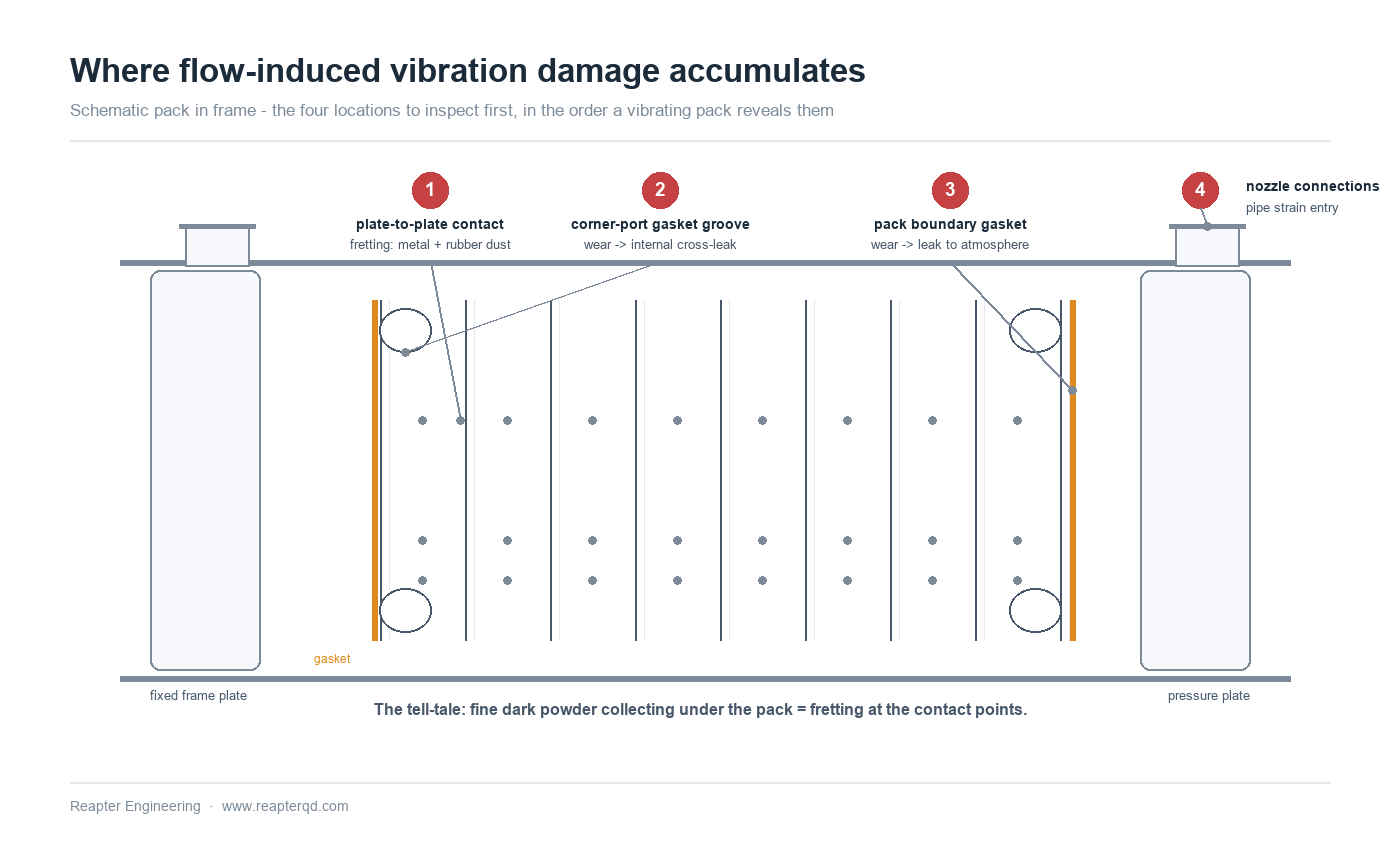
Vibration damage in a gasketed pack follows the mechanics: it accumulates wherever two parts press and micro-slip against each other under a fluctuating load. Four locations cover nearly all of it:
- Plate-to-plate contact points. Fretting wear at the corrugation contact points is the classic signature. It is silent while it happens, and the tell-tale is a fine dark powder — a mix of metal and rubber — collecting under the pack. Left long enough, worn contact points can thin the plate and open an internal cross-leak.
- The gasket groove at corner ports. The oscillating pressure across a port gasket erodes the groove and the gasket foot. The symptom is a cross-plate leak between the two sides — often misread as a defective gasket when the gasket was only the messenger.
- The pack boundary gasket. The outermost gaskets see the same oscillation against the frame plate. Wear here shows as an atmospheric drip at the frame edge.
- Nozzles, connections and frame bolts. Pipe strain and transmitted shake loosen bolts and work on the gasketed joints nearest the source of the excitation.
Match the symptom to the source
Vibration diagnosis is easier from the sound and the timing than from the pack itself. The pattern below covers the cases we see most:
| Symptom | Likely source | First checks |
|---|---|---|
| Rattle worst during start-up ramp | Air pockets, slugging in an unvented circuit | Vent slowly through the ramp; verify vent sizing and valve positions |
| Noise pitch tracks pump or fan speed | External excitation through piping or foundation | Isolate the source briefly; check alignment, flexible connectors, anchor bolts |
| Knocking from the steam or hot side | Condensate carryover or flashing slugs | Steam trap sizing and condition; condensate drainage; venting |
| Sudden onset after regasketing or adding plates | Wrong plate count or under-tightened pack | Measure the pack free length against the manufacturer target |
| Dark powder under the pack, little noise | Low-amplitude fretting at contact points | Audit actual channel velocities; open and inspect contact points |
| Vibration only at deep part load | Maldistribution between channels | Review control strategy; keep both sides inside their flow window |
One discipline matters more than any single row: put a name and a number on the excitation before touching the pack. Tightening, re-gasketing or re-plumbing on guesswork hides the symptom and preserves the cause.
Velocity: the first lever
Of the six sources, the one the designer and operator control most directly is velocity. Buffeting loads rise roughly with the square of channel velocity, so doubling velocity multiplies the fluctuating load roughly fourfold — and a two-phase, slugging stream multiplies it again by several times. The figure below shows the shape of that relationship as an illustrative index: the loads are relative, not measured plant data, but the decision it supports is real. Keep clean single-phase duties inside the typical design band of roughly 0.4–0.8 m/s channel velocity, treat anything much beyond it as a case to verify with the frame maker, and never assume that a two-phase duty tolerates the same velocity as water.
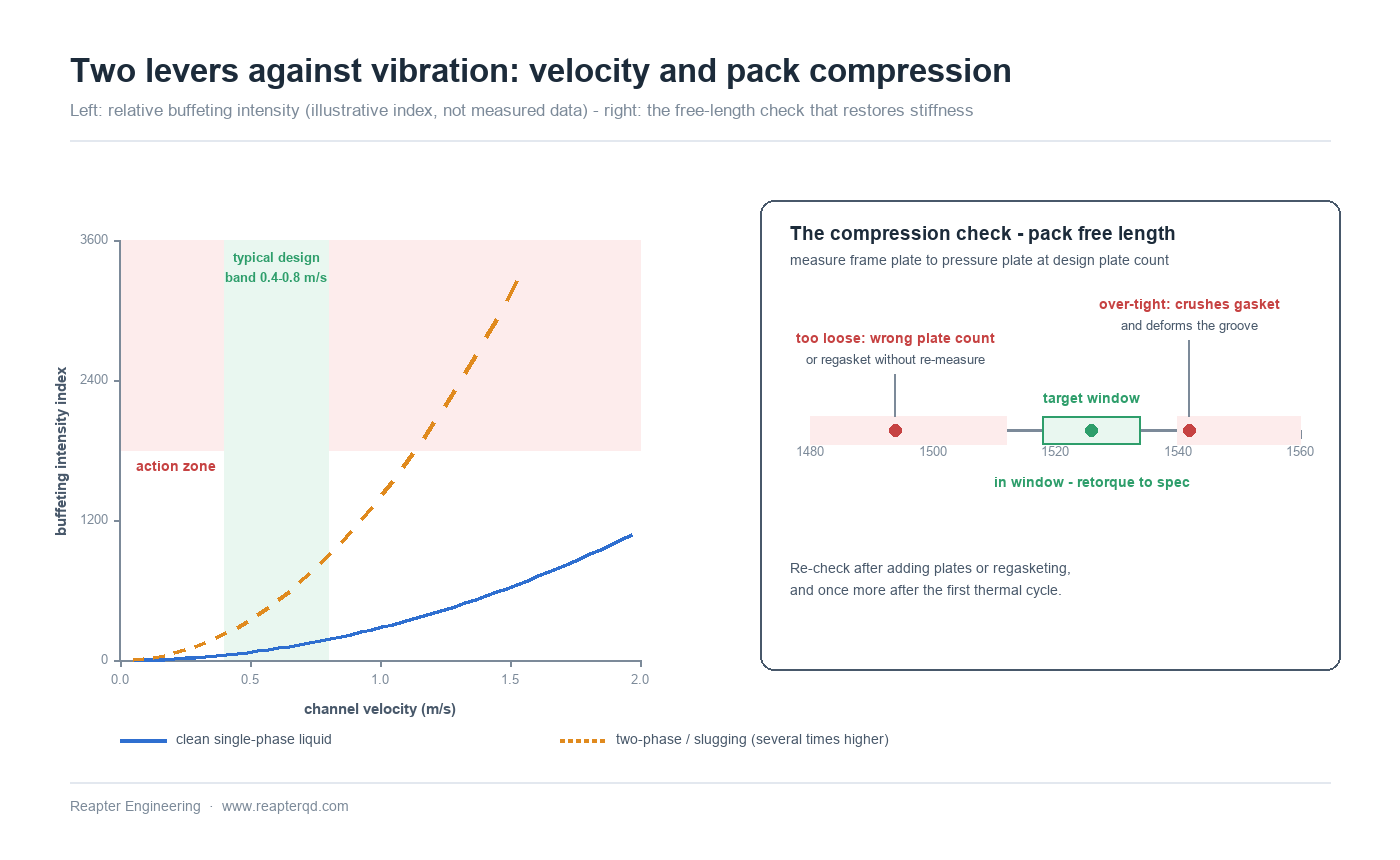
Two operating habits follow directly. First, do not buy insurance with an oversized pump: an impeller trimmed to real duty is quieter and cheaper than a throttle valve dumping turbulence into the exchanger inlet. Second, when a duty has been re-rated upward, verify the actual velocity — port averages hide channels running far above them.
The compression check: stiffness you can measure
Half of the "vibration problems" that reach a workshop are compression problems. The pack's stiffness comes from its contact points, and the contact points only carry load when the pack is tightened to its target free length. The check is mechanical and takes minutes:
- Measure the free length across the plate stack, frame plate to pressure plate, with the design plate count installed.
- Compare against the manufacturer's target — a narrow window, not a number you estimate. New plates and new gaskets change the target.
- Tighten diagonally and evenly to the specified torque, in stages, not by feel.
- Re-check after the first thermal cycle. Compression set is at its greatest in the first excursions to temperature; a pack tightened cold and never re-checked is a pack waiting to loosen.
An over-tightened pack is not the safe side of this trade: crushing the gasket shortens its life and deforms the groove. The target window exists because both edges of it are failures.
Two-phase and flashing duties
Where the process itself is two-phase, vibration resistance becomes a selection question. Slug impact loads on a gasketed boundary gasket are the most punishing duty a rubber seal can see, so keep the vapor or the flashing stream in welded cassettes where practical — semi-welded construction exists precisely for this split. On steam duties, size and maintain the condensate drainage so slugs do not arrive with the vapor, and vent the pack fully before loading it. A circuit that knocks only during the ramp is telling you about air, not about the pack.
Piping, foundations and isolation
When the noise tracks a pump, a fan or a building floor, the exchanger needs protection, not repair. Four measures cover most cases:
- Flexible connectors close to the nozzles, so pipe expansion and pump shake stop at the wall.
- Independent nozzle support — valves, strainers and heavy spools supported from structure, never hanging on the exchanger nozzles.
- Slow-closing control valves on both sides, which also removes the surge loads described in our earlier article on water hammer.
- Anchor-bolt surveillance: vibration loosens fasteners everywhere in the train, and the frame bolts are part of the pack's clamping system.
Common questions
Is a little noise from a plate pack normal? A steady rushing sound from liquid flow is normal. Rattling, knocking or a pitch that changes with pump speed is not — each points to one of the six excitation sources, and none of them heals with time.
Can I just tighten the pack harder? No. Stiffness comes from correct free length, not extra torque. Over-tightening crushes the gasket and deforms the groove; follow the manufacturer's window and re-check after the first thermal cycle.
Does vibration change thermal performance? Momentarily, buffeting can even raise film coefficients slightly — which is why "it never fouled so fast before" is a warning sign, not good news. The cost is fretting wear and groove erosion, and neither is a design strategy.
When should I suspect the pump rather than the exchanger? When the noise tracks machine speed, appears with a new pump or impeller trim, or vanishes when the pump is briefly isolated. Then the fix is isolation and alignment at the source, not another regasket.
Conclusion
A plate heat exchanger is quiet by construction — short spans, damped contact points, a clamped pack — and that construction fails gradually rather than suddenly. Read the symptoms before opening the pack: velocity, phase and compression explain nearly every case, and the dark powder under a pack is the earliest honest witness. Reapter builds gasketed, semi-welded and fully welded plate heat exchangers and supports operators worldwide with vibration and fouling diagnostics, pack compression procedures, replacement plate packs and gaskets for all major frames. If your pack is rattling, send us the sound pattern, the duty data and the last service record — our engineers will help you separate the excitation from the victim before you order parts. Contact us for a plate-pack vibration review.
Related information
- The quenching liquid cooling plate heat exchanger manufacturer you are looking for is here!
- Plate Heat Exchanger Semi-Welded Design
- Application of plate heat exchanger unit system
- Close Temperature Approach in Plate Heat Exchangers: How Close Is Practical?
- Price Factors for Plate Heat Exchangers
- I refuse you because you really can’t. The China Space Station refuses to join the United States, and so does the plate heat exchanger.
Relevant article
- Flow-Induced Vibration in Plate Heat Exchangers: Causes, Damage Patterns and Fixes
- Plate Heat Exchangers in Thermal Oil Systems: Seals, Film Temperature and When to Weld
- Water Hammer and Pressure Surges in Plate Heat Exchangers: Causes and Countermeasures
- Plate Heat Exchanger vs Shell-and-Tube Cleaning: Where the Lifetime Cost Diverges
- Plate Heat Exchanger Connections: DN vs NPS, PN vs Class, and What Goes Wrong on Site
- Free Cooling with Plate Heat Exchangers: Design and Changeover
- Multi-Section Plate Heat Exchangers: Two Duties, One Frame
- Retrofitting a Shell-and-Tube with a Plate Heat Exchanger: Fitting the Duty into an Existing Plant
- Packing a Plate Heat Exchanger for Ocean Freight: Preservation, Storage and Site Handover
- Plate Heat Exchangers Under Vacuum: Operating on the Negative-Pressure Side
Latest information
- Chemical Plate Heat Exchanger: Lubricant Roles & Care
- Heat Station Plate Heat Exchangers: Design & Application
- Heat Station Plate Heat Exchangers: Installation Guide
- Boiler Plate Heat Exchangers: Maintenance Guide
- The Integrated Heat Exchanger Unit: An Efficient Integration and Intelligent Control Solution for Thermal Energy Conversion
- Sulfuric Acid Plate Heat Exchangers: Design & Application
- Coal Chemical Plate Heat Exchangers: Cleaning & Maintenance
- Petrochemical Plate Heat Exchangers: Design & Application
- Chemical Plate Heat Exchangers: Gasket Ageing
- Sulfuric Acid Plate Heat Exchangers: Design & Application