Water Hammer and Pressure Surges in Plate Heat Exchangers: Causes and Countermeasures

Why plate heat exchangers notice water hammer first
A plate heat exchanger almost never causes water hammer, but it is frequently the first piece of equipment to show it. The pack is a stack of corrugated plates roughly 0.4–0.6 mm thick, sealed by elastomer gaskets and closed to a defined compression by the frame. That construction carries steady pressure very efficiently — it is what makes the plate heat exchanger compact and economical. What it tolerates poorly is a pressure wave: a spike that rises and falls within milliseconds, unseats gaskets, hammers the plate contact points and loads the carrying bar in ways the nameplate pressure class never describes. When an exchanger "leaks after every pump trip", the gasket is usually the witness, not the culprit. This article sets out the mechanism and its arithmetic, the damage pattern, and the countermeasures that stop repeat failures.
The mechanism: a moving wave, not a static overpressure
When a valve closes or a pump stops, the water immediately behind the obstruction decelerates abruptly. Its kinetic energy can only be absorbed by compressing the liquid and stretching the pipe wall, so it reappears as a pressure wave travelling back through the circuit at the wave speed c — about 1,200 m/s in water-filled steel pipework, less in plastic lines. The height of the first spike follows the Joukowsky relation:
ΔP = ρ · c · Δv
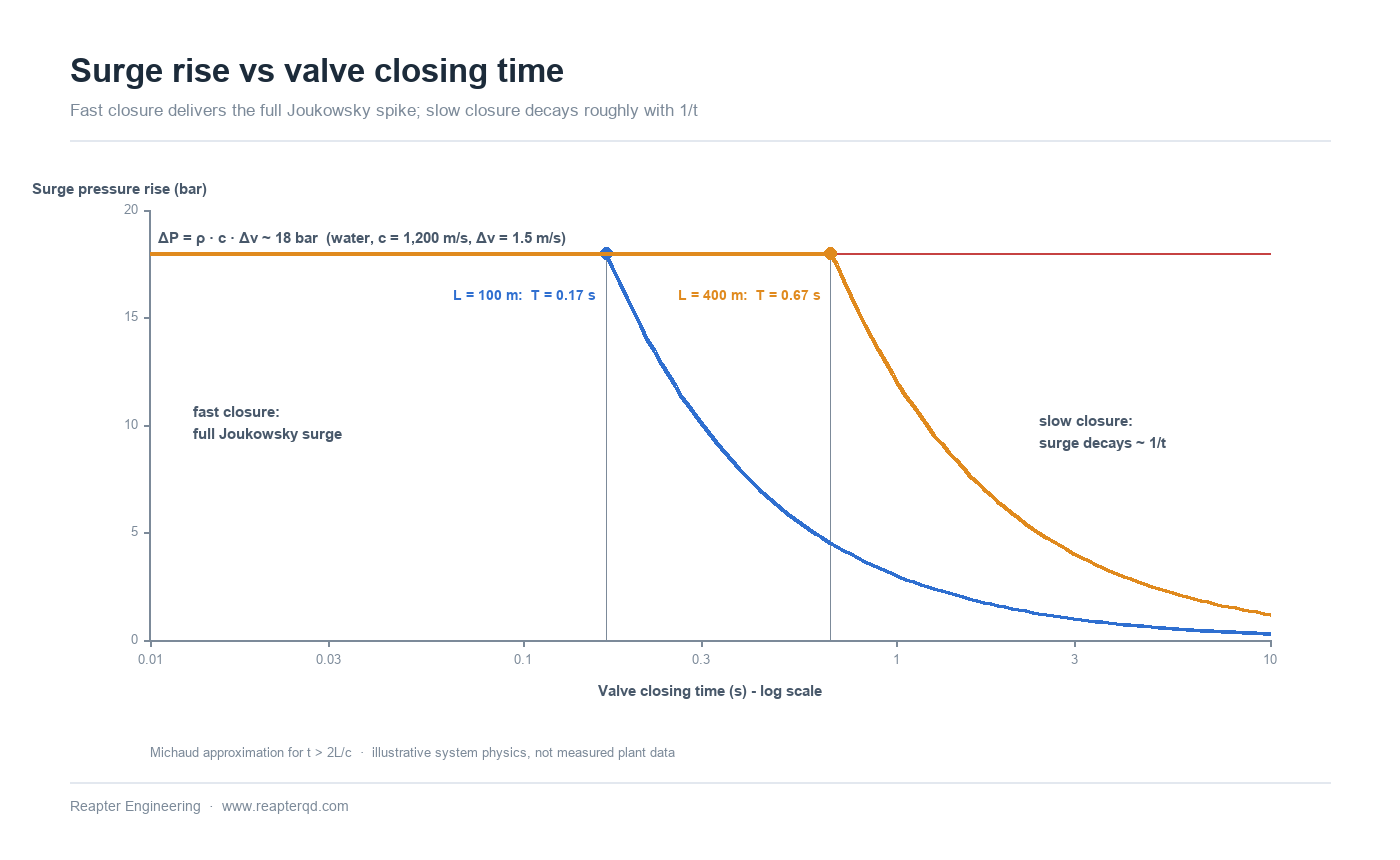
For a velocity change Δv of 1.5 m/s — an ordinary pump stop, nothing exotic — the spike is 1000 × 1200 × 1.5 ≈ 1.8 MPa: roughly 18 bar delivered almost instantly on top of the operating pressure. A pack rated PN16 that was comfortable at 10 bar operating pressure is momentarily asked to hold 28 bar.
Whether the full spike actually arrives depends on timing, not just magnitude. The wave needs time to run to a reflecting boundary and back, so the critical time for a line of length L is T = 2L/c. If the disturbance finishes faster than T, the full Joukowsky spike is delivered; if it is slower, reflected rarefaction waves cancel part of the compression and the peak falls off roughly in proportion to 1/t (the Michaud approximation). A 100 m run has T ≈ 0.17 s; a 400 m run stretches it to about 0.67 s. The same solenoid valve that is harmless on a compact skid can deliver a full surge on a long distribution line.
Where transients originate in a PHE circuit
Six events generate most of the transients that ever reach a plate pack:
- Pump trip with a swing check valve. Flow reverses before the flap closes, and the slam sends a steep wave back toward the exchanger. This is the most common single cause behind "the gasket started weeping after the power cut".
- Fast solenoid and pneumatically actuated valves. Travel times of 0.1–0.5 s sit far below the critical time of anything but the shortest runs, so every cycle delivers a near-full surge.
- Direct-on-line pump starts against a closed or throttling discharge, which spikes the cold side before flow is even established.
- Column separation. In lines with high points or long static lifts, a pump trip can tear the water column apart; when the vapour pocket collapses, the returning column arrives at full line velocity and the impact can exceed the Joukowsky value several times over.
- Steam admitted onto a cold, water-filled side. Condensation-induced hammer: violent, concentrated knocking as steam pockets collapse against trapped water, concentrated on the first-pass plates.
- Refill after draining. Air pushed ahead of a fast-filling slug slams into closed vents and dead legs, and the fill itself can hammer an open pack before any pressure is established.
What the damage looks like
Transient damage has a recognisable signature, and telling it apart from ordinary gasket ageing decides where the investigation should start:
- Gasket weep that appears within hours of a pump trip or valve cycle, worst near the connection-side plates, then settles until the next event.
- Polished or dented marks on the plate contact points, and corner cracks that follow repeated pressure reversals rather than corrosion.
- A frame that has crept out of its torque: the closing dimension has grown and the pack feels loose at the free end after an event that coincided with a loud knock.
- Intermittent leaks only during start-up — a sequencing problem, not a gasket age problem.
| Event in the circuit | Typical signature at the exchanger | First-line countermeasure |
|---|---|---|
| Pump trip, swing check valve | Clanking noise, weep at the frame edge within hours | Spring-loaded silent check valve |
| Fast solenoid or pneumatic valve | Sharp single knock each cycle, drip that comes and goes | Slow-closing trim or an accumulator near the valve |
| Direct-on-line pump start | Spike at start-up, frame load, no noise event | Soft starter or variable-speed ramp |
| Steam onto a cold water-filled side | Violent knocking, first-pass plate deformation | Pre-pressurize and vent the cold side before admitting steam |
| Column separation and collapse | Deep knock after a trip, damage far beyond one gasket | Keep positive static pressure at every high point |
| Repeated small surges over years | Contact-point marks, corner cracks, compression set | Audit valve travel times; add a suppressor |
Countermeasures live in the system, not the exchanger
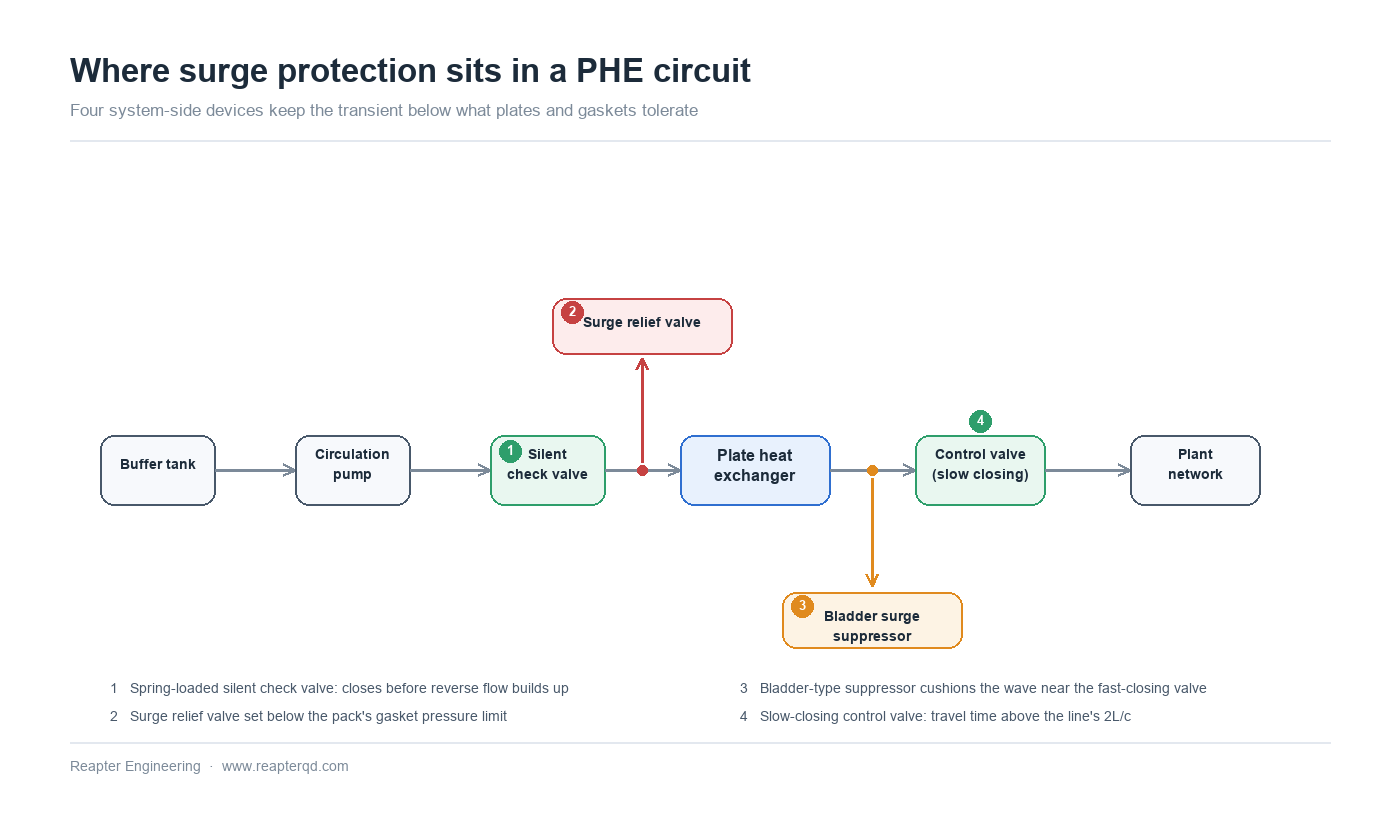
None of these events is fixed by buying a heavier exchanger. The wave energy is generated upstream and must be managed there. Four measures cover most circuits, and the schematic below shows where each one sits:
- Spring-loaded silent check valves at pump discharges. The disc closes before reverse flow builds, so there is no slam left to reflect.
- A surge relief valve tapped into the line ahead of the exchanger, set below the pack's gasket pressure limit and venting to a safe return point.
- A bladder-type surge suppressor close to the fast-closing valve, where the gas cushion absorbs the wave before it reaches the pack.
- Slow-closing control valves — motorized trim or ramped pneumatic actuation with a travel time well above the connected line's 2L/c. Variable-speed pump ramps serve the same purpose on start and stop.
Start-up and shutdown discipline
Several transients are procedural rather than mechanical, and they cost nothing to avoid:
- Fill from the bottom connection with the top vent open until a solid, air-free stream appears — air pushed ahead of the water is what knocks.
- Pre-pressurize and vent the cold side before admitting steam or hot fluid; condensation-induced hammer is almost always a sequencing fault.
- Ramp control valves; never drive a solenoid full-travel on a line whose critical time is shorter than the valve stroke.
- Never isolate the water side while the hot or steam side remains live — trapped, depressurised water against hot plates is both a hammer and a thermal-shock event.
- After any trip that produced a knock, log the event. A gasket weep that shows up two weeks later only makes sense against that record.
Common questions
Can a single water hammer event crack plates? Yes, in severe cases — a collapsing vapour pocket in column separation can deform or crack plates outright. More often a single event unseats a gasket, and it is the repeated events that fatigue the contact points. Either way the root cause sits upstream of the exchanger.
How slow is "slow enough" for a valve? Keep the effective closing time well above the connected line's 2L/c. As a working rule, at about five times the critical time the surge stays below a fifth of the full Joukowsky value — on a 100 m water line that means closing in no less than about one second.
Do brazed plate heat exchangers handle surges better? No. The wave physics is identical, the plates are thinner, and there are no gaskets to give early warning — the first symptom is usually an internal cross-leak, and a deformed brazed core cannot be re-gasketed or re-torqued. Surge protection matters at least as much.
Should we simply order a higher pressure class next time? No. Nameplate ratings cover steady pressure, not transients. A higher PN rating leaves the wave energy in the system, where it will find the next weakest component — often another exchanger, an instrument branch or a flange joint.
Conclusion
Water hammer is a circuit problem with an exchanger symptom. Once the wave speed, the critical closing time and the damage signature are understood, most repeat gasket failures can be traced to a specific valve, pump or sequence — and permanently fixed with standard system-side hardware. Reapter supplies gasketed, semi-welded and brazed plate heat exchangers and supports operators worldwide with re-gasketing, re-rating and failure diagnosis. If your exchangers leak after every pump trip or valve cycle, send us the duty and a sketch of the circuit; our engineers will help you find the transient behind it. Contact us for a transient review or a replacement-gasket quotation.
Related information
- PHE Gasket Failures: Main Causes
- Plate Heat Exchanger Gasket Selection: Matching Elastomer to Duty
- Heating Plate Heat Exchangers: Cleaning & Maintenance
- Which plate heat exchanger manufacturer is better? Identify Ruipute plate and shell heat exchanger manufacturers
- Plate Heat Exchangers: Cleaning & Maintenance
- NT-Series Compatible PHE Plates & Gaskets Guide
Relevant article
- Plate Heat Exchangers in Thermal Oil Systems: Seals, Film Temperature and When to Weld
- Water Hammer and Pressure Surges in Plate Heat Exchangers: Causes and Countermeasures
- Plate Heat Exchanger vs Shell-and-Tube Cleaning: Where the Lifetime Cost Diverges
- Plate Heat Exchanger Connections: DN vs NPS, PN vs Class, and What Goes Wrong on Site
- Free Cooling with Plate Heat Exchangers: Design and Changeover
- Multi-Section Plate Heat Exchangers: Two Duties, One Frame
- Retrofitting a Shell-and-Tube with a Plate Heat Exchanger: Fitting the Duty into an Existing Plant
- Packing a Plate Heat Exchanger for Ocean Freight: Preservation, Storage and Site Handover
- Plate Heat Exchangers Under Vacuum: Operating on the Negative-Pressure Side
- Gasket Compression Set and Bolt Torque Management in Plate Heat Exchangers
Latest information
- Chemical Plate Heat Exchanger: Lubricant Roles & Care
- Heat Station Plate Heat Exchangers: Design & Application
- Heat Station Plate Heat Exchangers: Installation Guide
- Boiler Plate Heat Exchangers: Maintenance Guide
- The Integrated Heat Exchanger Unit: An Efficient Integration and Intelligent Control Solution for Thermal Energy Conversion
- Sulfuric Acid Plate Heat Exchangers: Design & Application
- Coal Chemical Plate Heat Exchangers: Cleaning & Maintenance
- Petrochemical Plate Heat Exchangers: Design & Application
- Chemical Plate Heat Exchangers: Gasket Ageing
- Sulfuric Acid Plate Heat Exchangers: Design & Application