Don't you know what are the benefits of using semi-welded plate heat exchanger plates?

Semi-welded plate heat exchanger plates use mature laser welding technology, which has the advantages of small welding deformation, small residual stress and high quality. Double-sided forming technology is used to reduce deformation and stress. The main application is used in refrigeration systems such as ammonia refrigeration, and other working conditions with corrosive media.
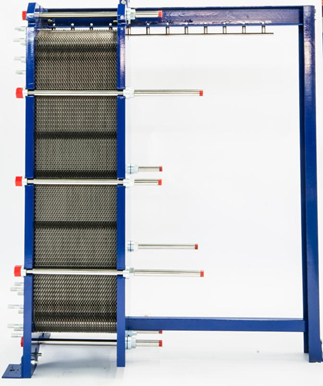
Advantages of laser welding:
1. The small processing range can control the energy input: the heat input is only 25% of the ordinary welding method, small thermal stress, small heat affected zone and small thermal deformation;
2. Narrow and smooth welds: can reduce or eliminate the post-weld treatment process;
3. The cooling speed is fast and the welding structure is fine, so the welding joint has good performance. Laser welding of stainless steel is easier to obtain high-quality joints than conventional welding, and the low thermal conductivity of stainless steel is easier to obtain deep-melting narrow welds;
4. The production process is easy to control: the sensor system monitors the processing in real time to ensure the welding quality;
5. Laser welding does not need to contact with the workpiece to avoid contact stress.
Our company can produce a variety of plate types of semi-welded plates and heat exchangers, the interface size from DN50-DN600, to meet the different needs of customers. There are also 304,316L stainless steel, titanium, nickel, SMO254, C276 and other plates, suitable for different working conditions.
Reapter was founded in 2014. In 2016, the component technology research and development team conducted research and research. It achieved automatic and stable welding of plate and shell heat exchangers, laser welding of semi-welded and double-walled plate heat exchangers in China. Break the monopoly of foreign technology.
At present, Qingdao Reapter has up to 17 technical R & D personnel, with strong technical strength and strong development capabilities. So please contact us if necessary. The above Qingdao Ruipute Heat Exchange Equipment Manufacturing Co., Ltd. is original, please indicate the source when reprinting:http://www.reapter-phe.com/
Related information
- Winter Shutdown and Freeze Protection for Plate Heat Exchangers
- Gasket Compression Set and Bolt Torque Management in Plate Heat Exchangers
- Plate and shell heat exchanger as raw water heater application
- Introduction of heat transfer equipment of several major categories
- What Makes a Plate Heat Exchanger Reliable
- How to choose the right plate heat exchanger
Relevant article
- Plate Heat Exchangers in Thermal Oil Systems: Seals, Film Temperature and When to Weld
- Water Hammer and Pressure Surges in Plate Heat Exchangers: Causes and Countermeasures
- Plate Heat Exchanger vs Shell-and-Tube Cleaning: Where the Lifetime Cost Diverges
- Plate Heat Exchanger Connections: DN vs NPS, PN vs Class, and What Goes Wrong on Site
- Free Cooling with Plate Heat Exchangers: Design and Changeover
- Multi-Section Plate Heat Exchangers: Two Duties, One Frame
- Retrofitting a Shell-and-Tube with a Plate Heat Exchanger: Fitting the Duty into an Existing Plant
- Packing a Plate Heat Exchanger for Ocean Freight: Preservation, Storage and Site Handover
- Plate Heat Exchangers Under Vacuum: Operating on the Negative-Pressure Side
- Gasket Compression Set and Bolt Torque Management in Plate Heat Exchangers
Latest information
- Chemical Plate Heat Exchanger: Lubricant Roles & Care
- Heat Station Plate Heat Exchangers: Design & Application
- Heat Station Plate Heat Exchangers: Installation Guide
- Boiler Plate Heat Exchangers: Maintenance Guide
- The Integrated Heat Exchanger Unit: An Efficient Integration and Intelligent Control Solution for Thermal Energy Conversion
- Sulfuric Acid Plate Heat Exchangers: Design & Application
- Coal Chemical Plate Heat Exchangers: Cleaning & Maintenance
- Petrochemical Plate Heat Exchangers: Design & Application
- Chemical Plate Heat Exchangers: Gasket Ageing
- Sulfuric Acid Plate Heat Exchangers: Design & Application