Industrial Plate Heat Exchangers: Working Principle

The boom in all industries requires a wide variety of gasketed industrial plate heat exchangers, and it can be used in virtually all types of industries. Its versatility allows it to be designed and configured for a wide range of applications, from relatively simple, low-demand conditions to very demanding performance requirements. It is primarily used for heating, cooling, heat recovery, condensation and evaporation.
The heat transfer zone of a gasketed industrial plate heat exchanger consists of a series of corrugated plates stacked between a frame plate and a pressure plate, capable of maintaining the design pressure. The plate to plate seal consists of gaskets. In order to obtain higher thermal performance and very close temperatures, the fluid usually flows counter-currently through the heat exchanger equipment. Available in industrial lines are herringbone patterns of various depths and angles and corrugations of various shapes, which are carefully designed and selected to achieve better heat transfer as well as reduced pressure losses.
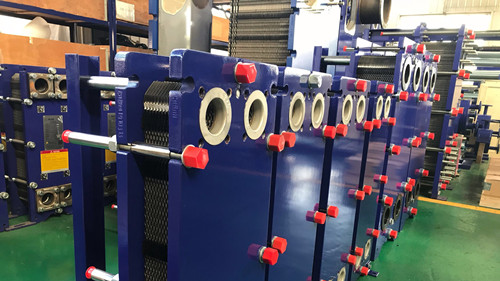
Although gasketed industrial plate heat exchangers can be used in HVAC, refrigeration, engine cooling, dairy and food, chemical processing, oil production, and power plants, each one is almost different because of the different working conditions it faces. At the same time, its principle is the same, that is, heat balance, the hot side releases heat, the cold side absorbs heat, and so on. If you want to do a good job of such a device, you need good quality raw materials, mature manufacturing technology, strict management, and these are realized in Qingdao REAPTER, click the red box below, you want to know, you can know.
Related information
- Large professional plate and shell heat exchanger manufacturer-Qingdao Ruipute
- Manufacturer Selection for Plate Heat Exchangers
- Precautions for installation of plate heat exchanger
- Why your plate heat exchanger gasket swelling happens?
- Plate Heat Exchangers for Waste Heat Recovery Duty
- How to Specify Replacement Plates for a Plate Heat Exchanger
Relevant article
- Chemical Plate Heat Exchanger: Lubricant Roles & Care
- Heat Station Plate Heat Exchangers: Design & Application
- Heat Station Plate Heat Exchangers: Installation Guide
- Boiler Plate Heat Exchangers: Maintenance Guide
- The Integrated Heat Exchanger Unit: An Efficient Integration and Intelligent Control Solution for Thermal Energy Conversion
- Sulfuric Acid Plate Heat Exchangers: Design & Application
- Coal Chemical Plate Heat Exchangers: Cleaning & Maintenance
- Petrochemical Plate Heat Exchangers: Design & Application
- Chemical Plate Heat Exchangers: Gasket Ageing
- Sulfuric Acid Plate Heat Exchangers: Design & Application
Latest information
- Chemical Plate Heat Exchanger: Lubricant Roles & Care
- Heat Station Plate Heat Exchangers: Design & Application
- Heat Station Plate Heat Exchangers: Installation Guide
- Boiler Plate Heat Exchangers: Maintenance Guide
- The Integrated Heat Exchanger Unit: An Efficient Integration and Intelligent Control Solution for Thermal Energy Conversion
- Sulfuric Acid Plate Heat Exchangers: Design & Application
- Coal Chemical Plate Heat Exchangers: Cleaning & Maintenance
- Petrochemical Plate Heat Exchangers: Design & Application
- Chemical Plate Heat Exchangers: Gasket Ageing
- Sulfuric Acid Plate Heat Exchangers: Design & Application