HTST Pasteurization with Plate Heat Exchangers: Regeneration, Holding Time and Pressure Differential

Three duties, one frame, three numbers that matter
A high-temperature short-time (HTST) pasteurizer does not heat and then separately cool a product in two machines. It does both in one plate frame: cold raw product is warmed by hot pasteurized product in a regeneration section, a small heater closes the last few degrees, an external holding tube fixes the residence time, and the product returns through the regeneration section before a final cooler brings it down to storage temperature. For fluid milk the reference treatment is at least 72 °C for 15 seconds (EU 853/2004 and the US PMO); higher-fat or sweetened products commonly move to about 74 °C for 15 seconds. Once the thermal target is fixed, the engineering of the exchanger reduces to three numbers: the regeneration percentage, the holding time, and the pressure difference between the two sides of the regenerator. Everything else — plate count, frame length, pump arrangement, instrumentation — follows from those three.
The thermal sequence, step by step
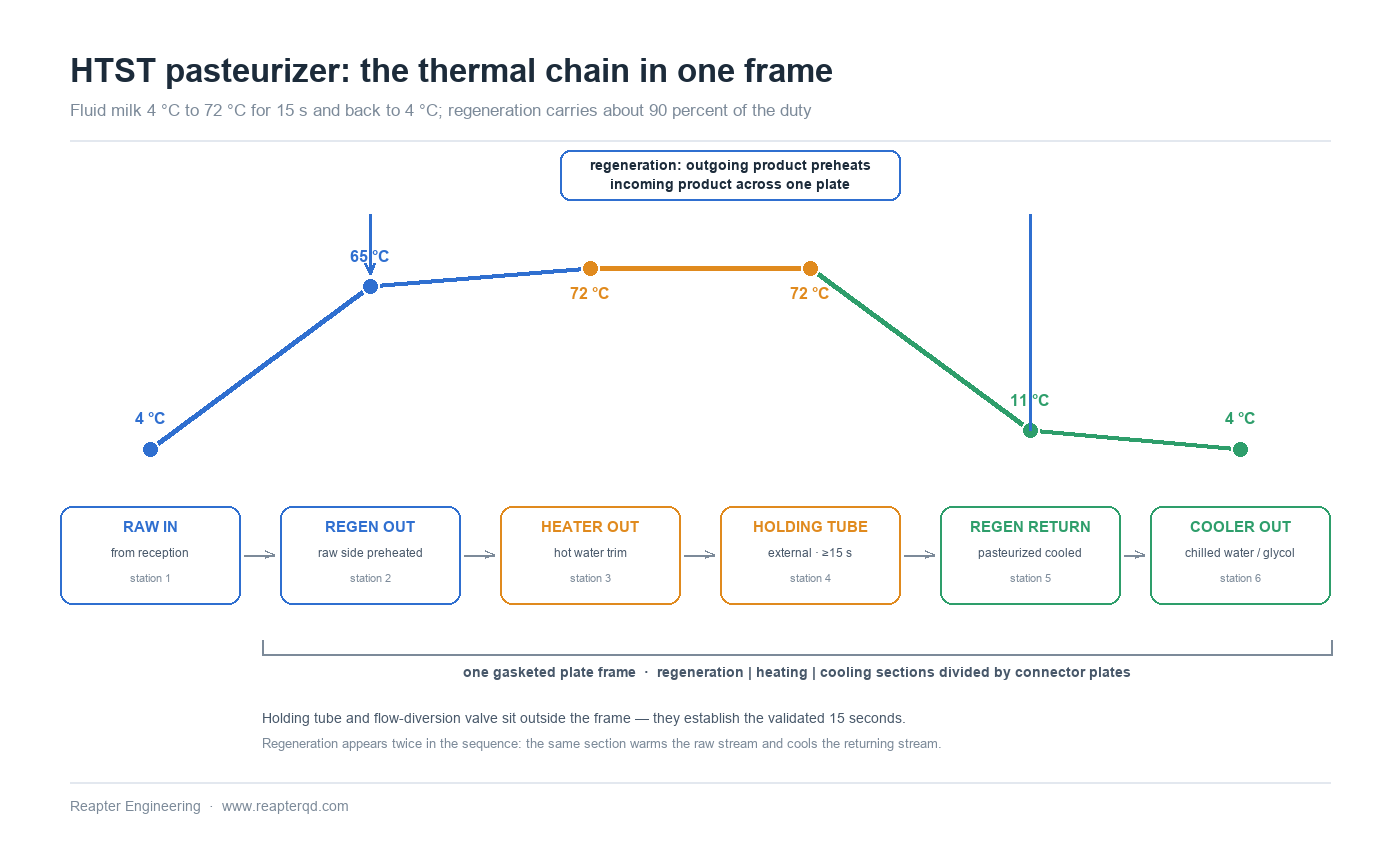
Consider a line receiving raw milk at 4 °C and pasteurizing at 72 °C. The total rise is 68 K. In the regeneration section the incoming stream runs counter-current to the outgoing pasteurized stream across thin stainless-steel plates; at a typical 90 percent regeneration it leaves that section near 65 °C, having already recovered 61 K. The heater section then adds only the remaining 7 K with hot water, usually at a 1–3 K approach at the outlet. The product passes through the holding tube at 72 °C for at least 15 seconds, returns to the regeneration section and gives back roughly the same 61 K, leaving near 11 °C, and finally reaches a cooling section on chilled water that takes it to 4 °C or below. The hot-water section and the refrigeration plant only ever handle the part the regenerator could not recover — which is why regeneration, not the heater, sets the operating cost of the line.
Regeneration efficiency and what each point costs
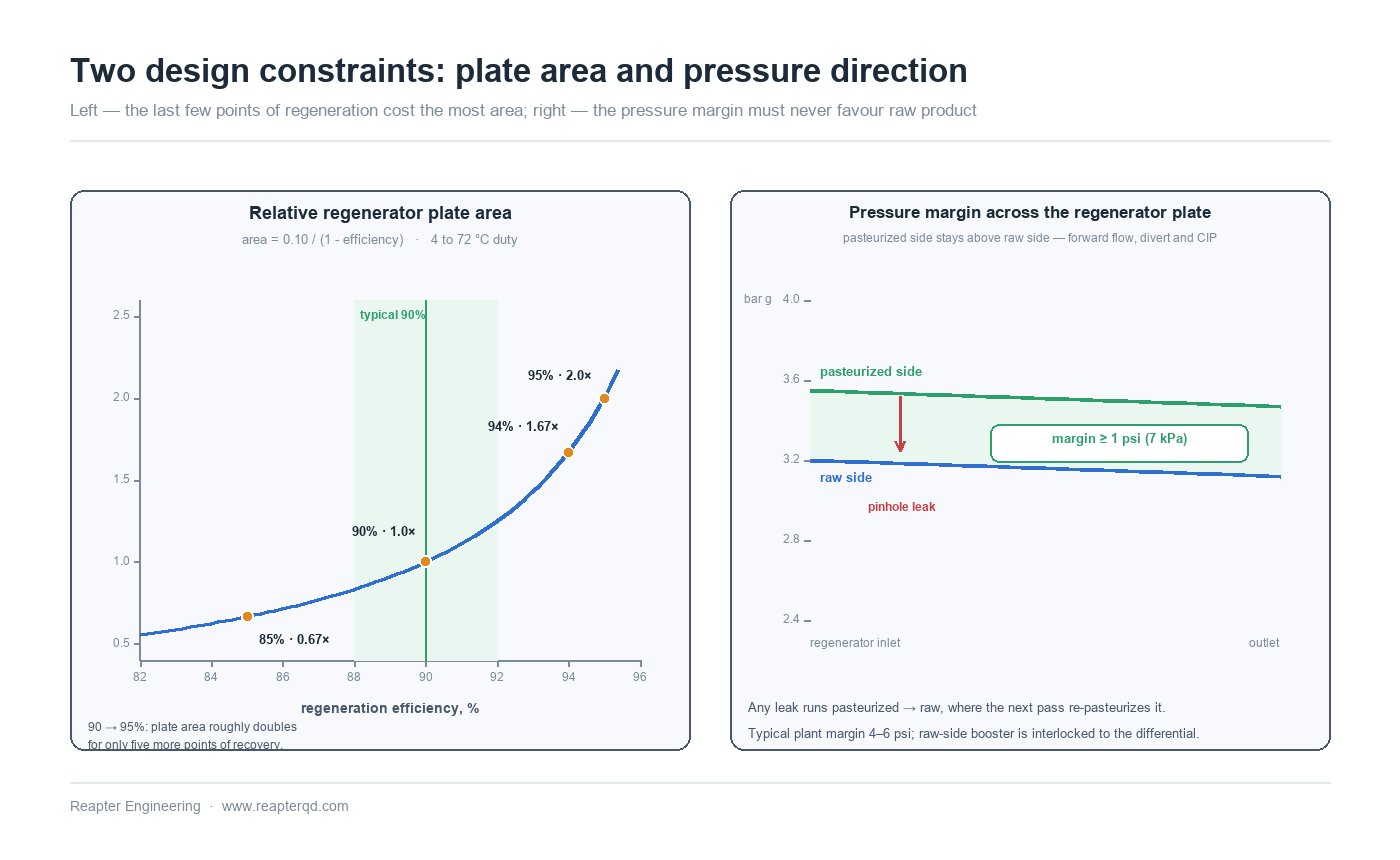
Regeneration efficiency is the rise across the regenerator divided by the total rise from reception to pasteurizing temperature: (65.2 ? 4) / (72 ? 4) = 90 percent in the example. Because the two streams are the same product at closely matched flow rates, the temperature difference along the regenerator is nearly constant, and that difference is the approach. At 90 percent the approach is about 6.8 K; at 95 percent it falls to about 3.4 K. Heat-transfer area scales inversely with approach, so the last five points roughly double the plate count while recovering only five more percent of the total duty. In practice most fluid-milk frames settle between 85 and 94 percent, with 90 percent the common design point; going higher is a decision about steam and refrigeration prices and run length, not an automatic improvement.
| Regeneration | Raw outlet | Regenerator approach | Relative plate area | Utility duty* |
|---|---|---|---|---|
| 85% | 61.8 °C | 10.2 K | 0.67 × | 15% |
| 90% (typical) | 65.2 °C | 6.8 K | 1.00 × | 10% |
| 94% | 67.9 °C | 4.1 K | 1.67 × | 6% |
| 95% | 68.6 °C | 3.4 K | 2.00 × | 5% |
*Heater and cooler duty as a share of the full temperature rise, before losses. Calculated from a 4 °C to 72 °C duty; area scales as 1/approach. Indicative design arithmetic, not a quotation.
The other half of the calculation is fouling. A high-efficiency regenerator works on a small approach, so even a couple of degrees of fouling over a long run erodes the raw outlet temperature, opens the hot-water valve and pushes the heater wall hotter — which accelerates fouling further. A frame specified at 94 percent that is cleaned on a 90 percent schedule gives its efficiency back in operation. Regeneration is a design target that has to be maintained, not a fixed property of the plate pack.
The pressure differential is a safety function
The regenerator is the one place in the line where raw and pasteurized product are separated by a single thin plate. A pinhole or a failed gasket there can undo the pasteurization downstream, so the direction of any leak is controlled by pressure. The US PMO requires the pasteurized side to be held at least 1 psi (about 7 kPa) above the raw side at every point — in forward flow, in divert and during cleaning; Canadian practice typically asks for 2 psi (14 kPa), and operating plants often run a wider margin of 4–6 psi. With the pressure pointing that way, a through-plate defect pushes a small amount of pasteurized product into the raw stream, where the next pass will pasteurize it, rather than letting raw product reach the filler.
A plate pack does not create that differential by itself. The arrangement does: the timing pump draws raw product through the raw side under suction, the pasteurized side leaves under pressure, and a back-pressure device holds the pasteurized regenerator outlet up. Where a raw-side booster pump is needed for capacity, it is interlocked so it cannot run unless the timing pump is running, the diversion valve is in forward flow and the measured differential is present. The differential is recorded on the same chart as the temperature and checked by inspectors. Shutdown order matters too — the raw side must lose head first, which is why the regenerator is laid out to drain toward the raw side.
Holding time and the fastest particle
Pasteurization is a time–temperature law, and the plate frame does not provide the time. The holding tube between the heater and the returning regenerator does, and it is sized on the fastest-moving particle rather than the average. A 15-second hold at a design velocity of about 1.5 m/s calls for roughly 22–23 m of tube; in practice the tube is coiled, sloped continuously upward so air cannot create a short circuit, and its diameter and length are validated against the maximum permitted flow. A positive-displacement timing pump — often the homogenizer itself on a milk line — fixes that flow, and a magnetic flow meter can be used to prove it has not exceeded the validated limit. At the tube exit a temperature-actuated flow diversion valve sends any sub-temperature product back to the balance tank. The legal record of every diversion event is part of the system, not an optional extra.
Construction choices that follow the duty
For fluid milk the standard answer is a gasketed frame with 316L product plates, EPDM gaskets and hygienic connections built to 3-A practice; it opens for inspection and individual plates can be replaced. Cream and high-fat mixes usually need wide-gap channels to keep velocity and pressure drop reasonable at higher viscosity. Products with pulp, cocoa or fibre are better served by a corrugated tubular regenerator, where a plate channel would plug. Where a processor wants physical rather than pressure-based separation — infant formula is the usual example — double-wall regenerator plates put a vented gap between the two products so a failed plate weeps at the edge instead of crossing; they transfer roughly 20 percent less heat per plate and need more area. Connector plates divide the sections inside one frame, so regeneration, heating and cooling share one set of tie bars rather than three separate skids.
A practical specification sequence
- Fix the legal duty. Confirm the required time–temperature combination and the product's fat or sugar content with the local regulator before sizing anything.
- Choose regeneration from energy economics. Compare steam and refrigeration costs and run length; 90 percent is the usual starting point, 94 percent only where the payback is real.
- Set the utility approaches. A 1–3 K hot-water approach at the heater and a 1–2 K chilled-water approach at the cooler (wider on glycol, with a freeze interlock) decide utility temperatures and plate counts.
- Design the pressure arrangement. Specify the back-pressure device, the booster interlock, the differential transmitter and the drain direction together — they are one safety function.
- Validate the hold. Size the holding tube on the fastest particle, state the maximum permitted flow, and include the diversion valve and the chart recorder in the same specification.
- Confirm cleaning access. Check that the frame can be opened where the product demands manual inspection, and that CIP coverage reaches the regeneration section and the tube.
Common questions
Is 95 percent regeneration always better than 90 percent? No. It roughly doubles the regenerator plate area and the frame length for five more points of recovery, and it narrows the approach to the range where a few degrees of fouling visibly erodes performance. It pays where utilities are expensive and runs are long.
Why must the pasteurized side be at higher pressure? So that a pinhole leak goes from pasteurized product into raw product, where the next pass will treat it, instead of raw product reaching the filled container. The margin is a legal requirement in regulated dairy markets and a good practice elsewhere.
Can the holding time be provided inside the plate frame? No. The frame has too little hold-up volume to guarantee a validated residence time for every particle. An external holding tube with a controlled flow is what establishes the hold; the frame only sets temperature.
Does a high regeneration figure mean the plant's energy bill falls by that percentage? No. It describes heat recovered product-to-product inside the pasteurizer. Total site energy also depends on CIP heating, pumps, separators, cooling-water temperature and start-up losses.
Conclusion
An HTST plate pasteurizer is best understood as three coupled decisions: how much heat the regenerator recovers, how reliably the holding tube delivers the validated time, and how certainly the pressure keeps product on the safe side of every plate. Get those right and the frame length, pump interlocks and instrumentation follow without guesswork. Reapter designs and supplies gasketed plate heat exchangers for dairy, beverage and food pasteurization duties worldwide, including regeneration-focused retrofits, spare plates and gaskets, and commissioning support for overseas projects. Send us your product, inlet and target temperatures, and throughput, and we will work through the regeneration and pressure arrangement with you.
Related reading
Related information
- Titanium plate heat exchanger manufacturers to explain product features
- Where is the wide gap better than the tube type heat exchanger?
- Many people were killed in the Aegean earthquake. How can seawater plate heat exchangers be accident-free?
- Chemical Plate Heat Exchanger Guide
- Shandong production of titanium palladium, Hastelloy alloy, 254SMO, nickel plate and other plate heat exchanger plate manufacturers
- Transcritical CO2 Systems: Selecting Plate Heat Exchangers for High Pressure
Relevant article
- Wort Cooling with Plate Heat Exchangers: Two-Stage Design, Heat Recovery and Hygiene
- Insulating a Plate Heat Exchanger: Heat Loss, Condensation and Removable Covers
- PED vs ASME for Exported Plate Heat Exchangers: A Practical Compliance Guide
- Plate Heat Exchangers in Desalination: Feed Preheating, Brine Cooling and Material Limits
- HTST Pasteurization with Plate Heat Exchangers: Regeneration, Holding Time and Pressure Differential
- Steam Stall in Plate Heat Exchangers: Why a Steam Heater Loses Control at Part Load
- Gasketed, Semi-Welded or Fully Welded: Choosing Plate Heat Exchanger Construction for the Duty
- Gasket Shelf Life and Storage: Keeping Spare Plate Heat Exchanger Gaskets Fit for Duty
- Plate Heat Exchangers in MVR Evaporation: Designing Around a Small Driving Force
- Plate Heat Exchangers in Sugar Mills: Juice Heating, Evaporation Support and Molasses Cooling
Latest information
- Chemical Plate Heat Exchanger: Lubricant Roles & Care
- Heat Station Plate Heat Exchangers: Design & Application
- Heat Station Plate Heat Exchangers: Installation Guide
- Boiler Plate Heat Exchangers: Maintenance Guide
- The Integrated Heat Exchanger Unit: An Efficient Integration and Intelligent Control Solution for Thermal Energy Conversion
- Sulfuric Acid Plate Heat Exchangers: Design & Application
- Coal Chemical Plate Heat Exchangers: Cleaning & Maintenance
- Petrochemical Plate Heat Exchangers: Design & Application
- Chemical Plate Heat Exchangers: Gasket Ageing
- Sulfuric Acid Plate Heat Exchangers: Design & Application