Plate Heat Exchangers in Desalination: Feed Preheating, Brine Cooling and Material Limits

Desalination has two heat problems, and both belong to the plate exchanger
In a seawater reverse-osmosis (SWRO) plant, membranes make the water and the energy-recovery device (ERD) saves most of the pumping power. Neither one manages heat. Yet across a global fleet of plants — from the 38,000–42,000 mg/L waters of the Arabian Gulf and the Red Sea to temperate coastlines where winter intake falls near 10 °C — the same two thermal questions keep returning: how to hold feed temperature inside a productive window, and where to place low-grade heat that would otherwise be wasted. A gasketed plate heat exchanger is usually the most practical answer to both. It is not the headline equipment, but it is the component that decides whether a plant meets its output guarantee in the coldest month and whether a waste-heat source can be used at all.
Why a few degrees change the whole design
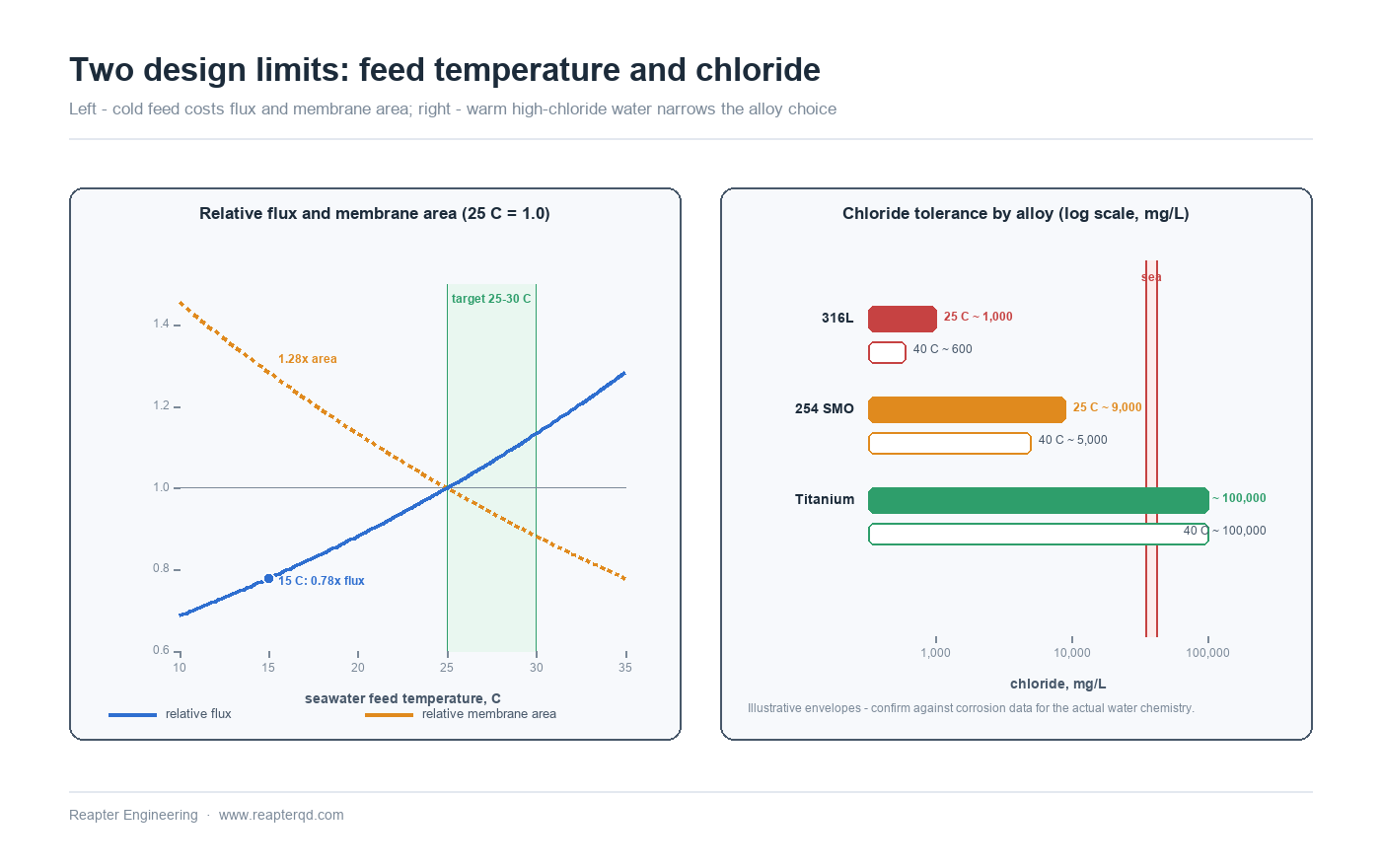
Membrane elements are rated at a 25 °C reference. Away from that point, flux moves sharply: a widely used rule of thumb puts the change in permeate flow at roughly 2–3 % per 1 °C of feed temperature. The physical driver is viscosity rather than membrane ageing. Water's dynamic viscosity rises from about 0.89 mPa·s at 25 °C to roughly 1.31 mPa·s at 10 °C — a factor near 1.5 — so the same transmembrane pressure pushes less water through the same membrane area.
The consequence is easy to under-estimate. Falling from 25 °C to 15 °C removes roughly a fifth to a quarter of the output; restoring it by raising pressure costs energy and runs into the pressure and temperature ceilings of the polyamide element, whose continuous operating limit is generally in the region of 45 °C, with the exact figure set by the membrane supplier. Before blaming fouling, operators should normalise permeate flow to 25 °C with a temperature-correction factor: a cold feed and a fouled membrane look alike in a raw flow trend, but only one of them is cured by cleaning.
Where the plate exchanger sits in an SWRO train
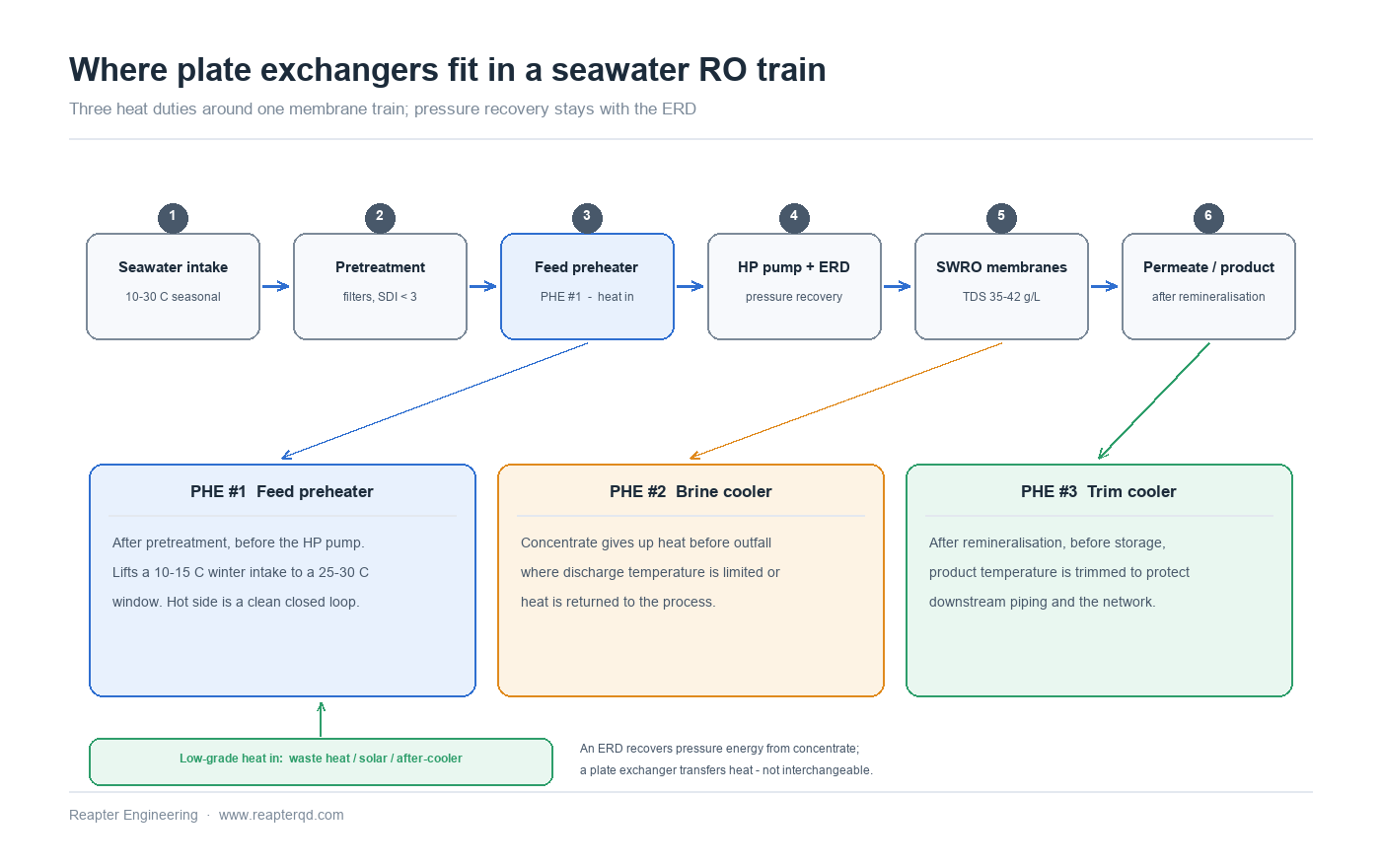
A plate exchanger does not recover pressure — that is the job of an isobaric pressure exchanger or a turbine ERD, which transfers energy from the concentrate stream to incoming feed. The plate exchanger transfers heat, and it appears in up to three positions around the same train:
- Feed preheater. Set after pretreatment and ahead of the high-pressure pump, it lifts intake temperature toward a 25–30 °C window using a closed loop of low-grade heat — turbine exhaust, compressor after-cooler duty, solar-heated water or process waste heat. The hot side carries clean water or glycol, never raw seawater, so a plate leak cannot seed the membrane feed with untreated water.
- Brine cooler / heat-recovery exchanger. Where discharge temperature is regulated or heat must be returned to the process, outgoing concentrate gives up heat across a second plate exchanger before outfall.
- Product-water trim cooler. After remineralisation and ahead of storage, product temperature can be trimmed to protect downstream piping and the distribution network.
Keeping these duties distinct from the ERD matters at specification time. Claiming that a plate exchanger replaces an energy-recovery device confuses two different forms of energy and will not survive a serious technical review.
The trade-off in numbers
The figures below are indicative, built from the typical 2–3 % per °C correction and normalised to 25 °C. They show why preheating is a design lever rather than a comfort feature: below roughly 18 °C the membrane area required climbs quickly, and the plant must either buy more surface or buy more pressure.
| Feed temperature | Relative flux | Relative membrane area | Engineering reading |
|---|---|---|---|
| 30 °C | about 1.13× | about 0.88× | High flux; watch biological growth and slightly lower salt rejection |
| 25 °C | 1.00× | 1.00× | Reference point for membrane ratings |
| 20 °C | about 0.88× | about 1.14× | Modest derating, usually absorbed by design margin |
| 15 °C | about 0.78× | about 1.28× | Common winter design case at temperate intakes |
| 10 °C | about 0.69× | about 1.46× | Without preheating, the output guarantee is at risk |
Modern SWRO plants with an ERD typically consume 2.5–4.0 kWh/m3 for the whole site, of which the high-pressure section accounts for roughly 1.8–2.2 kWh/m3; without an ERD, the high-pressure section alone can reach 5.5–8 kWh/m3. Heat management does not replace that saving, but it protects the flux the membranes were sized for. Verified against published SWRO design guides, these are industry-wide ranges, not values measured at any single plant.
Materials: seawater is not one corrosion problem
Intake salinity sets the material envelope. Open-ocean feed commonly sits near 35,000 mg/L TDS, while Gulf and Red Sea intakes run 38,000–42,000 mg/L, and any given alloy tolerates less chloride as temperature rises. Titanium Grade 2 remains the safe long-life choice for seawater-side plates, especially where chlorination and warm water coincide. High-molybdenum stainless such as 254 SMO can serve at lower chloride and controlled temperature; 316L is generally reserved for short duty or low-chloride water and is a poor bet in a hot, high-salinity Gulf summer.
Because chlorine-based conditioning is routine at the intake, gasket selection leans toward EPDM compounds rather than generic nitrile, with the final grade checked against actual dosing and temperature. Even after cartridge filtration the seawater side is still raw seawater, so design velocity is normally held in the 0.6–1.5 m/s band — enough to limit biological adhesion without paying an excessive pressure drop. Where the heat source is a warm utility loop, the temperature envelope must be rechecked at the highest expected seawater temperature, not the annual mean.
Thermal desalination: the other half of the story
In multi-effect distillation (MED) and multi-stage flash (MSF), common in power-and-water cogeneration, heat is the process rather than a utility. Plate and plate-and-shell exchangers serve as feed preheaters, inter-effect condensers, distillate and brine heat-recovery units, and final condensers. Their small temperature approach — often a few kelvin — recovers heat between stages that a conventional shell-and-tube unit would leave unused. The trade-off is the same as elsewhere in seawater service: narrower channels demand disciplined cleaning, so a gasketed construction that can be opened and inspected on site is often preferred over a permanently welded one.
A practical specification sequence
- Collect the minimum, maximum and design intake temperatures together with a full salinity analysis; design for the coldest month, not the annual average.
- Choose a target feed window (commonly 25–30 °C) and calculate the duty from flow × cp × ΔT.
- Identify the heat source and specify a clean closed loop on the hot side, so raw seawater never enters the utility circuit.
- Select the seawater-side alloy against chloride and temperature together; assume a tighter envelope in warm Gulf water.
- Set the approach temperature and plate area with a fouling margin, and hold seawater velocity in the 0.6–1.5 m/s band.
- Provide cleaning access — CIP connections and a gasketed pack that can be opened — and plan for seasonal biological fouling.
- Package spare gaskets and a specified plate set with the unit, and define who commissions the exchanger and re-tightens it after the first thermal cycle.
Common questions
Can a plate exchanger replace an energy-recovery device? No. An ERD returns pressure energy from concentrate to feed; a plate exchanger moves heat between two streams. A well-designed plant uses both, and conflating them is a specification error.
Is feed preheating always worth the capital cost? Not always. For an intake that stays near 28–30 °C year-round the return is small. For a temperate or seasonal intake, or where a free low-grade heat source exists, preheating protects output and can cut peak pressure demand. Decide on a monthly temperature and energy profile, not a single design day.
Why not simply use 316L and save money? Warm, high-chloride water with residual oxidant is exactly the combination that triggers pitting and crevice corrosion in 316L. The saving disappears at the first unplanned plate replacement, which is why titanium is specified for Gulf and Red Sea service.
How close an approach can a plate exchanger achieve? Two to five kelvin is a practical band once fouling and plate-area cost are included. Tighter approaches are possible but buy area and cleaning frequency, so they are justified only when the heat source would otherwise be wasted.
Conclusion
Desalination plants are judged on output and energy, and both are sensitive to temperature. A correctly specified plate heat exchanger turns otherwise wasted low-grade heat into stable membrane flux, recovers heat between effects in thermal plants, and gives the operator a pack that can be cleaned and serviced in the field. Reapter supplies titanium and high-alloy gasketed plate units, spare-part packages and on-site service for desalination projects from high-salinity Gulf waters to temperate coastal intakes. Request a quotation with your intake analysis and monthly temperature profile.
Related reading
Related information
Relevant article
- Wort Cooling with Plate Heat Exchangers: Two-Stage Design, Heat Recovery and Hygiene
- Insulating a Plate Heat Exchanger: Heat Loss, Condensation and Removable Covers
- PED vs ASME for Exported Plate Heat Exchangers: A Practical Compliance Guide
- Plate Heat Exchangers in Desalination: Feed Preheating, Brine Cooling and Material Limits
- HTST Pasteurization with Plate Heat Exchangers: Regeneration, Holding Time and Pressure Differential
- Steam Stall in Plate Heat Exchangers: Why a Steam Heater Loses Control at Part Load
- Gasketed, Semi-Welded or Fully Welded: Choosing Plate Heat Exchanger Construction for the Duty
- Gasket Shelf Life and Storage: Keeping Spare Plate Heat Exchanger Gaskets Fit for Duty
- Plate Heat Exchangers in MVR Evaporation: Designing Around a Small Driving Force
- Plate Heat Exchangers in Sugar Mills: Juice Heating, Evaporation Support and Molasses Cooling
Latest information
- Chemical Plate Heat Exchanger: Lubricant Roles & Care
- Heat Station Plate Heat Exchangers: Design & Application
- Heat Station Plate Heat Exchangers: Installation Guide
- Boiler Plate Heat Exchangers: Maintenance Guide
- The Integrated Heat Exchanger Unit: An Efficient Integration and Intelligent Control Solution for Thermal Energy Conversion
- Sulfuric Acid Plate Heat Exchangers: Design & Application
- Coal Chemical Plate Heat Exchangers: Cleaning & Maintenance
- Petrochemical Plate Heat Exchangers: Design & Application
- Chemical Plate Heat Exchangers: Gasket Ageing
- Sulfuric Acid Plate Heat Exchangers: Design & Application