How Chevron Angle Affects Plate Heat Exchanger Performance

Why two plate packs with identical dimensions can perform completely differently
Two plate heat exchangers can share the same footprint, the same plate count, the same material, and the same connecting sizes — and still differ by a factor of two in heat transfer capacity and in pressure drop. In most cases the difference comes down to one geometric parameter that rarely appears on a data sheet: the chevron angle of the plate corrugation.
For engineers specifying or troubleshooting a plate heat exchanger, understanding what the chevron angle does is the difference between a unit that runs at design conditions for fifteen years and one that fouls, leaks, or simply fails to reach the required outlet temperature.
What the corrugation actually does
A plate heat exchanger transfers heat through thin metal plates. Between the plates, fluid flows through narrow channels formed by the corrugation pattern. That pattern is not decorative — it performs three distinct mechanical and thermal functions:
- It creates turbulence. The corrugation forces fluid to change direction repeatedly as it crosses the plate. Instead of the smooth, slow-moving boundary layer found in a smooth channel, the flow breaks into a thin, highly disturbed film. Because convective heat transfer depends on boundary layer thickness, this is the single largest reason plate heat exchangers achieve heat transfer coefficients several times higher than shell and tube units of comparable surface area.
- It provides structural support. Where the crests of one plate meet the troughs of its neighbour, the plates touch. These contact points carry the pressure load across the plate pack, which is what allows a 0.4–1.0 mm thick plate to withstand working pressures that would otherwise deform it immediately.
- It distributes flow. A well-designed pattern spreads fluid evenly across the full plate surface, avoiding the stagnant zones where scaling and corrosion begin.
The geometry that controls all three of these behaviours is the angle at which the corrugation runs relative to the plate's vertical axis — the chevron angle.
Reading the angle: soft and hard plates
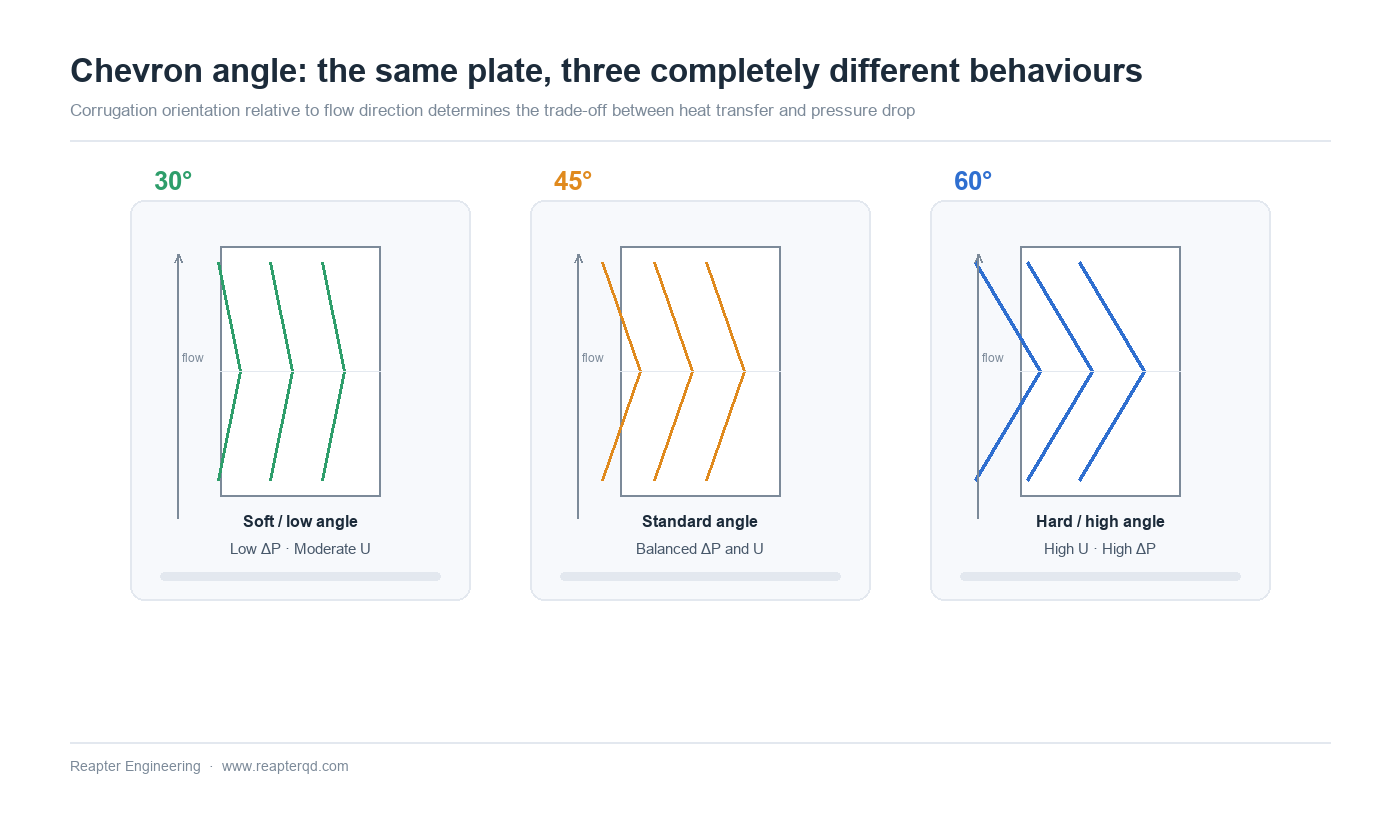
Chevron angles in commercial plate heat exchangers typically fall between roughly 30° and 65°. The industry shorthand divides them into two families:
Low-angle plates (around 30°) — often called "soft" plates. The corrugation runs closer to the direction of flow. Fluid passes through more easily, so pressure drop is low. But the boundary layer stays thicker, so heat transfer is comparatively modest. Soft plates are the right choice when the available pump head is limited, when the medium is viscous, or when the temperature approach is wide.
High-angle plates (around 60–65°) — "hard" plates. The corrugation cuts sharply across the flow path, forcing the fluid to turn more frequently. This thins the boundary layer and raises heat transfer substantially — but the same mechanism raises pressure drop, often by a factor of several. Hard plates suit clean, low-viscosity media where a close temperature approach matters more than pumping cost.
The critical point for selection work: the angle affects heat transfer and pressure drop in the same direction. There is no plate geometry that gives more heat transfer for less pressure drop. Every selection is a trade-off between the two.
The trade-off in numbers
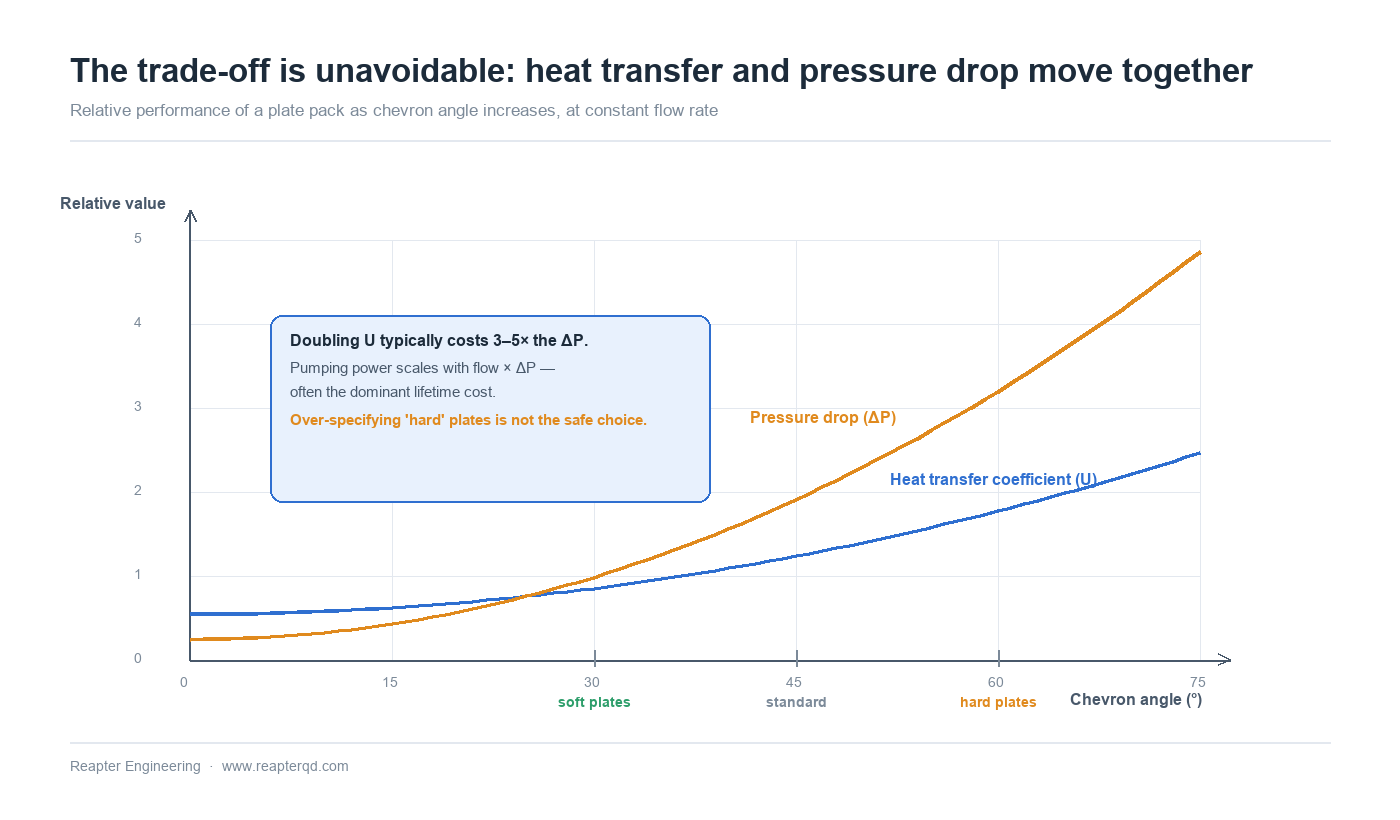
In published performance correlations — most plate manufacturers use the form developed from the Nusselt and friction factor relationships — moving from a 30° plate to a 65° plate under otherwise identical conditions typically increases the heat transfer coefficient by a factor of roughly two, while increasing the friction factor by a factor of three to five. Because pumping power scales with the product of flow rate and pressure drop, that apparently modest geometric change can multiply pump energy demand several times over.
For a cooling water duty running thousands of hours per year, that difference in pump energy frequently exceeds the entire capital cost of the exchanger within a few years of operation. It is the reason an over-specified "hard" plate selection is not the conservative choice it appears to be.
Mixed plate packs: using both angles in one unit
Because heat transfer and pressure drop do not need to be balanced identically on both sides of a heat exchanger, a single unit can be assembled from alternating hard and soft plates. This is standard practice and one of the most useful tools in plate exchanger design:
- The hard channels on one side provide high heat transfer for the stream that needs it.
- The soft channels on the other side keep pressure drop low for the stream that cannot tolerate it — a viscous product, a gravity-fed line, or a circuit with limited pump head.
The result is a unit that meets both thermal and hydraulic requirements, where a single-angle design would force a compromise on one of them. Mixed packs also increase turbulence in the low-angle channels, which raises the wall shear stress and reduces the rate at which fouling deposits adhere.
Practical selection guidance
When comparing plate options for a specific duty, work through the following in order:
- Establish the binding constraint. Determine whether the limitation comes from the required temperature approach (thermal) or from the allowable pressure drop (hydraulic). Only one of these usually governs.
- Do not treat catalogue pressure drop as a property of the plate. Pressure drop depends on flow rate, channel geometry, plate count, and pass arrangement together. Two suppliers quoting the "same" plate can return very different hydraulics.
- Check both sides independently. Hot-side and cold-side requirements are usually different. A mixed pack may be the correct answer even when a single-angle plate satisfies the thermal duty.
- Account for fouling margin honestly. A hard plate has a smaller margin than it appears: as fouling raises the effective resistance, a design that was already near the pressure limit will degrade quickly. Over-specifying heat transfer to "be safe" often shortens the interval between cleanings.
- Verify with measured operating data. After commissioning, compare actual outlet temperatures and pressure drops against the design values. A persistent gap usually indicates a selection assumption — frequently the viscosity at wall temperature — that did not hold.
Common questions
Does a higher chevron angle always mean higher pressure drop?
At equal flow rate and plate geometry, yes — the relationship is monotonic. The only way to reduce pressure drop at a fixed angle is to change the flow rate, the number of passes, or the channel configuration.
Can the chevron angle be changed after the unit is built?
No. The angle is set by the pressing die. Adjusting performance after installation means changing the plate pack — substituting plates of a different angle — not modifying existing plates.
Why does the same plate model show different performance in different projects?
Because performance is a property of the assembled unit, not the individual plate. Plate count, pass arrangement, and the pairing of hard and soft channels all change the result substantially.
How Reapter approaches plate selection
Reapter manufactures plate heat exchanger plates across a range of corrugation angles and offers mixed-plate configurations for duties where a single-angle pack would force an unacceptable compromise on either heat transfer or pressure drop. Our engineering team reviews the complete duty — flow rates, allowable pressure drop on both sides, fouling tendency, and temperature approach — before recommending a plate pattern, rather than quoting from a single catalogue line.
If you are re-rating an existing unit, replacing a plate pack, or specifying a new exchanger and want a second opinion on the plate geometry, send us the duty parameters and we will return a configuration with the underlying hydraulic calculations.
Reapter Engineering Team · Qingdao Ruipute Heat Exchange Equipment Manufacturing Co., Ltd.
Related information
- Sugar production with stainless steel plate heat exchanger in the overall role of the sugar industry production
- Plate and shell heat exchanger in AC on the application of hot water-Qingdao Ruipute
- Science Today: How to clean a plate heat exchanger
- Plate heat exchangers in paper mills can kill three birds with one stone only because of this feature
- Method for preventing electrochemical corrosion of detachable plate heat exchanger
- How to be able to produce high quality plate heat exchanger plates
Relevant article
- How Chevron Angle Affects Plate Heat Exchanger Performance
- Plate Heat Exchanger Pressure Drop: Steam Service | REAPTER
- Gasketed vs Brazed Plate Heat Exchangers: Differences, Advantages and Applications
- Plate Heat Exchanger for Concentrated Juice Processing
- Factors Affecting the Heat Transfer Coefficient of Plate Heat Exchangers
- What Factors Affect the Heat Transfer Coefficient of a Plate Heat Exchanger?
- Factors affecting the pressure drop of plate heat exchangers
- Can plate heat exchanger be directly used for feed water heating or cooling?
- Why the heat transfer efficiency of plate heat exchangers in the heating industry is low
- How to determine the size and angle of plate heat exchanger plate?
Latest information
- The original lubricant in the chemical plate heat exchanger plays so many roles!
- Heat exchanger station supporting plate heat exchanger or have to pay attention to these points, or easily go wrong
- Heat station supporting plate heat exchanger installation is a technical work, these points should be noted
- Improve the efficiency of industrial boilers with plate heat exchanger, these maintenance points to keep in mind
- The Integrated Heat Exchanger Unit: An Efficient Integration and Intelligent Control Solution for Thermal Energy Conversion
- Sulfuric acid and other corrosive media for industrial plate heat exchanger requirements are what
- Simple and effective chemical cleaning method of coal chemical plate heat exchanger, can effectively improve efficiency
- A high-quality petrochemical plate heat exchanger in the production of what to consider
- These causes of chemical plate heat exchanger gasket aging you may not know
- Chemical plant plate heat exchanger, sulfuric acid cooling needs attention