-
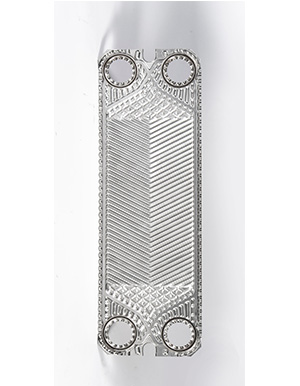
Double Wall Plates And Gaskets
The plate of the double wall plate heat exchanger replaces the single plate type with two welded plates. Once the plate is cracked or perforated, the fluid will flow between the two plates to the outside, which is easy to be found and taken. Doing this can avoid contamination or adverse reactions caused by the mixing of the two heat exchange media.More +
-
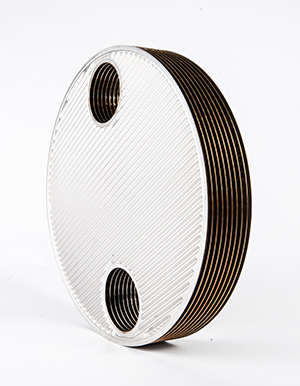
Plate And Shell Heat Exchanger Plate Pack
A bunch of circular plates made of stainless steel or other alloy material are laser welded into one body, called a heat exchanger lathed bundle, then placed in a cylinder to form a plate and shell heat exchanger. The plate and shell heat exchanger has the advantages of temperature resistance and pressure resistance with shell and tube heat exchanger, and also the advantages of high efficiency, compactness with plate heat exchanger.More +
-
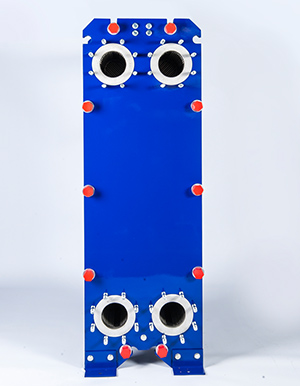
Double wall plate heat exchanger principle
The double wall plate heat exchanger plate is welded integrally with two thin plate pieces along the corner hole of each pair of plates. When the plate leaks, for example, the perforation caused by long time working will be easily detected from outside. Thereby it stops mixing between two materials.And at the same time, they plays very important roles towards warning internal leakage. Combined with the double seal of the gasket, the possibility of mixing two materials is avoided, and it is suitable for applications with high sanitary requirements or high safety and reliability of industrial production. Since the two sheets are welded to form a sheet, the heat transfer coefficient is inevitably lowered, but the highest safety is achieved in preventing materials mixing.More +
-
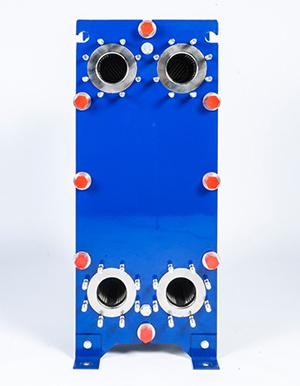
Semi welded plate heat exchanger
The semi welded plate heat exchanger is composed of a pair of plates, and each of the two plates is laser welded to form a pair of plates. It is sandwiched between the fixed pressing plate and the movable pressing plate in a superimposed mannerMore +
-
Plate heat exchanger
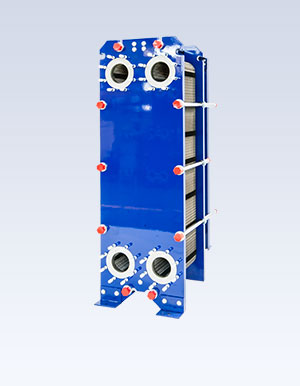
A plate and frame heat exchanger as known as gasketed plate heat exchanger is a high efficiency heat exchanger that is assembled from a series of metal sheets with a certain corrugated shape. A thin rectangular channel is formed between the various sheets, and heat is exchanged through the sheets.More +
-
Wide gap plate heat exchanger
A plate and frame heat exchanger as known as gasketed plate heat exchanger is a high efficiency heat exchanger that is assembled from a series of metal sheets with a certain corrugated shape. A thin rectangular channel is formed between the various sheets, and heat is exchanged through the sheets.More +
-
Food grade plate heat exchanger
A plate and frame heat exchanger as known as gasketed plate heat exchanger is a high efficiency heat exchanger that is assembled from a series of metal sheets with a certain corrugated shape. A thin rectangular channel is formed between the various sheets, and heat is exchanged through the sheets.More +
- [Q & A]Plate Heat Exchangers for Seawater and Brine Cooling: Materials and Limits2026.10.22 09:14
- How chloride duty changes plate heat exchanger selection: corrosion limits from 316L to titanium, gasket choice and design details for seawater and brine.
- read(1)
- [Q & A]Cross-Plate Leakage in a Plate Heat Exchanger: Diagnose Before You Order Parts2026.10.20 09:15
- How to tell an internal crossover from an external drip in a gasketed plate heat exchanger, localise the fault, and order the right part the first time.
- read(3)
- [Q & A]Hygienic Design for Food-Grade Plate Heat Exchangers: What the Standards Require2026.10.19 14:59
- What makes a plate heat exchanger food grade: groove geometry, dead space, elastomer compliance and verified cleaning. The standards and the design features.
- read(4)
- [Q & A]Plate Heat Exchanger Flow Arrangement: Series, Parallel and Multi-pass2026.10.19 14:58
- Series, parallel and multi-pass arrangements change the temperature difference, pressure drop and flow distribution of a plate heat exchanger. How to choose.
- read(5)
- [Q & A]Fouling Allowance in Plate Heat Exchanger Design: Sizing the Margin2026.10.19 14:57
- How to set the fouling allowance in plate heat exchanger design: typical resistances by fluid, why plate units are sensitive, and when more plates backfire.
- read(5)
- [Q & A]Close Temperature Approach in Plate Heat Exchangers: How Close Is Practical?2026.10.19 14:56
- The approach temperature decides the size, cost and behaviour of a plate heat exchanger. What it is, how close you can practically go, and what breaks below 2 C.
- read(4)
- [Q & A]District Heating Substations: Sizing Plate Heat Exchangers for Seasonal Load2026.10.19 09:15
- How to size a district heating substation plate heat exchanger for the winter peak and the summer DHW duty: approach temperature, velocity and arrangement.
- read(5)
- [Q & A]Commissioning a Plate Heat Exchanger: A Field Checklist2026.10.18 09:15
- A field checklist for commissioning a gasketed plate heat exchanger: pre-closure checks, torque sequence, flushing, pressure testing, clean baseline.
- read(5)
- [Q & A]Plate Heat Exchanger Gasket Selection: Matching Elastomer to Duty2026.10.17 09:10
- The elastomer, not the plate, usually sets the temperature limit. NBR, EPDM, HNBR, FKM and PTFE compared by duty, with a practical selection sequence.
- read(8)
- [Q & A]How to Re-rate a Plate Heat Exchanger for Higher Duty2026.10.16 09:14
- A higher duty often needs more plates, not a new exchanger. The three ceilings that decide it, the four levers, and the checks before ordering.
- read(3)
- [Q & A]How to Specify Replacement Plates for a Plate Heat Exchanger2026.10.15 09:14
- A replacement plate fits only if it matches the installed plate dimension for dimension. What to measure, how to identify an unmarked plate, and what to order.
- read(3)
- [Q & A]Plate and Shell vs Shell and Tube: Choosing the Right Exchanger2026.10.14 10:11
- Plate and shell units keep the thermal efficiency of plate designs while removing the gasket. Where they beat shell and tube — and where they do not.
- read(6)
- [Q & A]How Chevron Angle Affects Plate Heat Exchanger Performance2026.10.14 10:10
- The chevron angle determines how a plate heat exchanger balances heat transfer against pressure drop. What soft and hard plates do, and how to select between them.
- read(14)
Related search
Hot spot focusing
- 1Shandong Hengbang uses Ripute semi-welded evaporator and condenser case
- 2Haier new materials use Ripute small plate heat exchanger case
- 3Chuanqing Drilling Engineering Company uses Repute plate and shell heat exchanger case
- 4As a manufacturer of Plates and Gaskets, what are the advantages of Qingdao Ruipute Heat Exchange Equipment Manufacturing Co., Ltd ?
- 5As a manufacturer of plate heat exchangers, what are the advantages of Qingdao Ruipute Heat Exchange Equipment Manufacturing Co., Ltd?
- 6What are the advantages of plate heat exchangers compared to conventional heat exchangers?