Home › News › Is the plate heat exchanger for juice cooling imported or domestic? Your focus is simply wrong
Is the plate heat exchanger for juice cooling imported or domestic? Your focus is simply wrong

Regardless of whether it is juice/milk/beer, these working conditions are relatively simple. For heat exchange, a wide flow channel (free flow) detachable plate heat exchanger made of stainless steel is generally used. There are no technical difficulties.
At one point, there is not much difference between domestic and imported products, so what should we pay attention to?
It should be food safety.
This is a commonplace topic, but not all companies can provide corresponding maintenance services. For example, a fruit juice manufacturer will never only produce fruit juice. It is very likely that there will be peanuts/milk/soy milk/wheat.
Certain fibrous media, such as orange juice and the pulp inside, if they are not cleaned or there is a problem on the pasteurized plate heat exchanger, these large particles will breed microorganisms, which are hidden dangers to food safety.
, Without disassembling the equipment, flush and clean.
Both methods are ok, but they must all require professional guidance/operation, so when choosing a manufacturer, you must consider more variable factors!
At one point, there is not much difference between domestic and imported products, so what should we pay attention to?
It should be food safety.
This is a commonplace topic, but not all companies can provide corresponding maintenance services. For example, a fruit juice manufacturer will never only produce fruit juice. It is very likely that there will be peanuts/milk/soy milk/wheat.
If the heat exchanger is not cleaned properly, these residues are likely to become allergens for some people.
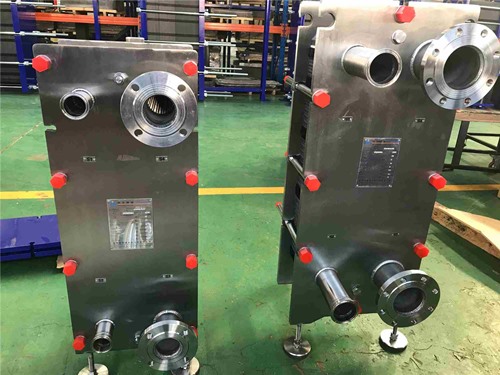
Certain fibrous media, such as orange juice and the pulp inside, if they are not cleaned or there is a problem on the pasteurized plate heat exchanger, these large particles will breed microorganisms, which are hidden dangers to food safety.
Therefore, it is very important to maintain the plate heat exchanger regularly. However, the physical cleaning method-CIP, requires disassembly of the heat exchanger. If the operation is improper, the rubber strip is easily damaged. At this time, the plate replacement is required to purchase the manufacturer’s instructions.
, Without disassembling the equipment, flush and clean.
Both methods are ok, but they must all require professional guidance/operation, so when choosing a manufacturer, you must consider more variable factors!
【Paper label】:juice cooling plate heat exchanger
Related information
- plate heat exchanger gasket causes problems, these factors are the key
- What is the new plate and shell heat exchanger?
- Plate Heat Exchangers in Heat Pump Systems: Source-Side and Load-Side Selection
- Stainless steel plate and shell heat exchanger high heat transfer efficiency and long life, so what is the specific information about it?
- Coal chemical plate heat exchanger in the selection process of these places to pay attention to
- Convenient panel shell heat exchanger for high temperature oil heat exchange, great use in fully automatic production process
Relevant article
- Reading a Water Analysis Before You Specify a Plate Heat Exchanger
- High-Temperature Heat Pumps Above 100 °C: Exchanger Selection for Steam Replacement
- Data Centre Waste Heat to District Heating: Matching Low-Grade Heat to a Network
- Plate Heat Exchanger Sizing: A Worked Calculation from Duty to Plate Count
- Plate Heat Exchanger Troubleshooting: Reading the Symptoms Before Opening the Pack
- Winter Shutdown and Freeze Protection for Plate Heat Exchangers
- Transcritical CO2 Systems: Selecting Plate Heat Exchangers for High Pressure
- Waste Heat Recovery with Plate Heat Exchangers: Sizing and Fouling
- Plate Heat Exchangers in Heat Pump Systems: Source-Side and Load-Side Selection
- Plate Heat Exchangers in Data Center Liquid Cooling: CDU Selection
Latest information
- The original lubricant in the chemical plate heat exchanger plays so many roles!
- Heat exchanger station supporting plate heat exchanger or have to pay attention to these points, or easily go wrong
- Heat station supporting plate heat exchanger installation is a technical work, these points should be noted
- Improve the efficiency of industrial boilers with plate heat exchanger, these maintenance points to keep in mind
- The Integrated Heat Exchanger Unit: An Efficient Integration and Intelligent Control Solution for Thermal Energy Conversion
- Sulfuric acid and other corrosive media for industrial plate heat exchanger requirements are what
- Simple and effective chemical cleaning method of coal chemical plate heat exchanger, can effectively improve efficiency
- A high-quality petrochemical plate heat exchanger in the production of what to consider
- These causes of chemical plate heat exchanger gasket aging you may not know
- Chemical plant plate heat exchanger, sulfuric acid cooling needs attention