Plate Heat Exchangers: Selection Guide

Plate heat exchangers are also widely used in the industrial field, including the cooling of hydraulic oil, lubricating oil and other oil media. The plate heat exchanger for lubricating oil cooling is an important part of the equipment operation.
During the operation of the lubricating oil, it absorbs the heat generated by the friction of the bearing and other components, and the temperature will continue to rise. In order to ensure the safe operation of the equipment, the oil temperature must be controlled within a reasonable range.
If the viscosity is too high, the viscosity will decrease. If the viscosity is low, it is not easy to form an oil film. If the oil temperature is too high, it is too late to take away the heat generated by the bearing and other components. Over time, the bearing will burn out; if the temperature is too low, the viscosity of the lubricant will increase.
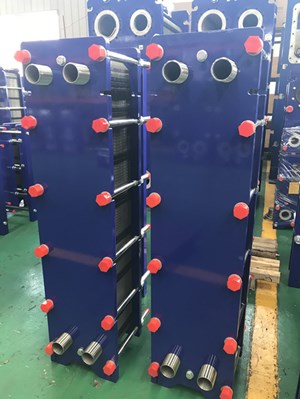
Large, it will increase the extra labor of the equipment, so in this process, the plate heat exchanger uses cold water to cool the lubricating oil to achieve the purpose of temperature control.
After all, lubricating oil is an oil medium, and its types are also very rich. Its special physical properties have high requirements on the heat exchange effect of the equipment and the plates and rubber strips. The lubricating oil must be designed with different considerations.
The physical properties of the lubricants at different temperatures, the plate type and the depth of the plate used for different physical properties will also be different, and in the selection of the material of the rubber strip, the appropriate material should be selected according to the medium and temperature.
For 13 years in Qingdao RPT, our technical engineers have specially developed and used different layouts for different working conditions. Through different layouts, different plate depths, and different rubber strip materials, we can achieve the best heat transfer.
Effectively, if you are considering buying a lubricating oil-cooled plate heat exchanger, Qingdao RPT is your perfect choice.
Related information
- Commissioning a Plate Heat Exchanger: A Field Checklist
- How PHE Model Codes Are Structured
- How exactly does a plate heat exchanger last up to 10 years?
- New plate heat exchanger units were added to the Lab to provide data support for technology upgrade
- NT50M Compatible PHE Plates & Gaskets in Stock
- Corrosion Analysis for Chemical Plate Heat Exchangers
Relevant article
- Plate Heat Exchangers in Thermal Oil Systems: Seals, Film Temperature and When to Weld
- Water Hammer and Pressure Surges in Plate Heat Exchangers: Causes and Countermeasures
- Plate Heat Exchanger vs Shell-and-Tube Cleaning: Where the Lifetime Cost Diverges
- Plate Heat Exchanger Connections: DN vs NPS, PN vs Class, and What Goes Wrong on Site
- Free Cooling with Plate Heat Exchangers: Design and Changeover
- Multi-Section Plate Heat Exchangers: Two Duties, One Frame
- Retrofitting a Shell-and-Tube with a Plate Heat Exchanger: Fitting the Duty into an Existing Plant
- Packing a Plate Heat Exchanger for Ocean Freight: Preservation, Storage and Site Handover
- Plate Heat Exchangers Under Vacuum: Operating on the Negative-Pressure Side
- Gasket Compression Set and Bolt Torque Management in Plate Heat Exchangers
Latest information
- Chemical Plate Heat Exchanger: Lubricant Roles & Care
- Heat Station Plate Heat Exchangers: Design & Application
- Heat Station Plate Heat Exchangers: Installation Guide
- Boiler Plate Heat Exchangers: Maintenance Guide
- The Integrated Heat Exchanger Unit: An Efficient Integration and Intelligent Control Solution for Thermal Energy Conversion
- Sulfuric Acid Plate Heat Exchangers: Design & Application
- Coal Chemical Plate Heat Exchangers: Cleaning & Maintenance
- Petrochemical Plate Heat Exchangers: Design & Application
- Chemical Plate Heat Exchangers: Gasket Ageing
- Sulfuric Acid Plate Heat Exchangers: Design & Application