PHE Storage Guidelines for Spare Units

Because the plate heat exchanger contains rubber gaskets, its storage has certain special characteristics. Generally, it should be carried out according to the requirements of rubber amine, such as avoiding light, ventilation, and away from ozone, etc., and has certain temperature and humidity requirements. When it is not used for a long time, it should be ensured that the rubber gasket has a certain amount of loosening, which will not cause permanent deformation and maintain its elastic state.
Let's take a look at how some of the world's major brand plate heat exchanger manufacturers, such as Tranter, APV, GEA, and Alfa Laval, store temporary heat exchange equipment that is not in use.
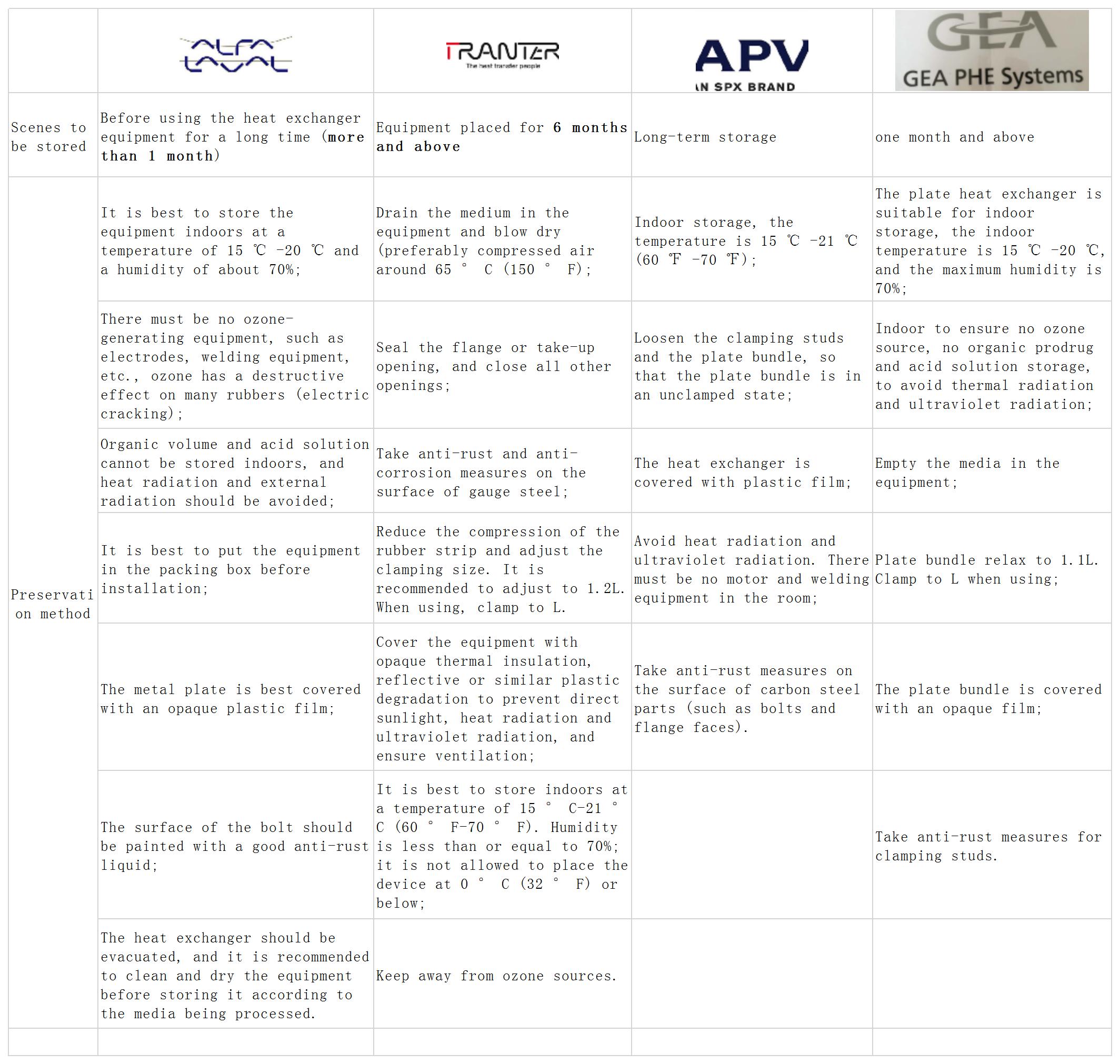
The above is the storage guide for these big brand plate heat exchanger manufacturers. If your equipment also needs to be stored or will not be used for a period of time, learn these methods! Ruipute's heat exchanger standards are in line with international first-line brands, and similar storage methods; or if you have any questions about the storage of heat exchangers, you can call our staff!
Related information
- Plate Heat Exchangers: Manufacturer Selection
- Waste Heat Recovery with Plate Heat Exchangers
- How to judge the plate heat exchanger adhesive gasket from the senses
- How to Assess Plate Heat Exchanger Build Quality
- To buy a cheap plate heat exchanger gasket? You may pay more when using it
- Coal Chemical Plate Heat Exchangers: Cleaning & Maintenance
Relevant article
- Gasketed, Semi-Welded or Fully Welded: Choosing Plate Heat Exchanger Construction for the Duty
- Gasket Shelf Life and Storage: Keeping Spare Plate Heat Exchanger Gaskets Fit for Duty
- Plate Heat Exchangers in MVR Evaporation: Designing Around a Small Driving Force
- Plate Heat Exchangers in Sugar Mills: Juice Heating, Evaporation Support and Molasses Cooling
- Plate Heat Exchangers in Pulp and Paper Mills: Duties, Fibre, Fouling and Materials
- Flow-Induced Vibration in Plate Heat Exchangers: Causes, Damage Patterns and Fixes
- Plate Heat Exchangers in Thermal Oil Systems: Seals, Film Temperature and When to Weld
- Water Hammer and Pressure Surges in Plate Heat Exchangers: Causes and Countermeasures
- Plate Heat Exchanger vs Shell-and-Tube Cleaning: Where the Lifetime Cost Diverges
- Plate Heat Exchanger Connections: DN vs NPS, PN vs Class, and What Goes Wrong on Site
Latest information
- Chemical Plate Heat Exchanger: Lubricant Roles & Care
- Heat Station Plate Heat Exchangers: Design & Application
- Heat Station Plate Heat Exchangers: Installation Guide
- Boiler Plate Heat Exchangers: Maintenance Guide
- The Integrated Heat Exchanger Unit: An Efficient Integration and Intelligent Control Solution for Thermal Energy Conversion
- Sulfuric Acid Plate Heat Exchangers: Design & Application
- Coal Chemical Plate Heat Exchangers: Cleaning & Maintenance
- Petrochemical Plate Heat Exchangers: Design & Application
- Chemical Plate Heat Exchangers: Gasket Ageing
- Sulfuric Acid Plate Heat Exchangers: Design & Application