What is the production and processing technology of Qingdao Ruipute plate heat exchanger plate?

A plate heat exchanger is a combination of a set of corrugated metal plates with four corner holes for heat transfer of two fluids to direct the fluid through each channel alternately. They are closely arranged for heat exchange. High precision, small size, high heat exchange efficiency and space saving. Here we summarize the production and processing process of plate heat exchanger plates.
1. Plate separation zone design: even the widest plate distributes the fluid evenly and uniformly throughout the plate, resulting in minimal pressure loss in the separation zone. All heat exchange zones of the plate are involved in the effective heat transfer. All physical areas of the board are converted into an effective heat transfer area, no heat transfer dead zone, no flow dead ends, not easy to accumulate, not easy to cause scale caused by chloride ion corrosion, can make full use of the allowable pressure drop, increase the flow of convective heat transfer part, improve the overall heat transfer efficiency.
2. Unidirectional flow design: the entire plate heat exchanger uses only one type of plate, making it easier to pipe, install and maintain, and reducing the type and number of plates and pads.
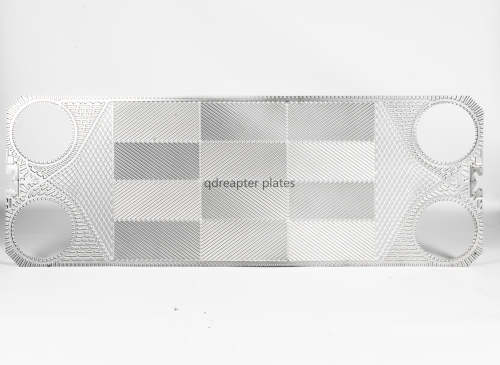
3. Plate has two corrugated angle H and L: the optimal combination of plate heat exchanger can maximize the heat transfer coefficient and reduce equipment costs.
4. The plate is formed by one punch: on the same plate, the depth of the corrugation is the same, each contact point between the plates is perfectly connected, there is no over-punching area on the plate, there will not produce any hidden cracks, the height of the metal grain on the plate is the same, the thinnest plate can reach 0.3mm, which makes the plate's pressure-bearing capacity is enhanced, to avoid thermal stress fatigue, to avoid vibration and high-frequency chatter caused by the heat exchanger. Mechanical fatigue corrosion, and better mechanical properties of the plate, avoiding hidden cracks. Leakage is eliminated and contact points are evenly distributed. When the medium flows through the plate, the turbulence is enhanced, the heat transfer efficiency is maximized, the weight of the equipment is reduced, and a higher heat transfer coefficient can be obtained under pressure requirements.
Ruipute Ltd. is the world's leading manufacturer and seller of plate heat exchanger plates, with the most complete variety and most models of plate heat exchanger plates in China. The production and processing technology of the plate heat exchanger plates of the company produced by Qingdao Ruipute is at the domestic level, the press adopts the imported system and has its own mold processing center, the quality level and technical service level have been widely praised by customers at home and abroad. Welcome customers to inquire now, you can get free selection design scheme.
Related information
- Qingdao Ruipute production of plate heat exchanger in the use of the process to pay attention to what matters
- The temperature difference design of the heat exchanger
- Are the plates of SS304, 316L, Hastelloy, and titanium unclear? Large heat exchanger manufacturers tell you the answer
- Why your plate heat exchanger gasket swelling happens?
- Installation Guide for Plate Heat Exchangers
- Today let's take a look at some of the unspeakable secrets of the imported plate type heat exchanger
Relevant article
- Gasketed, Semi-Welded or Fully Welded: Choosing Plate Heat Exchanger Construction for the Duty
- Gasket Shelf Life and Storage: Keeping Spare Plate Heat Exchanger Gaskets Fit for Duty
- Plate Heat Exchangers in MVR Evaporation: Designing Around a Small Driving Force
- Plate Heat Exchangers in Sugar Mills: Juice Heating, Evaporation Support and Molasses Cooling
- Plate Heat Exchangers in Pulp and Paper Mills: Duties, Fibre, Fouling and Materials
- Flow-Induced Vibration in Plate Heat Exchangers: Causes, Damage Patterns and Fixes
- Plate Heat Exchangers in Thermal Oil Systems: Seals, Film Temperature and When to Weld
- Water Hammer and Pressure Surges in Plate Heat Exchangers: Causes and Countermeasures
- Plate Heat Exchanger vs Shell-and-Tube Cleaning: Where the Lifetime Cost Diverges
- Plate Heat Exchanger Connections: DN vs NPS, PN vs Class, and What Goes Wrong on Site
Latest information
- Chemical Plate Heat Exchanger: Lubricant Roles & Care
- Heat Station Plate Heat Exchangers: Design & Application
- Heat Station Plate Heat Exchangers: Installation Guide
- Boiler Plate Heat Exchangers: Maintenance Guide
- The Integrated Heat Exchanger Unit: An Efficient Integration and Intelligent Control Solution for Thermal Energy Conversion
- Sulfuric Acid Plate Heat Exchangers: Design & Application
- Coal Chemical Plate Heat Exchangers: Cleaning & Maintenance
- Petrochemical Plate Heat Exchangers: Design & Application
- Chemical Plate Heat Exchangers: Gasket Ageing
- Sulfuric Acid Plate Heat Exchangers: Design & Application