Causes of heat exchanger gasket aging

The plate heat exchanger has the advantages of high heat transfer efficiency, compact structure and flexible operation, which has been the rapid development and increasingly widespread application, but many users have encountered in the use of the gasket aging, the following editor to introduce the causes.
1. Size of the impact
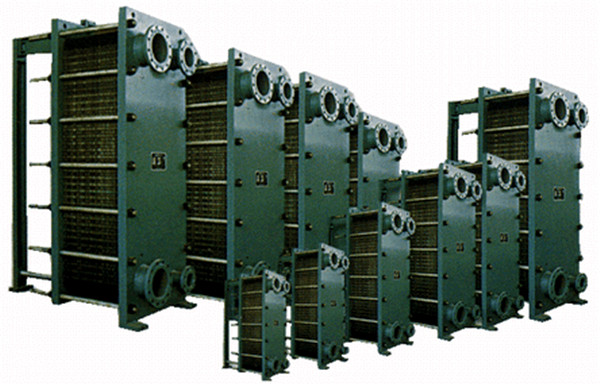
The plate heat exchanger is composed of a fixed cover plate, a removable cover plate and a set of plates. The principle of the structure is that the plates are compressed by means of a screw between the front and rear plates, which also generates the necessary pressure on the seal. Based on this structure of the heat exchanger, during the heat exchanger compacting process, the movable cover plate is constantly pressed closer to the fixed cover plate, resulting in the The plates near the moving cover are the first to be compressed. The greater the number of plates to be compressed, the greater the pre-stressing. Due to this structural characteristic, the number of plates in the same working condition also affects the service life of the heat exchanger seal.
2. The influence of the location of the equipment
The use of plate heat exchanger seals is influenced not only by light and weather, but also by the surrounding environment. This is why heat exchangers placed outdoors will have a different seal life than those placed indoors. In order to reduce the influence of the environment, it is very effective to use a protective cover or insulation on the outside of the plate heat exchanger.
3. Influence of operating conditions
The effect of temperature and pressure variations on the service life of seals should never be underestimated. In the case of a change in operating conditions, the stress peaks generated in various parts of the seal have a more negative effect on the internal structure of the material than a long time of constant temperature and pressure. The load on the seal is even more lethal. Likewise, start-stop procedures or long downtimes can negatively impact seal life. From an equipment standpoint, if the process requires frequent start-stop procedures, a spring device between the tie rods and the removable cover to Reduce the effect of temperature load changes on the seal.
4. Influence of the flow medium in the plate heat exchanger.
The medium flowing through the plate heat exchanger has the greatest impact on the life of the seal. The selection of a suitable seal is often not perfect in terms of fluid substance and operating conditions, and during the design process The mixing of cooling and heating additives, inhibitors and other substances that tend to penetrate into the seal and cause The destruction of its physical properties.
The above is the reason for the aging of the heat exchanger gasket, I hope it can help you, if you still have other aspects you want to know, you can come to consult us.
Related information
- In what cases can't I use a plate heat exchanger device?
- Applications for Industrial Plate Heat Exchangers
- Understand the operation control of heat exchanger
- Water Hammer and Pressure Surges in Plate Heat Exchangers: Causes and Countermeasures
- Coal Chemical Plate Heat Exchangers: Cleaning & Maintenance
- How high are the requirements for temperature in marine aquaculture, and how high are the requirements for plate heat exchangers
Relevant article
- Plate Heat Exchangers in Thermal Oil Systems: Seals, Film Temperature and When to Weld
- Water Hammer and Pressure Surges in Plate Heat Exchangers: Causes and Countermeasures
- Plate Heat Exchanger vs Shell-and-Tube Cleaning: Where the Lifetime Cost Diverges
- Plate Heat Exchanger Connections: DN vs NPS, PN vs Class, and What Goes Wrong on Site
- Free Cooling with Plate Heat Exchangers: Design and Changeover
- Multi-Section Plate Heat Exchangers: Two Duties, One Frame
- Retrofitting a Shell-and-Tube with a Plate Heat Exchanger: Fitting the Duty into an Existing Plant
- Packing a Plate Heat Exchanger for Ocean Freight: Preservation, Storage and Site Handover
- Plate Heat Exchangers Under Vacuum: Operating on the Negative-Pressure Side
- Gasket Compression Set and Bolt Torque Management in Plate Heat Exchangers
Latest information
- Chemical Plate Heat Exchanger: Lubricant Roles & Care
- Heat Station Plate Heat Exchangers: Design & Application
- Heat Station Plate Heat Exchangers: Installation Guide
- Boiler Plate Heat Exchangers: Maintenance Guide
- The Integrated Heat Exchanger Unit: An Efficient Integration and Intelligent Control Solution for Thermal Energy Conversion
- Sulfuric Acid Plate Heat Exchangers: Design & Application
- Coal Chemical Plate Heat Exchangers: Cleaning & Maintenance
- Petrochemical Plate Heat Exchangers: Design & Application
- Chemical Plate Heat Exchangers: Gasket Ageing
- Sulfuric Acid Plate Heat Exchangers: Design & Application