Do you know plate heat exchanger plate corrosion? Let me tell you.

Nowadays, with the improvement of living standards, people are not stingy with their money, but the biggest fear is that they cannot buy good things after spending money. This principle also applies to the plate heat exchanger industry. Especially in plate heat exchanger plate corrosion.
Many customers come to us, and the feedback is that they bought heat exchangers in other countries, and this heat exchanger is the manufacturer they chose carefully and investigated for a long time. Finally, the situation they were most afraid of appeared on the production line: it was not bad at the beginning. After a period of time, heat exchange efficiency was reduced and leakage occurred. The thermal operation was no problem, but during the outage, seepage occurred, which finally led to the failure of normal operation.
Both the site photos taken by customers and the feedback we sent professional maintenance personnel to the site for inspection finally came back to us from many manufacturers: the plates had started to rust or scale after being disassembled. Improper selection, material selection is not appropriate.
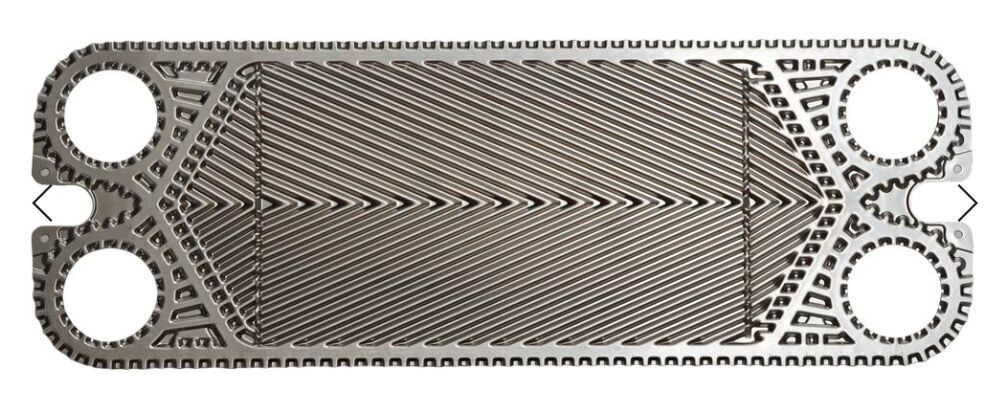
The customer did not understand why the heat exchanger had rust, scale and even corrosion in such a short time.
If you want to solve the corrosion of the plate, first of all to understand the heat exchanger application of the medium, if it is acid, alkaline and other corrosive medium, in the use of the plate raw materials to choose strong corrosion resistance plate for production; Secondly, the raw material of the plate also has the difference between good and bad, when the manufacturer chooses the raw material of the plate, the same is said to use 304/316 of the plate, thickness actually also has the difference. The final step in sheet production is processing: the raw material is first cut for subsequent pressing. Strictly in accordance with the European CE standard production of the above two points determine the subsequent drawing of the plate, the plate is seriously uneven drawing will lead to slide.
Poor corrosion bearing
Type selection to production process
Persistence and research and development
In the pressing process, the really effective pressure of the press determines the groove depth of the plate, and the groove depth determines the velocity of the medium flow and the pressure of the heat exchanger as a whole, to a small extent, it affects the heat exchange efficiency, to a large extent, whether the heat exchanger can be used normally, which is related to the cost to output ratio of the production line! Having read the above, will you know how to avoid lightning in your next board purchase?
Qingdao Ruipute heat exchanger for export has over 13 years, has been to European premium brands Alfa Laval production standards as a benchmark, more than 20 years experience in technology research and development team to ensure that process design with the international synchronization upgrade, far more than the domestic standard, let the customer at home can feel the quality of international brands, free choice to contact us.
Related information
- Industrial Plate Heat Exchangers: Applications
- Plate Heat Exchangers in District Heating Projects
- Retrofitting a Shell-and-Tube with a Plate Heat Exchanger: Fitting the Duty into an Existing Plant
- Plate Heat Exchanger vs Shell-and-Tube Cleaning: Where the Lifetime Cost Diverges
- The function and structure of plate heat exchanger
- Three Criteria for Choosing a PHE Supplier
Relevant article
- Plate Heat Exchangers in Thermal Oil Systems: Seals, Film Temperature and When to Weld
- Water Hammer and Pressure Surges in Plate Heat Exchangers: Causes and Countermeasures
- Plate Heat Exchanger vs Shell-and-Tube Cleaning: Where the Lifetime Cost Diverges
- Plate Heat Exchanger Connections: DN vs NPS, PN vs Class, and What Goes Wrong on Site
- Free Cooling with Plate Heat Exchangers: Design and Changeover
- Multi-Section Plate Heat Exchangers: Two Duties, One Frame
- Retrofitting a Shell-and-Tube with a Plate Heat Exchanger: Fitting the Duty into an Existing Plant
- Packing a Plate Heat Exchanger for Ocean Freight: Preservation, Storage and Site Handover
- Plate Heat Exchangers Under Vacuum: Operating on the Negative-Pressure Side
- Gasket Compression Set and Bolt Torque Management in Plate Heat Exchangers
Latest information
- Chemical Plate Heat Exchanger: Lubricant Roles & Care
- Heat Station Plate Heat Exchangers: Design & Application
- Heat Station Plate Heat Exchangers: Installation Guide
- Boiler Plate Heat Exchangers: Maintenance Guide
- The Integrated Heat Exchanger Unit: An Efficient Integration and Intelligent Control Solution for Thermal Energy Conversion
- Sulfuric Acid Plate Heat Exchangers: Design & Application
- Coal Chemical Plate Heat Exchangers: Cleaning & Maintenance
- Petrochemical Plate Heat Exchangers: Design & Application
- Chemical Plate Heat Exchangers: Gasket Ageing
- Sulfuric Acid Plate Heat Exchangers: Design & Application