Why does Ruipute only make plate heat exchangers?

A search of heat exchangers (heat exchangers), a variety of dizzyingly, what tube heat exchangers, plate heat exchangers, and subdivided plate fin heat exchangers, brazed heat exchangers, semi-welded heat exchangers and so on, so to the layman, really big head.But when you buy it, the manufacturer will not tell you the disadvantages of their heat exchanger.However, for major projects, the choice of heat exchanger sloppy, which is also the reason for the long procurement time.
But those with tight purchasing time and urgent projects, it is easy to choose the wrong product.So today, let's take a look at the major heat exchangers.According to the structure can be divided into coil heat exchanger, plate heat exchanger, shell heat exchanger, and a wave joint heat exchanger also belongs to shell heat exchanger.
The earliest was the shell and tube type, and you still see it quite often.
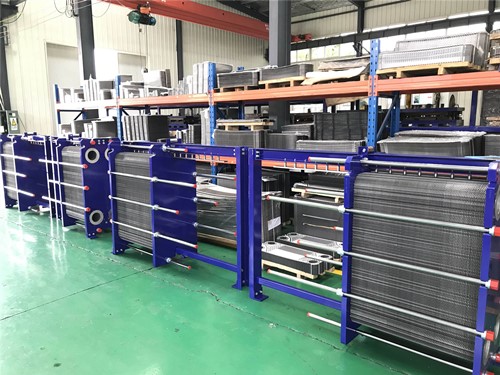
It costs less, but covers a large area, cannot be cleaned, easy to scale.
So the plate heat exchanger, which is actually a derivative of it, certainly has more advantages than that.That's why we only make plate heat exchangers -- it's a little bit wider.
Therefore, many of the projects we undertake are in some challenging and severe conditions, such as heat exchange conditions for oil and natural gas companies -- high temperature, high pressure, sulfuric acid and other chemical companies -- strong corrosion conditions.
May know the friends will ask, plate heat exchanger has a strip, no shell, high temperature and pressure resistance, is not the shell better?
Of course, there is no perfect heat exchanger in the world, so our company also has a more niche product -- plate and shell heat exchanger.
Like the shell and tube type, it is more resistant to high temperature and high pressure without adhesive tape under the condition of full closure, but the heat exchange efficiency, I can guarantee that the shell and plate type is better than the shell and tube type, so is the cost.
We do research and development, do their own brand of plate and shell heat exchanger, because we believe that one day, efficient heat exchange will be the king of the heat exchanger industry.
Related information
- Gasket Selection for Plate Heat Exchangers
- Plate Heat Exchanger Connections: DN vs NPS, PN vs Class, and What Goes Wrong on Site
- Do you know that under the condition of all refrigerants, the focus of imported semi welded plate heat exchanger should be different
- Winter Shutdown and Freeze Protection for Plate Heat Exchangers
- Plate heat exchangers in paper mills can kill three birds with one stone only because of this feature
- Faced with complex working conditions, precise selection is the essence of plate heat exchangers
Relevant article
- Plate Heat Exchangers in Thermal Oil Systems: Seals, Film Temperature and When to Weld
- Water Hammer and Pressure Surges in Plate Heat Exchangers: Causes and Countermeasures
- Plate Heat Exchanger vs Shell-and-Tube Cleaning: Where the Lifetime Cost Diverges
- Plate Heat Exchanger Connections: DN vs NPS, PN vs Class, and What Goes Wrong on Site
- Free Cooling with Plate Heat Exchangers: Design and Changeover
- Multi-Section Plate Heat Exchangers: Two Duties, One Frame
- Retrofitting a Shell-and-Tube with a Plate Heat Exchanger: Fitting the Duty into an Existing Plant
- Packing a Plate Heat Exchanger for Ocean Freight: Preservation, Storage and Site Handover
- Plate Heat Exchangers Under Vacuum: Operating on the Negative-Pressure Side
- Gasket Compression Set and Bolt Torque Management in Plate Heat Exchangers
Latest information
- Chemical Plate Heat Exchanger: Lubricant Roles & Care
- Heat Station Plate Heat Exchangers: Design & Application
- Heat Station Plate Heat Exchangers: Installation Guide
- Boiler Plate Heat Exchangers: Maintenance Guide
- The Integrated Heat Exchanger Unit: An Efficient Integration and Intelligent Control Solution for Thermal Energy Conversion
- Sulfuric Acid Plate Heat Exchangers: Design & Application
- Coal Chemical Plate Heat Exchangers: Cleaning & Maintenance
- Petrochemical Plate Heat Exchangers: Design & Application
- Chemical Plate Heat Exchangers: Gasket Ageing
- Sulfuric Acid Plate Heat Exchangers: Design & Application