Do you know that under the condition of all refrigerants, the focus of imported semi welded plate heat exchanger should be different?

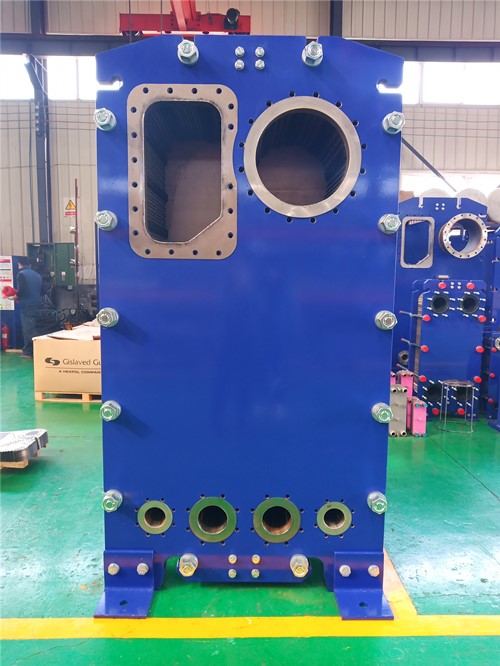
For example, the refrigerant medium we come into contact with in the heat exchanger industry is nothing more than ammonia water and Freon, which can be divided into 22 and 13. The corresponding heat exchanger is nothing more than a semi welded plate heat exchanger.The reason why customers would rather spend more money to buy imported products rather than domestic heat exchangers is closely related to the process.But you know, even refrigerants, you can't generalize?
Ammonia, for example, is the most common cause of fouling in heat exchangers, freon 22 for freezing and Freon 13 for leaking.Fluorine 22 and Fluorine 13 are referred to below.
When the temperature is lower than 0?, the carrier refrigerant (refrigerant) generally needs to use sodium chloride or calcium chloride brine solution. When the heat exchanger is not well selected, scaling on the flow cross section is easy to occur.
The problem of freezing and plugging is generally caused by the decrease of heat exchange efficiency. When the machine runs for a long time without maintenance, or the heat exchange efficiency itself is unstable, such a problem is easy to occur.
Throughout the cooling system, a small amount of lubricating oil from the compressor is taken out and mixed with fluorine 13 into the heat exchanger.Because it is not soluble, it is easy to accumulate in the heat exchanger, which will lead to leakage in the long run.
Therefore, even if the choice of imported semi-welded plate heat exchanger, there is no special engineer for the selection, design and manufacturing, imported heat exchanger bought back at a high price, it is easy to say bad.
If you are hesitant to choose the type, afraid to buy imported heat exchanger money lost, you might as well call Ruipter, professional engineers and major brands of the selection of software check, you can achieve the same quality as imported products, the price is not so expensive oh!
Related information
- Heat Pump Plate Heat Exchangers: Selection Guide
- Plate Heat Exchanger for Concentrated Juice Processing
- Waste Heat Recovery Plate Heat Exchangers: Applications
- European olive oil exports set a record! Edible oil plate and shell heat exchangers are popular at home and abroad
- Plate heat exchanger manufacturers to reveal your secret - plate heat exchanger rubber gasket processing technology
- Chemical Plate Heat Exchangers: Selection Guide
Relevant article
- Plate Heat Exchangers in Thermal Oil Systems: Seals, Film Temperature and When to Weld
- Water Hammer and Pressure Surges in Plate Heat Exchangers: Causes and Countermeasures
- Plate Heat Exchanger vs Shell-and-Tube Cleaning: Where the Lifetime Cost Diverges
- Plate Heat Exchanger Connections: DN vs NPS, PN vs Class, and What Goes Wrong on Site
- Free Cooling with Plate Heat Exchangers: Design and Changeover
- Multi-Section Plate Heat Exchangers: Two Duties, One Frame
- Retrofitting a Shell-and-Tube with a Plate Heat Exchanger: Fitting the Duty into an Existing Plant
- Packing a Plate Heat Exchanger for Ocean Freight: Preservation, Storage and Site Handover
- Plate Heat Exchangers Under Vacuum: Operating on the Negative-Pressure Side
- Gasket Compression Set and Bolt Torque Management in Plate Heat Exchangers
Latest information
- Chemical Plate Heat Exchanger: Lubricant Roles & Care
- Heat Station Plate Heat Exchangers: Design & Application
- Heat Station Plate Heat Exchangers: Installation Guide
- Boiler Plate Heat Exchangers: Maintenance Guide
- The Integrated Heat Exchanger Unit: An Efficient Integration and Intelligent Control Solution for Thermal Energy Conversion
- Sulfuric Acid Plate Heat Exchangers: Design & Application
- Coal Chemical Plate Heat Exchangers: Cleaning & Maintenance
- Petrochemical Plate Heat Exchangers: Design & Application
- Chemical Plate Heat Exchangers: Gasket Ageing
- Sulfuric Acid Plate Heat Exchangers: Design & Application