How to perform plate heat exchanger repair if there is a failure

Any machine has the possibility of failure, plate heat exchanger is a machine, so it is possible to have problems that also need to be repaired, today we will talk about what are its common failures and how to do plate heat exchanger repair.
Plate heat exchanger often failures are nothing more than a reduction in heat transfer efficiency and performance, as well as leaks or string of leaks, some of these problems need to be carefully observed and contrast to find, some directly from the outside found, but no matter what problems have to be dealt with in a timely manner, maintenance of normal operation.
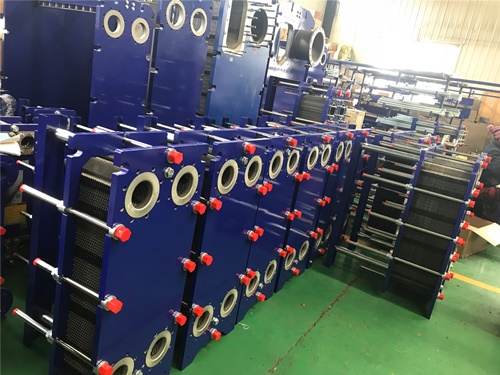
Low heat transfer efficiency is a plate heat exchanger maintenance process is often faced with a problem, this problem occurs for a very simple reason, because The core components of the heat transfer corrugated plate stacked together, the medium from the plate and the formation of channels between the plate through. Then the medium and plate contact will inevitably produce scaling or blockage, the flow is not smooth will cause the heat transfer efficiency becomes low, and then the The heat exchanger has problems with the system and the overall performance decreases.
Then there is the problem of leakage or string leakage. This is also a plate heat exchanger repair more often a problem, the reason for this is that there are several, it is possible that there is no clamping or sealing parts There is debris; the seal strip is old and the adhesive strips are dislodged; the seal grooves are corroded; and there is a problem with the order in which the plates are arranged. The general solution to these problems is to clean up the debris, replace the plate, and install the plate according to the correct method. Previously posted article.
Plate heat exchanger repair is often faced with the problem of the actual use of our industry, if you can figure out the reasons for the failure to solve their own problems so save time and effort, if you encounter large difficult to solve or uncertainty of the best time to contact the local dealer or consulting manufacturers, so as not to cause unwanted losses.
Related information
- Sulfuric Acid Plate Heat Exchangers: Material Selection
- Free-Flow PHE for High-Viscosity Media
- Application of plate heat exchangers
- How does the heat exchange rate of the plate and shell heat exchanger compare with the plate heat exchanger?
- In what cases can't I use a plate heat exchanger device?
- Plate Heat Exchanger Fault Diagnosis
Relevant article
- Plate Heat Exchangers in Thermal Oil Systems: Seals, Film Temperature and When to Weld
- Water Hammer and Pressure Surges in Plate Heat Exchangers: Causes and Countermeasures
- Plate Heat Exchanger vs Shell-and-Tube Cleaning: Where the Lifetime Cost Diverges
- Plate Heat Exchanger Connections: DN vs NPS, PN vs Class, and What Goes Wrong on Site
- Free Cooling with Plate Heat Exchangers: Design and Changeover
- Multi-Section Plate Heat Exchangers: Two Duties, One Frame
- Retrofitting a Shell-and-Tube with a Plate Heat Exchanger: Fitting the Duty into an Existing Plant
- Packing a Plate Heat Exchanger for Ocean Freight: Preservation, Storage and Site Handover
- Plate Heat Exchangers Under Vacuum: Operating on the Negative-Pressure Side
- Gasket Compression Set and Bolt Torque Management in Plate Heat Exchangers
Latest information
- Chemical Plate Heat Exchanger: Lubricant Roles & Care
- Heat Station Plate Heat Exchangers: Design & Application
- Heat Station Plate Heat Exchangers: Installation Guide
- Boiler Plate Heat Exchangers: Maintenance Guide
- The Integrated Heat Exchanger Unit: An Efficient Integration and Intelligent Control Solution for Thermal Energy Conversion
- Sulfuric Acid Plate Heat Exchangers: Design & Application
- Coal Chemical Plate Heat Exchangers: Cleaning & Maintenance
- Petrochemical Plate Heat Exchangers: Design & Application
- Chemical Plate Heat Exchangers: Gasket Ageing
- Sulfuric Acid Plate Heat Exchangers: Design & Application