Dairy Plate Heat Exchangers: Manufacturer Selection

Mentioned milk production process, have to say that pasteurization, pasteurization is to mix raw materials heating to 68 ~ 70 ?, and keep the temperature of 30 min after rapid cooling to 4-5 ?, for general bacteria lethal point are the temperature below 68 ? and the time for 30 min, so to mix raw materials after this treatment, can kill the pathogenic bacteria and the vast majority of non-pathogenic bacteria, under the principle of pasteurization, as the raw material milk requires rapid heating cooling, with the larger temperature difference between the need for a lot of heat exchange, and the heat exchanger, it is specially used for industrial purposes, Suitable for mass production of equipment with heat exchange.
For the all-welded heat exchanger, the liquid milk medium has a high Reynolds number due to its unique interplate structure, which leads to the existence of the medium mainly in the form of turbulence, and the irregular motion of turbulence is the perfect condition for the heat exchange of liquid fluids.
However, the all-welded heat exchanger of general materials is not competent for the heat exchange of milk products. According to the national standard "General Safety Requirements for Food Contact Materials and Products" (GB4806.1-2016), the common safety and health requirements are specified. The materials that come into contact with edible media are 300 series austenitic stainless steel.
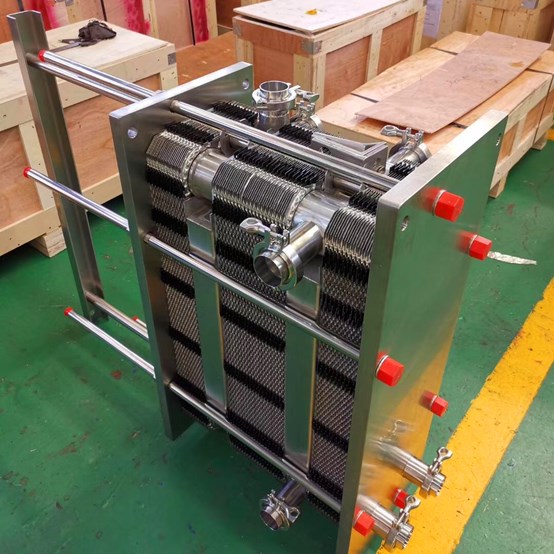
At the same time, in the heat exchanger processing technology, austenitic stainless steel is commonly used in the two types of 304 series and 316 series, to commonly used 304 stainless steel for example, 304 stainless steel and Q345 carbon steel, stainless steel after welding will produce cooling shrinkage, compared with Q345 carbon steel material is more prone to deformation.
This determines the stainless steel in the process of more difficult, and heat exchanger service life, working conditions and processing technology are closely related. Therefore, for some domestic heat exchanger manufacturers, the use effect of full-welded stainless steel heat exchanger is worrying due to the manufacturing process and other problems, such as shell side interface leakage or welding deformation, which will affect the installation of equipment and other problems.
Qingdao Ruipute heat exchange Equipment Manufacturing Co., LTD., in the manufacturing and production process of all-welded heat exchanger, strictly controls the process control points, strictly demands the product quality and high quality, and guarantees the quality of the stainless steel materials used. At the same time, he has rich experience in all - welded heat exchanger manufacturing, which is perfect for milk production.
Related information
- Plate heat exchanger sealing gaskets HNBR type
- Don't you know what are the benefits of using semi-welded plate heat exchanger plates?
- Plate Heat Exchanger Model Code Guide
- PHE Gasket Replacement: Step-by-Step Guide
- Customized processing of wide gap plate heat exchanger
- NT50M Compatible PHE Plates & Gaskets in Stock
Relevant article
- Plate Heat Exchangers in Thermal Oil Systems: Seals, Film Temperature and When to Weld
- Water Hammer and Pressure Surges in Plate Heat Exchangers: Causes and Countermeasures
- Plate Heat Exchanger vs Shell-and-Tube Cleaning: Where the Lifetime Cost Diverges
- Plate Heat Exchanger Connections: DN vs NPS, PN vs Class, and What Goes Wrong on Site
- Free Cooling with Plate Heat Exchangers: Design and Changeover
- Multi-Section Plate Heat Exchangers: Two Duties, One Frame
- Retrofitting a Shell-and-Tube with a Plate Heat Exchanger: Fitting the Duty into an Existing Plant
- Packing a Plate Heat Exchanger for Ocean Freight: Preservation, Storage and Site Handover
- Plate Heat Exchangers Under Vacuum: Operating on the Negative-Pressure Side
- Gasket Compression Set and Bolt Torque Management in Plate Heat Exchangers
Latest information
- Chemical Plate Heat Exchanger: Lubricant Roles & Care
- Heat Station Plate Heat Exchangers: Design & Application
- Heat Station Plate Heat Exchangers: Installation Guide
- Boiler Plate Heat Exchangers: Maintenance Guide
- The Integrated Heat Exchanger Unit: An Efficient Integration and Intelligent Control Solution for Thermal Energy Conversion
- Sulfuric Acid Plate Heat Exchangers: Design & Application
- Coal Chemical Plate Heat Exchangers: Cleaning & Maintenance
- Petrochemical Plate Heat Exchangers: Design & Application
- Chemical Plate Heat Exchangers: Gasket Ageing
- Sulfuric Acid Plate Heat Exchangers: Design & Application